Recursion in Python: Understanding Self-Calling Functions
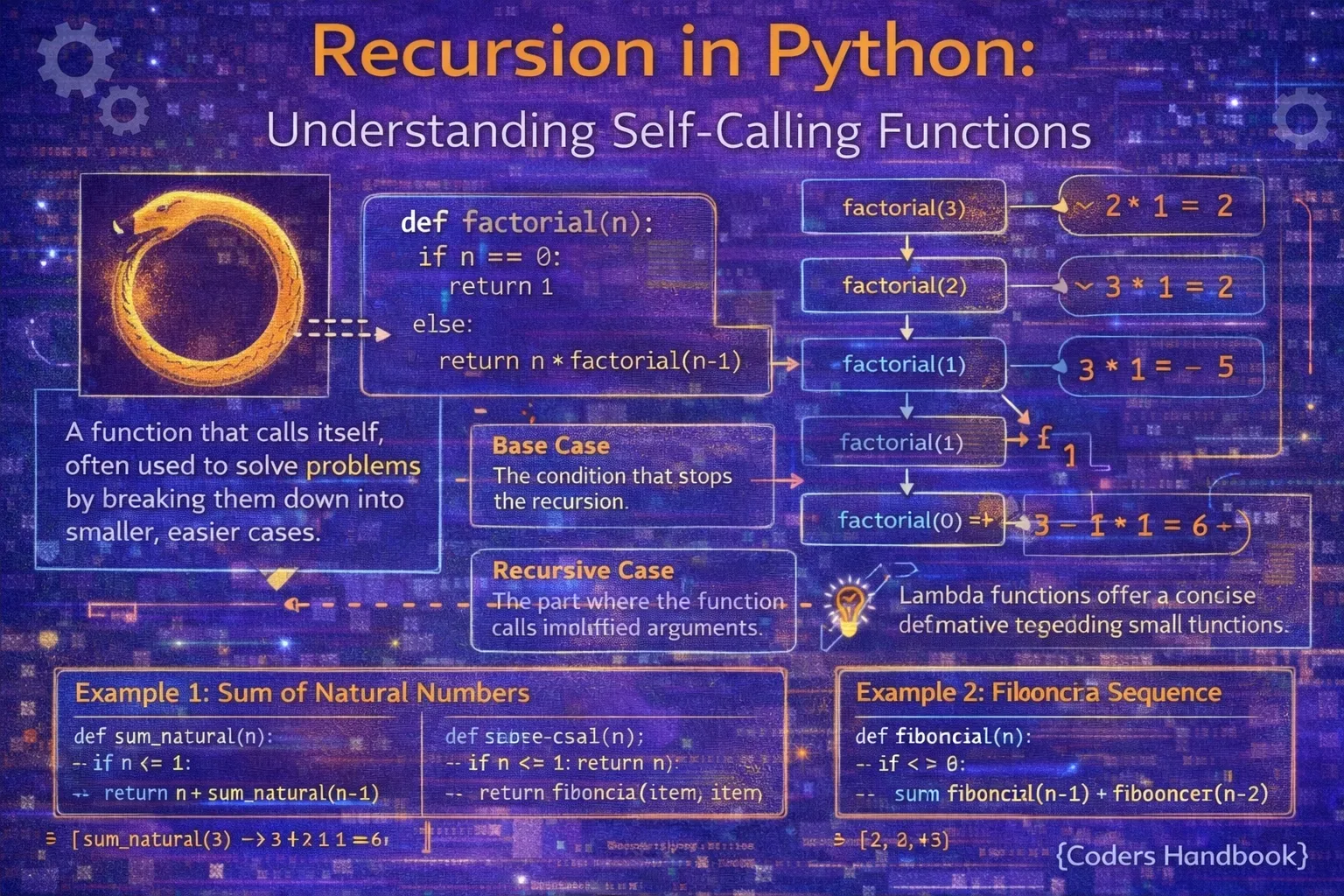
Recursion is a powerful programming technique where functions call themselves to solve problems by breaking them into smaller subproblems of the same type, enabling elegant solutions for naturally recursive structures like trees, mathematical sequences, and divide-and-conquer algorithms. A recursive function consists of two essential components: the base case providing stopping conditions that prevent infinite recursion, and the recursive case where the function calls itself with modified parameters moving toward the base case. Understanding recursion is fundamental to computer science, as it underlies important algorithms including tree traversals, sorting methods like quicksort and mergesort, backtracking solutions, dynamic programming, and functional programming patterns, while also developing problem-solving skills for decomposing complex problems into simpler subproblems.
This comprehensive guide explores recursive function structure including base cases and recursive cases, classic examples like factorial calculation and Fibonacci sequence generation, recursion visualization through call stacks demonstrating execution flow, Python's recursion depth limits and how to handle them, optimization techniques including memoization for avoiding redundant calculations, comparing recursive versus iterative approaches weighing elegance against efficiency, practical applications in tree traversal and list processing, and best practices for writing correct, efficient recursive functions. Whether you're implementing algorithms requiring recursive thinking, processing hierarchical data structures, solving mathematical problems with recursive definitions, or understanding computer science fundamentals, mastering recursion provides essential tools for elegant problem solving while recognizing when iterative alternatives may be more appropriate for performance or clarity.
Recursion Fundamentals
Every recursive function requires a base case that stops recursion by returning a value without further function calls, and a recursive case that calls the function with parameters moving progressively toward the base case. Without proper base cases, functions recurse infinitely until hitting Python's recursion limit causing stack overflow errors. The recursive case must modify parameters ensuring eventual base case satisfaction, whether by decrementing counters, reducing list sizes, or simplifying problem structures.
# Recursion Fundamentals

# Simple example: Countdown
def countdown(n):
    """Count down from n to 0 using recursion."""
    # Base case: stop when n reaches 0
    if n <= 0:
        print("Blastoff!")
        return

    # Recursive case: print and call with n-1
    print(n)
    countdown(n - 1)

countdown(5)
# Output:
# 5
# 4
# 3
# 2
# 1
# Blastoff!

# Example without base case (NEVER DO THIS!)
def infinite_recursion(n):
    """This will cause RecursionError!"""
    print(n)
    infinite_recursion(n - 1)  # No base case!

# infinite_recursion(5)  # Uncomment to see error
# RecursionError: maximum recursion depth exceeded

# Sum of numbers from 1 to n
def sum_recursive(n):
    """Calculate sum of 1 to n recursively."""
    # Base case: sum of 1 is 1
    if n == 1:
        return 1
    # Recursive case: n + sum of (n-1)
    return n + sum_recursive(n - 1)

print(sum_recursive(5))  # Output: 15 (5+4+3+2+1)

# Visualizing the recursion:
# sum_recursive(5)
#   = 5 + sum_recursive(4)
#   = 5 + (4 + sum_recursive(3))
#   = 5 + (4 + (3 + sum_recursive(2)))
#   = 5 + (4 + (3 + (2 + sum_recursive(1))))
#   = 5 + (4 + (3 + (2 + 1)))
#   = 15

# String reversal using recursion
def reverse_string(s):
    """Reverse a string recursively."""
    # Base case: empty string or single character
    if len(s) <= 1:
        return s
    # Recursive case: last char + reverse of rest
    return s[-1] + reverse_string(s[:-1])

print(reverse_string("Python"))  # Output: nohtyP

# Power calculation
def power(base, exponent):
    """Calculate base^exponent recursively."""
    # Base case: anything to power 0 is 1
    if exponent == 0:
        return 1
    # Recursive case: base * base^(exponent-1)
    return base * power(base, exponent - 1)

print(power(2, 5)) # Output: 32 (2^5)Classic Recursive Examples
Factorial calculation and Fibonacci sequence generation are classic recursion examples demonstrating fundamental patterns. Factorial computes the product of all positive integers up to a number using the recursive definition that factorial of n equals n times factorial of n-1, with base case factorial of 0 or 1 equaling 1. Fibonacci generates sequences where each number is the sum of the two preceding ones, with recursive implementation directly mirroring the mathematical definition though suffering from inefficiency without optimization.
# Classic Recursive Examples

# Factorial: n! = n × (n-1)!
def factorial(n):
    """Calculate factorial of n recursively."""
    # Base cases
    if n == 0 or n == 1:
        return 1
    # Recursive case
    return n * factorial(n - 1)

print(factorial(5))   # Output: 120 (5×4×3×2×1)
print(factorial(0))   # Output: 1 (base case)
print(factorial(10))  # Output: 3628800

# Factorial execution trace for factorial(4):
# factorial(4)
#   = 4 * factorial(3)
#   = 4 * (3 * factorial(2))
#   = 4 * (3 * (2 * factorial(1)))
#   = 4 * (3 * (2 * 1))
#   = 24

# Fibonacci: F(n) = F(n-1) + F(n-2)
def fibonacci(n):
    """Calculate nth Fibonacci number recursively."""
    # Base cases
    if n == 0:
        return 0
    if n == 1:
        return 1
    # Recursive case
    return fibonacci(n - 1) + fibonacci(n - 2)

print(fibonacci(0))   # Output: 0
print(fibonacci(1))   # Output: 1
print(fibonacci(5))   # Output: 5 (0,1,1,2,3,5)
print(fibonacci(10))  # Output: 55

# Fibonacci sequence: 0, 1, 1, 2, 3, 5, 8, 13, 21, 34, 55...

# Problem: Naive Fibonacci is inefficient!
# fibonacci(5) calls:
#   fibonacci(4) + fibonacci(3)
#     fibonacci(3) + fibonacci(2) + fibonacci(2) + fibonacci(1)
#       ... many repeated calculations!

# Greatest Common Divisor (Euclidean algorithm)
def gcd(a, b):
    """Calculate GCD using Euclidean algorithm."""
    # Base case: when b is 0, GCD is a
    if b == 0:
        return a
    # Recursive case: GCD(a,b) = GCD(b, a mod b)
    return gcd(b, a % b)

print(gcd(48, 18))   # Output: 6
print(gcd(100, 35))  # Output: 5

# Binary Search (recursive version)
def binary_search(arr, target, left, right):
    """Search for target in sorted array recursively."""
    # Base case: not found
    if left > right:
        return -1

    mid = (left + right) // 2

    # Base case: found
    if arr[mid] == target:
        return mid
    # Recursive case: search left half
    elif arr[mid] > target:
        return binary_search(arr, target, left, mid - 1)
    # Recursive case: search right half
    else:
        return binary_search(arr, target, mid + 1, right)

arr = [1, 3, 5, 7, 9, 11, 13, 15]
print(binary_search(arr, 7, 0, len(arr) - 1))   # Output: 3
print(binary_search(arr, 10, 0, len(arr) - 1))  # Output: -1
Recursion Depth and Limits
Python enforces a maximum recursion depth limit (typically around 1000) to prevent stack overflow errors from consuming all available memory. When recursion depth exceeds this limit, Python raises a RecursionError protecting the system from crashes. While the limit can be increased using sys.setrecursionlimit(), this should be done cautiously as excessively deep recursion can still cause crashes, and often indicates that an iterative solution would be more appropriate.
# Recursion Depth and Limits

import sys

# Check current recursion limit
print(f"Default recursion limit: {sys.getrecursionlimit()}")
# Output: Default recursion limit: 1000 (typical)

# Function that exceeds recursion limit
def deep_recursion(n):
    """Function with deep recursion."""
    if n == 0:
        return 0
    return 1 + deep_recursion(n - 1)

# This will raise RecursionError
try:
    result = deep_recursion(2000)
except RecursionError as e:
    print(f"RecursionError: {e}")

# Increasing recursion limit (use with caution!)
sys.setrecursionlimit(3000)
print(f"New recursion limit: {sys.getrecursionlimit()}")

# Now this works
result = deep_recursion(2000)
print(f"Result: {result}")  # Output: Result: 2000

# Reset to default
sys.setrecursionlimit(1000)

# Better approach: Use iteration for deep recursion
def deep_iteration(n):
    """Iterative version handles any depth."""
    count = 0
    while n > 0:
        count += 1
        n -= 1
    return count

result = deep_iteration(10000)
print(f"Iterative result: {result}")  # Output: Iterative result: 10000

# Tail recursion (Python doesn't optimize this!)
def tail_factorial(n, accumulator=1):
    """Tail-recursive factorial (still hits depth limit)."""
    if n == 0:
        return accumulator
    return tail_factorial(n - 1, n * accumulator)

# Even tail recursion hits limits in Python
try:
    result = tail_factorial(2000)
except RecursionError:
    print("Tail recursion still hits depth limit in Python")

# Practical recursion depth monitoring
def recursive_with_depth(n, depth=0):
    """Track recursion depth."""
    if depth % 100 == 0:
        print(f"Recursion depth: {depth}")

    if n == 0:
        print(f"Maximum depth reached: {depth}")
        return depth

    return recursive_with_depth(n - 1, depth + 1)

max_depth = recursive_with_depth(500)
# Output shows depth at intervalssys.setrecursionlimit(), consider using iteration for problems requiring deep recursion. Deep recursion often signals an iterative solution is better.Optimization with Memoization
Memoization optimizes recursive functions by caching previously computed results, avoiding redundant calculations that occur when the same subproblems are solved multiple times. The naive Fibonacci implementation recalculates the same values exponentially many times, but memoization reduces time complexity from exponential to linear by storing results in a dictionary or using Python's @lru_cache decorator. This technique transforms inefficient recursive solutions into practical algorithms suitable for real-world use.
# Optimization with Memoization

import time
from functools import lru_cache

# Naive Fibonacci (exponential time complexity)
def fibonacci_naive(n):
    """Inefficient Fibonacci with repeated calculations."""
    if n <= 1:
        return n
    return fibonacci_naive(n - 1) + fibonacci_naive(n - 2)

# Manual memoization using dictionary
def fibonacci_memo(n, memo=None):
    """Fibonacci with manual memoization."""
    if memo is None:
        memo = {}

    # Check cache first
    if n in memo:
        return memo[n]

    # Base cases
    if n <= 1:
        return n

    # Calculate and store in cache
    memo[n] = fibonacci_memo(n - 1, memo) + fibonacci_memo(n - 2, memo)
    return memo[n]

# Using @lru_cache decorator (cleanest approach)
@lru_cache(maxsize=None)
def fibonacci_cached(n):
    """Fibonacci with automatic caching."""
    if n <= 1:
        return n
    return fibonacci_cached(n - 1) + fibonacci_cached(n - 2)

# Performance comparison
print("Testing fibonacci(30):")

# Naive version (very slow)
start = time.time()
result_naive = fibonacci_naive(30)
time_naive = time.time() - start
print(f"Naive: {result_naive} in {time_naive:.4f}s")

# Memoized version (fast)
start = time.time()
result_memo = fibonacci_memo(30)
time_memo = time.time() - start
print(f"Memoized: {result_memo} in {time_memo:.6f}s")

# Cached version (fastest)
start = time.time()
result_cached = fibonacci_cached(30)
time_cached = time.time() - start
print(f"Cached: {result_cached} in {time_cached:.6f}s")

print(f"\nSpeedup: {time_naive/time_cached:.0f}x faster")

# Can now handle much larger values
print(f"\nfibonacci_cached(100) = {fibonacci_cached(100)}")

# Memoization for other problems
@lru_cache(maxsize=None)
def factorial_cached(n):
    """Cached factorial for reuse."""
    if n <= 1:
        return 1
    return n * factorial_cached(n - 1)

print(f"\nfactorial_cached(20) = {factorial_cached(20)}")

# Custom memoization decorator
def memoize(func):
    """Custom memoization decorator."""
    cache = {}

    def wrapper(*args):
        if args not in cache:
            cache[args] = func(*args)
        return cache[args]

    return wrapper

@memoize
def fibonacci_custom(n):
    """Fibonacci with custom memoization."""
    if n <= 1:
        return n
    return fibonacci_custom(n - 1) + fibonacci_custom(n - 2)

print(f"fibonacci_custom(50) = {fibonacci_custom(50)}")@lru_cache decorator provides automatic memoization. Add it to recursive functions with repeated subproblems for massive performance gains with zero code changes to the function logic.Recursive Tree Traversal
Tree data structures are naturally recursive, making recursion ideal for traversal algorithms. Each node can be processed recursively by handling the current node and recursively processing children, enabling elegant implementations of depth-first search, preorder, inorder, and postorder traversals. Recursion's elegance for trees demonstrates when recursive solutions truly shine, providing clearer code than iterative alternatives requiring explicit stack management.
# Recursive Tree Traversal

# Binary tree node
class TreeNode:
    def __init__(self, value, left=None, right=None):
        self.value = value
        self.left = left
        self.right = right

# Build sample tree:
#       1
#      / \
#     2   3
#    / \
#   4   5
root = TreeNode(1,
    TreeNode(2,
        TreeNode(4),
        TreeNode(5)
    ),
    TreeNode(3)
)

# Preorder traversal (Root, Left, Right)
def preorder(node):
    """Preorder traversal: process root first."""
    if node is None:
        return
    print(node.value, end=' ')
    preorder(node.left)
    preorder(node.right)

print("Preorder: ", end='')
preorder(root)  # Output: 1 2 4 5 3
print()

# Inorder traversal (Left, Root, Right)
def inorder(node):
    """Inorder traversal: process root between children."""
    if node is None:
        return
    inorder(node.left)
    print(node.value, end=' ')
    inorder(node.right)

print("Inorder: ", end='')
inorder(root)  # Output: 4 2 5 1 3
print()

# Postorder traversal (Left, Right, Root)
def postorder(node):
    """Postorder traversal: process root last."""
    if node is None:
        return
    postorder(node.left)
    postorder(node.right)
    print(node.value, end=' ')

print("Postorder: ", end='')
postorder(root)  # Output: 4 5 2 3 1
print()

# Tree height calculation
def tree_height(node):
    """Calculate height of tree recursively."""
    if node is None:
        return 0
    left_height = tree_height(node.left)
    right_height = tree_height(node.right)
    return 1 + max(left_height, right_height)

print(f"\nTree height: {tree_height(root)}")  # Output: 3

# Count nodes in tree
def count_nodes(node):
    """Count total nodes recursively."""
    if node is None:
        return 0
    return 1 + count_nodes(node.left) + count_nodes(node.right)

print(f"Total nodes: {count_nodes(root)}")  # Output: 5

# Sum all values
def sum_tree(node):
    """Sum all node values recursively."""
    if node is None:
        return 0
    return node.value + sum_tree(node.left) + sum_tree(node.right)

print(f"Sum of values: {sum_tree(root)}")  # Output: 15

# Find maximum value
def find_max(node):
    """Find maximum value in tree."""
    if node is None:
        return float('-inf')
    left_max = find_max(node.left)
    right_max = find_max(node.right)
    return max(node.value, left_max, right_max)

print(f"Maximum value: {find_max(root)}")  # Output: 5
Recursion vs Iteration
Choosing between recursion and iteration involves weighing elegance and clarity against performance and resource usage. Recursion excels for naturally recursive problems like tree operations, divide-and-conquer algorithms, and backtracking, providing clearer code mirroring problem structure. Iteration is better for simple linear problems, performance-critical code, and situations requiring deep call stacks, as it avoids function call overhead and stack limitations while consuming less memory.
# Recursion vs Iteration Comparison

# Factorial: Recursive version
def factorial_recursive(n):
    """Recursive factorial: elegant but limited depth."""
    if n <= 1:
        return 1
    return n * factorial_recursive(n - 1)

# Factorial: Iterative version
def factorial_iterative(n):
    """Iterative factorial: efficient for large n."""
    result = 1
    for i in range(2, n + 1):
        result *= i
    return result

print(factorial_recursive(10))  # Output: 3628800
print(factorial_iterative(10))  # Output: 3628800

# Iterative handles larger values without depth issues
print(factorial_iterative(500))  # Works fine
# factorial_recursive(500) would cause RecursionError

# List sum: Recursive version
def sum_list_recursive(lst):
    """Sum list recursively."""
    if not lst:
        return 0
    return lst[0] + sum_list_recursive(lst[1:])

# List sum: Iterative version
def sum_list_iterative(lst):
    """Sum list iteratively."""
    total = 0
    for num in lst:
        total += num
    return total

numbers = [1, 2, 3, 4, 5]
print(sum_list_recursive(numbers))  # Output: 15
print(sum_list_iterative(numbers))  # Output: 15
# Better: sum(numbers)

# When recursion is better: Tree problems
def max_depth_recursive(node):
    """Finding tree depth is naturally recursive."""
    if node is None:
        return 0
    return 1 + max(max_depth_recursive(node.left),
                   max_depth_recursive(node.right))

# Iterative version requires explicit stack
def max_depth_iterative(root):
    """Iterative version needs stack management."""
    if not root:
        return 0

    stack = [(root, 1)]
    max_depth = 0

    while stack:
        node, depth = stack.pop()
        max_depth = max(max_depth, depth)

        if node.left:
            stack.append((node.left, depth + 1))
        if node.right:
            stack.append((node.right, depth + 1))

    return max_depth

# Recursive is clearer for this problem!
Recursion Best Practices
- Always define base cases: Every recursive function needs clear stopping conditions. Missing base cases cause infinite recursion and RecursionError
- Progress toward base case: Each recursive call must move closer to the base case through smaller inputs, reduced lists, or simplified structures
- Use memoization for repeated subproblems: Apply
@lru_cacheto recursive functions solving the same subproblems multiple times, like Fibonacci - Consider iteration for simple problems: Linear problems like factorial or list summing are often better as loops, avoiding recursion overhead
- Watch recursion depth: Be aware of Python's ~1000 call limit. Deep recursion often signals iteration would be better
- Use recursion for recursive structures: Trees, graphs, nested lists, and divide-and-conquer algorithms are naturally recursive, making recursive solutions clearer
- Document recursive logic: Explain base cases and how recursive calls progress toward them. Recursion can be tricky to understand
- Test with small inputs: Debug recursive functions with small test cases to trace execution flow and verify correctness before scaling up
- Avoid unnecessary recursion: Don't use recursion to look clever. Choose it when it genuinely simplifies the solution
- Handle edge cases: Test with empty inputs, single elements, and boundary values to ensure base cases handle all scenarios correctly
Conclusion
Recursion is a powerful programming technique where functions call themselves to solve problems by breaking them into smaller subproblems, requiring two essential components: base cases providing stopping conditions preventing infinite recursion, and recursive cases calling functions with modified parameters progressing toward base cases. Classic examples including factorial calculation using the definition that n factorial equals n times factorial of n-1, Fibonacci sequence generation where each number sums the two preceding ones, greatest common divisor via Euclidean algorithm, and binary search dividing sorted arrays demonstrate fundamental recursive patterns applicable across diverse problems. Python enforces recursion depth limits typically around 1000 calls to prevent stack overflow errors, raisable via sys.setrecursionlimit() though deep recursion often signals iterative solutions would be more appropriate avoiding function call overhead and memory constraints.
Memoization optimizes recursive functions by caching previously computed results using dictionaries or Python's @lru_cache decorator, transforming inefficient naive implementations like Fibonacci from exponential to linear time complexity by eliminating redundant calculations when same subproblems are solved multiple times. Tree traversal demonstrates recursion's natural elegance for hierarchical structures, with preorder, inorder, and postorder algorithms recursively processing nodes and children more clearly than iterative alternatives requiring explicit stack management. Comparing recursion versus iteration involves weighing elegance and problem clarity against performance and resource usage, with recursion excelling for naturally recursive structures like trees, divide-and-conquer algorithms, and backtracking while iteration proves better for simple linear problems, performance-critical code, and deep recursion avoiding call stack limitations. Best practices emphasize always defining clear base cases preventing infinite recursion, ensuring recursive calls progress toward base cases through smaller inputs, applying memoization for repeated subproblems, considering iteration for simple linear problems avoiding overhead, watching recursion depth limits, choosing recursion for inherently recursive structures, documenting logic explaining base cases and progression, testing with small inputs for debugging, avoiding unnecessary recursion purely for cleverness, and handling edge cases including empty inputs and boundaries. By mastering recursion fundamentals, classic patterns, optimization techniques, tree traversal applications, comparison with iteration, and best practices balancing elegance with practicality, you gain essential problem-solving tools for elegant solutions to naturally recursive problems while recognizing when simpler iterative alternatives better serve performance, resource, and clarity requirements in professional Python development.
$ share --platform
$ cat /comments/ (0)
$ cat /comments/
// No comments found. Be the first!