Python Interview Preparation: 60 Essential Questions and Answers
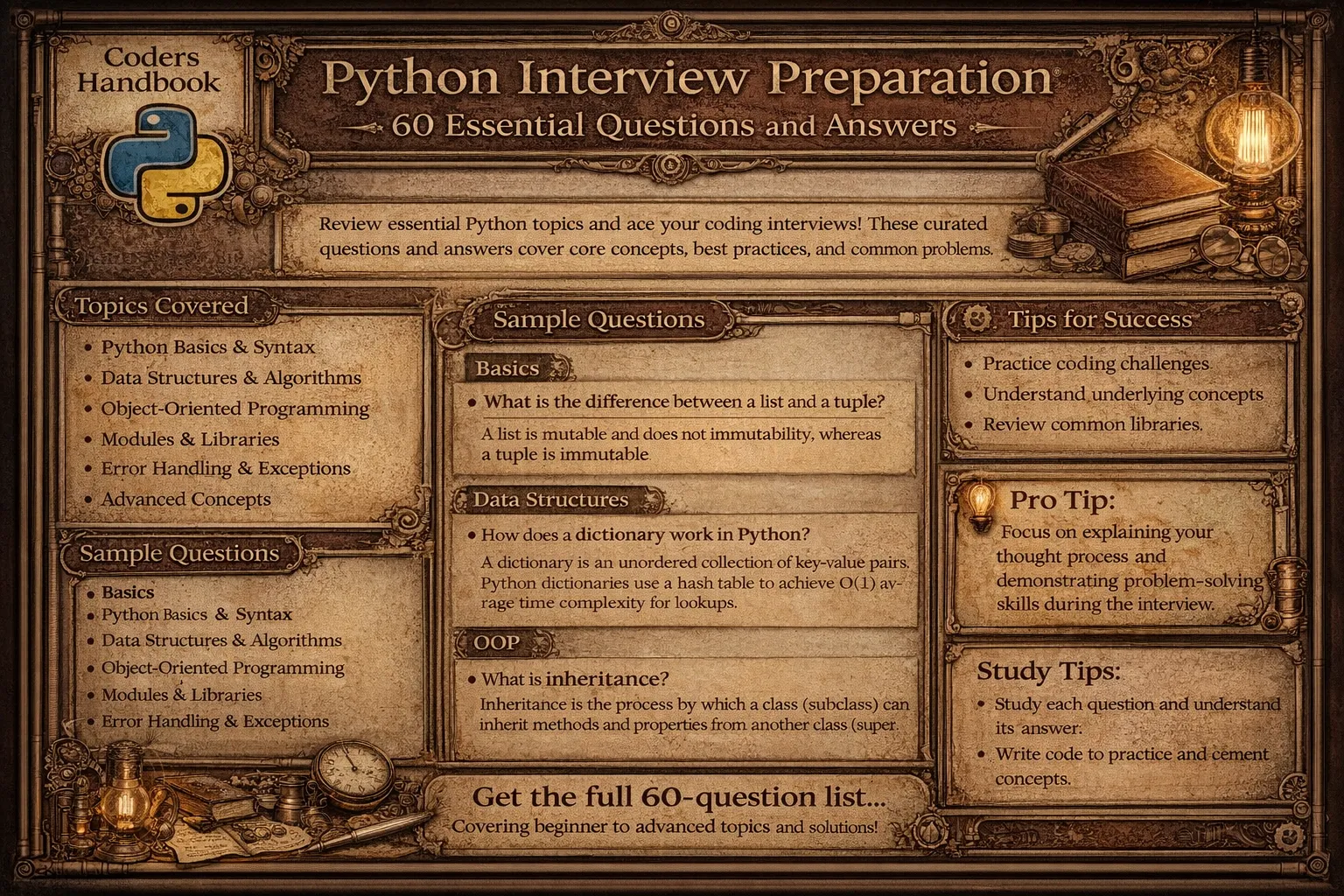
Python interviews assess comprehensive understanding spanning language fundamentals, object-oriented programming, data structures, standard libraries, and problem-solving abilities. This guide covers 60 essential questions organized by difficulty and topic helping candidates prepare systematically. Questions range from basic syntax and data types through advanced OOP concepts, algorithms, and coding challenges reflecting real interview scenarios at top tech companies. Mastering these questions demonstrates proficiency in Python development, problem-solving skills, code optimization, and best practices essential for securing software engineering, data science, and backend development positions.
Python Basics (Questions 1-15)
These fundamental questions cover Python's core concepts including data types, operators, control structures, and basic syntax that every Python developer must master.
# Question 1: What makes Python different from other programming languages?
# Answer: Python is interpreted, dynamically typed, emphasizes readability with
# significant whitespace, supports multiple paradigms (procedural, OOP, functional),
# features automatic memory management, and extensive standard library.

# Question 2: Explain the difference between lists and tuples
# Lists - Mutable
my_list = [1, 2, 3]
my_list[0] = 10  # Can modify
my_list.append(4)
print(my_list)  # [10, 2, 3, 4]

# Tuples - Immutable
my_tuple = (1, 2, 3)
# my_tuple[0] = 10  # TypeError
dict_with_tuple = {(1, 2): 'value'}  # Tuples hashable

# Question 3: Python's built-in data types
# Numeric: int, float, complex
# Sequences: list, tuple, range
# Text: str
# Mapping: dict
# Sets: set, frozenset
# Boolean: bool
# Binary: bytes, bytearray
# None type

# Question 4: List comprehension
squares = [x**2 for x in range(10)]
print(squares)  # [0, 1, 4, 9, 16, 25, 36, 49, 64, 81]

even_squares = [x**2 for x in range(10) if x % 2 == 0]
print(even_squares)  # [0, 4, 16, 36, 64]

matrix = [[i*j for j in range(3)] for i in range(3)]
print(matrix)

# Question 5: Difference between == and is
a = [1, 2, 3]
b = [1, 2, 3]
c = a

print(a == b)  # True - same values
print(a is b)  # False - different objects
print(a is c)  # True - same object reference

# Question 6: Mutable vs Immutable
# Mutable: list, dict, set - can be modified
# Immutable: int, float, str, tuple - cannot be modified

mutable_list = [1, 2, 3]
mutable_list[0] = 99  # Works

immutable_string = "hello"
# immutable_string[0] = 'H'  # TypeError

# Question 7: Python decorators
import time

def timer_decorator(func):
    def wrapper(*args, **kwargs):
        start = time.time()
        result = func(*args, **kwargs)
        end = time.time()
        print(f"{func.__name__} took {end-start:.4f}s")
        return result
    return wrapper

@timer_decorator
def slow_function():
    time.sleep(0.5)
    return "Done"

result = slow_function()

# Question 8: *args and **kwargs
def demo_function(*args, **kwargs):
    print("Positional:", args)
    print("Keyword:", kwargs)

demo_function(1, 2, 3, name="John", age=30)
# Output: Positional: (1, 2, 3)
# Output: Keyword: {'name': 'John', 'age': 30}

def sum_all(*numbers):
    return sum(numbers)

print(sum_all(1, 2, 3, 4, 5))  # 15

# Question 9: Deep copy vs Shallow copy
import copy

original = [[1, 2, 3], [4, 5, 6]]

# Shallow copy
shallow = copy.copy(original)
shallow[0][0] = 99
print(original)  # [[99, 2, 3], [4, 5, 6]] - affected!

# Deep copy
original = [[1, 2, 3], [4, 5, 6]]
deep = copy.deepcopy(original)
deep[0][0] = 99
print(original)  # [[1, 2, 3], [4, 5, 6]] - not affected

# Question 10: Python's GIL (Global Interpreter Lock)
# GIL is mutex preventing multiple threads executing Python bytecode
# simultaneously. Limits multi-threading for CPU-bound tasks.
# Use multiprocessing for CPU-bound, threading for I/O-bound.

# Question 11: Lambda functions
square = lambda x: x**2
print(square(5))  # 25

numbers = [1, 2, 3, 4, 5]
squared = list(map(lambda x: x**2, numbers))
print(squared)  # [1, 4, 9, 16, 25]

even = list(filter(lambda x: x % 2 == 0, numbers))
print(even)  # [2, 4]

students = [('Alice', 85), ('Bob', 75), ('Charlie', 95)]
sorted_students = sorted(students, key=lambda x: x[1])
print(sorted_students)

# Question 12: break, continue, and pass
for i in range(10):
    if i == 3:
        continue  # Skip 3
    if i == 7:
        break  # Exit at 7
    print(i)

class EmptyClass:
    pass  # Placeholder

# Question 13: List slicing
numbers = [0, 1, 2, 3, 4, 5, 6, 7, 8, 9]
print(numbers[2:5])      # [2, 3, 4]
print(numbers[:5])       # [0, 1, 2, 3, 4]
print(numbers[5:])       # [5, 6, 7, 8, 9]
print(numbers[::2])      # [0, 2, 4, 6, 8]
print(numbers[::-1])     # Reversed
print(numbers[-3:])      # [7, 8, 9]

# Question 14: Memory management
# Python uses reference counting and garbage collection
# Objects freed when reference count reaches zero
# Cyclic GC handles circular references

# Question 15: Generators
def countdown(n):
    while n > 0:
        yield n
        n -= 1

for num in countdown(5):
    print(num)  # 5, 4, 3, 2, 1

squares_gen = (x**2 for x in range(10))
print(next(squares_gen))  # 0
print(next(squares_gen))  # 1

def fibonacci():
    a, b = 0, 1
    while True:
        yield a
        a, b = b, a + b

fib = fibonacci()
print([next(fib) for _ in range(10)])
Object-Oriented Programming (Questions 16-30)
OOP questions evaluate understanding of classes, inheritance, polymorphism, encapsulation, and design patterns essential for building scalable applications.
# Question 16: Four pillars of OOP
# 1. Encapsulation: Bundle data and methods, hide internal details
# 2. Inheritance: Classes inherit from parents, promote reuse
# 3. Polymorphism: Methods take many forms through overriding
# 4. Abstraction: Hide implementation, show only necessary features

# Question 17: What is 'self' in Python?
class Dog:
    def __init__(self, name, age):
        self.name = name  # self refers to instance
        self.age = age

    def bark(self):
        return f"{self.name} says Woof!"

dog1 = Dog("Buddy", 3)
print(dog1.bark())  # Buddy says Woof!

# Question 18: Class methods vs Static methods
class MyClass:
    class_variable = 0

    def __init__(self, value):
        self.value = value

    @classmethod
    def class_method(cls):
        return f"Class variable: {cls.class_variable}"

    @staticmethod
    def static_method(x, y):
        return x + y  # No access to class/instance

print(MyClass.class_method())
print(MyClass.static_method(5, 3))  # 8

# Question 19: Method overriding
class Animal:
    def sound(self):
        return "Some sound"

class Dog(Animal):
    def sound(self):  # Override parent method
        return "Woof!"

class Cat(Animal):
    def sound(self):
        return "Meow!"

dog = Dog()
cat = Cat()
print(dog.sound())  # Woof!
print(cat.sound())  # Meow!

# Question 20: Multiple inheritance
class A:
    def method(self):
        return "A"

class B:
    def method(self):
        return "B"

class C(A, B):  # Multiple inheritance
    pass

c = C()
print(c.method())  # "A" - MRO determines order
print(C.__mro__)  # Method Resolution Order

# Question 21: Magic methods (dunder methods)
class Point:
    def __init__(self, x, y):
        self.x = x
        self.y = y

    def __str__(self):
        return f"Point({self.x}, {self.y})"

    def __add__(self, other):
        return Point(self.x + other.x, self.y + other.y)

    def __eq__(self, other):
        return self.x == other.x and self.y == other.y

p1 = Point(1, 2)
p2 = Point(3, 4)
print(p1)  # Point(1, 2)
p3 = p1 + p2  # Uses __add__
print(p3)  # Point(4, 6)

# Question 22: Property decorators
class Temperature:
    def __init__(self, celsius):
        self._celsius = celsius

    @property
    def celsius(self):
        return self._celsius

    @celsius.setter
    def celsius(self, value):
        if value < -273.15:
            raise ValueError("Below absolute zero!")
        self._celsius = value

    @property
    def fahrenheit(self):
        return self._celsius * 9/5 + 32

temp = Temperature(25)
print(temp.celsius)  # 25
print(temp.fahrenheit)  # 77.0
temp.celsius = 30

# Question 23: Method overloading
# Python doesn't support traditional overloading
# Use default arguments or *args/**kwargs
def add(a, b=0, c=0):
    return a + b + c

print(add(1))       # 1
print(add(1, 2))    # 3
print(add(1, 2, 3)) # 6

# Question 24: Abstract classes
from abc import ABC, abstractmethod

class Shape(ABC):
    @abstractmethod
    def area(self):
        pass

    @abstractmethod
    def perimeter(self):
        pass

class Rectangle(Shape):
    def __init__(self, width, height):
        self.width = width
        self.height = height

    def area(self):
        return self.width * self.height

    def perimeter(self):
        return 2 * (self.width + self.height)

rect = Rectangle(5, 3)
print(rect.area())  # 15

# Question 25: Composition vs Inheritance
# Composition: has-a relationship
class Engine:
    def start(self):
        return "Engine started"

class Car:
    def __init__(self):
        self.engine = Engine()  # Composition

    def start(self):
        return self.engine.start()

car = Car()
print(car.start())

# Question 26: Encapsulation
class BankAccount:
    def __init__(self, balance):
        self.__balance = balance  # Private (name mangling)

    def deposit(self, amount):
        if amount > 0:
            self.__balance += amount

    def get_balance(self):
        return self.__balance

account = BankAccount(1000)
account.deposit(500)
print(account.get_balance())  # 1500
# print(account.__balance)  # AttributeError

# Question 27: Class vs Instance variables
class Student:
    school = "ABC School"  # Class variable

    def __init__(self, name):
        self.name = name  # Instance variable

s1 = Student("Alice")
s2 = Student("Bob")
print(s1.school)  # ABC School
Student.school = "XYZ School"
print(s2.school)  # XYZ School

# Question 28: super() function
class Parent:
    def __init__(self, name):
        self.name = name

    def greet(self):
        return f"Hello, {self.name}"

class Child(Parent):
    def __init__(self, name, age):
        super().__init__(name)  # Call parent __init__
        self.age = age

    def greet(self):
        parent_greeting = super().greet()
        return f"{parent_greeting}, age {self.age}"

child = Child("Alice", 10)
print(child.greet())

# Question 29: Mixins
class LoggingMixin:
    def log(self, message):
        print(f"[LOG] {message}")

class DataProcessor(LoggingMixin):
    def process(self, data):
        self.log("Processing started")
        # Process data
        self.log("Processing completed")

processor = DataProcessor()
processor.process([1, 2, 3])

# Question 30: Polymorphism example
class Shape:
    def area(self):
        pass

class Circle(Shape):
    def __init__(self, radius):
        self.radius = radius

    def area(self):
        return 3.14 * self.radius ** 2

class Square(Shape):
    def __init__(self, side):
        self.side = side

    def area(self):
        return self.side ** 2

shapes = [Circle(5), Square(4)]
for shape in shapes:
    print(shape.area())  # Polymorphism in action
Data Structures & Algorithms (Questions 31-45)
Data structure and algorithm questions test problem-solving abilities, complexity analysis, and implementation skills crucial for technical interviews.
# Question 31: How dictionaries work internally
# Dictionaries use hash tables with O(1) average lookup
# Keys hashed to determine storage location
# Hash collisions handled through open addressing/chaining

# Question 32: Time complexity of list operations
# append: O(1) amortized
# insert: O(n)
# delete: O(n)
# access by index: O(1)
# search: O(n)
# sort: O(n log n)

# Question 33: Sets vs Lists
my_list = [1, 2, 2, 3, 3, 3]
my_set = {1, 2, 3}  # Unique elements, unordered

print(2 in my_list)  # O(n) - slow
print(2 in my_set)   # O(1) - fast

# Question 34: Reverse a string
def reverse_string(s):
    return s[::-1]

print(reverse_string("hello"))  # olleh

# Alternative methods
def reverse_iterative(s):
    return ''.join(reversed(s))

def reverse_loop(s):
    result = ""
    for char in s:
        result = char + result
    return result

# Question 35: Check palindrome
def is_palindrome(s):
    return s == s[::-1]

print(is_palindrome("racecar"))  # True
print(is_palindrome("hello"))    # False

# Case-insensitive, ignore spaces
def is_palindrome_advanced(s):
    s = s.replace(" ", "").lower()
    return s == s[::-1]

print(is_palindrome_advanced("A man a plan a canal Panama"))

# Question 36: Remove duplicates from list
# Method 1: Using set (loses order)
my_list = [1, 2, 2, 3, 3, 4]
unique = list(set(my_list))

# Method 2: Preserving order
unique_ordered = list(dict.fromkeys(my_list))
print(unique_ordered)  # [1, 2, 3, 4]

# Method 3: Using loop
def remove_duplicates(lst):
    seen = set()
    result = []
    for item in lst:
        if item not in seen:
            seen.add(item)
            result.append(item)
    return result

# Question 37: Sorting algorithms complexity
# Bubble Sort: O(n²)
# Merge Sort: O(n log n)
# Quick Sort: O(n log n) average, O(n²) worst
# Python's sort(): Timsort O(n log n)

numbers = [64, 34, 25, 12, 22, 11, 90]
numbers.sort()  # In-place
print(numbers)

sorted_numbers = sorted(numbers)  # Returns new list

# Question 38: Find duplicate elements
from collections import Counter

numbers = [1, 2, 3, 2, 4, 5, 3]
duplicates = [k for k, v in Counter(numbers).items() if v > 1]
print(duplicates)  # [2, 3]

# Set approach
def find_duplicates(lst):
    seen = set()
    dups = set()
    for item in lst:
        if item in seen:
            dups.add(item)
        seen.add(item)
    return list(dups)

# Question 39: Binary search implementation
def binary_search(arr, target):
    left, right = 0, len(arr) - 1

    while left <= right:
        mid = (left + right) // 2

        if arr[mid] == target:
            return mid
        elif arr[mid] < target:
            left = mid + 1
        else:
            right = mid - 1

    return -1

arr = [1, 3, 5, 7, 9, 11, 13]
print(binary_search(arr, 7))  # 3
print(binary_search(arr, 6))  # -1

# Question 40: Merge two sorted lists
def merge_sorted_lists(l1, l2):
    result = []
    i = j = 0

    while i < len(l1) and j < len(l2):
        if l1[i] < l2[j]:
            result.append(l1[i])
            i += 1
        else:
            result.append(l2[j])
            j += 1

    result.extend(l1[i:])
    result.extend(l2[j:])
    return result

list1 = [1, 3, 5, 7]
list2 = [2, 4, 6, 8]
print(merge_sorted_lists(list1, list2))

# Question 41: Stack implementation
class Stack:
    def __init__(self):
        self.items = []

    def push(self, item):
        self.items.append(item)

    def pop(self):
        if not self.is_empty():
            return self.items.pop()

    def peek(self):
        if not self.is_empty():
            return self.items[-1]

    def is_empty(self):
        return len(self.items) == 0

stack = Stack()
stack.push(1)
stack.push(2)
print(stack.pop())  # 2

# Question 42: Queue implementation
from collections import deque

class Queue:
    def __init__(self):
        self.items = deque()

    def enqueue(self, item):
        self.items.append(item)

    def dequeue(self):
        if not self.is_empty():
            return self.items.popleft()

    def is_empty(self):
        return len(self.items) == 0

queue = Queue()
queue.enqueue(1)
queue.enqueue(2)
print(queue.dequeue())  # 1

# Question 43: Find missing number in sequence
def find_missing_number(arr, n):
    # Sum formula: n * (n + 1) / 2
    expected_sum = n * (n + 1) // 2
    actual_sum = sum(arr)
    return expected_sum - actual_sum

numbers = [1, 2, 4, 5, 6]  # Missing 3
print(find_missing_number(numbers, 6))  # 3

# Question 44: Linked list node implementation
class Node:
    def __init__(self, data):
        self.data = data
        self.next = None

class LinkedList:
    def __init__(self):
        self.head = None

    def insert_at_beginning(self, data):
        new_node = Node(data)
        new_node.next = self.head
        self.head = new_node

    def print_list(self):
        current = self.head
        while current:
            print(current.data, end=" -> ")
            current = current.next
        print("None")

ll = LinkedList()
ll.insert_at_beginning(3)
ll.insert_at_beginning(2)
ll.insert_at_beginning(1)
ll.print_list()  # 1 -> 2 -> 3 -> None

# Question 45: Detect cycle in linked list (Floyd's Algorithm)
def has_cycle(head):
    if not head:
        return False

    slow = fast = head

    while fast and fast.next:
        slow = slow.next
        fast = fast.next.next

        if slow == fast:
            return True

    return False
Libraries & Advanced Topics (Questions 46-55)
Advanced questions cover Python's ecosystem including popular libraries, asynchronous programming, context managers, and advanced language features.
# Question 46: NumPy arrays vs Python lists
import numpy as np

# Lists - dynamic, heterogeneous, slower
python_list = [1, 2, 3, 4, 5]
list_result = [x * 2 for x in python_list]  # Requires loop

# NumPy - fixed-type, vectorized, faster
numpy_array = np.array([1, 2, 3, 4, 5])
array_result = numpy_array * 2  # Vectorized operation
print(array_result)  # [ 2  4  6  8 10]

# NumPy is 50x faster for numerical operations

# Question 47: Pandas DataFrame
import pandas as pd

data = {
    'name': ['Alice', 'Bob', 'Charlie'],
    'age': [25, 30, 35],
    'salary': [50000, 60000, 70000]
}

df = pd.DataFrame(data)
print(df)
print(df['age'].mean())  # 30.0
print(df[df['salary'] > 55000])  # Filter

# Question 48: Context managers
class FileManager:
    def __init__(self, filename, mode):
        self.filename = filename
        self.mode = mode
        self.file = None

    def __enter__(self):
        self.file = open(self.filename, self.mode)
        return self.file

    def __exit__(self, exc_type, exc_val, exc_tb):
        if self.file:
            self.file.close()

with FileManager('test.txt', 'w') as f:
    f.write('Hello, World!')
# File automatically closed

# Using contextlib
from contextlib import contextmanager

@contextmanager
def timer():
    import time
    start = time.time()
    yield
    end = time.time()
    print(f"Elapsed: {end - start:.4f}s")

with timer():
    sum([i**2 for i in range(1000000)])

# Question 49: Exception handling
def divide_numbers(a, b):
    try:
        result = a / b
    except ZeroDivisionError:
        print("Cannot divide by zero!")
        return None
    except TypeError:
        print("Invalid types!")
        return None
    else:
        print("Division successful")
        return result
    finally:
        print("Cleanup operations")

print(divide_numbers(10, 2))  # 5.0
print(divide_numbers(10, 0))  # None

# Custom exceptions
class InvalidAgeError(Exception):
    pass

def set_age(age):
    if age < 0:
        raise InvalidAgeError("Age cannot be negative")
    return age

# Question 50: Multithreading vs Multiprocessing
import threading
import multiprocessing
import time

# Threading - I/O bound
def io_task():
    time.sleep(1)

threads = [threading.Thread(target=io_task) for _ in range(5)]
for t in threads:
    t.start()
for t in threads:
    t.join()

# Multiprocessing - CPU bound
def cpu_task(n):
    return sum(i**2 for i in range(n))

with multiprocessing.Pool(4) as pool:
    results = pool.map(cpu_task, [1000000] * 4)

# Question 51: Async/await
import asyncio

async def fetch_data(id):
    print(f"Fetching {id}...")
    await asyncio.sleep(1)  # Simulate I/O
    return f"Data {id}"

async def main():
    tasks = [fetch_data(i) for i in range(3)]
    results = await asyncio.gather(*tasks)
    print(results)

# asyncio.run(main())  # Run async code

# Question 52: Regular expressions
import re

text = "Contact: [email protected], phone: 123-456-7890"

# Find email
email = re.search(r'[\w\.-]+@[\w\.-]+', text)
print(email.group())  # [email protected]

# Find phone
phone = re.search(r'\d{3}-\d{3}-\d{4}', text)
print(phone.group())  # 123-456-7890

# Replace
masked = re.sub(r'\d', '*', text)
print(masked)

# Find all
numbers = re.findall(r'\d+', text)
print(numbers)  # ['123', '456', '7890']

# Question 53: Iterators
class Counter:
    def __init__(self, max):
        self.max = max
        self.current = 0

    def __iter__(self):
        return self

    def __next__(self):
        if self.current >= self.max:
            raise StopIteration
        self.current += 1
        return self.current

counter = Counter(5)
for num in counter:
    print(num)  # 1, 2, 3, 4, 5

# Question 54: map, filter, reduce
numbers = [1, 2, 3, 4, 5]

# map - apply function to all
squared = list(map(lambda x: x**2, numbers))
print(squared)  # [1, 4, 9, 16, 25]

# filter - keep elements where function returns True
even = list(filter(lambda x: x % 2 == 0, numbers))
print(even)  # [2, 4]

# reduce - cumulative operation
from functools import reduce
sum_all = reduce(lambda x, y: x + y, numbers)
print(sum_all)  # 15

product = reduce(lambda x, y: x * y, numbers)
print(product)  # 120

# Question 55: Pickle module
import pickle

data = {'name': 'Alice', 'age': 30, 'scores': [85, 90, 95]}

# Serialize (pickling)
with open('data.pkl', 'wb') as f:
    pickle.dump(data, f)

# Deserialize (unpickling)
with open('data.pkl', 'rb') as f:
    loaded_data = pickle.load(f)
    print(loaded_data)

# Warning: Don't unpickle untrusted data (security risk)
# Use JSON for simple data interchange
Coding Challenges (Questions 56-60)
Classic coding challenges frequently asked in interviews to assess problem-solving skills and code implementation abilities.
# Question 56: FizzBuzz
def fizzbuzz():
    for i in range(1, 101):
        if i % 15 == 0:
            print("FizzBuzz")
        elif i % 3 == 0:
            print("Fizz")
        elif i % 5 == 0:
            print("Buzz")
        else:
            print(i)

# One-liner version
for i in range(1, 101):
    print('FizzBuzz' if i % 15 == 0 else 'Fizz' if i % 3 == 0
          else 'Buzz' if i % 5 == 0 else i)

# Question 57: Fibonacci sequence
# Iterative with generator
def fibonacci(n):
    a, b = 0, 1
    for _ in range(n):
        yield a
        a, b = b, a + b

print(list(fibonacci(10)))  # [0, 1, 1, 2, 3, 5, 8, 13, 21, 34]

# Recursive
def fib_recursive(n):
    if n <= 1:
        return n
    return fib_recursive(n-1) + fib_recursive(n-2)

# Memoized version (efficient)
from functools import lru_cache

@lru_cache(maxsize=None)
def fib_memo(n):
    if n <= 1:
        return n
    return fib_memo(n-1) + fib_memo(n-2)

print(fib_memo(50))  # Fast even for large n

# Question 58: Two Sum problem
def two_sum(nums, target):
    """
    Find two numbers that add up to target.
    Return their indices.
    """
    seen = {}

    for i, num in enumerate(nums):
        complement = target - num

        if complement in seen:
            return [seen[complement], i]

        seen[num] = i

    return None

numbers = [2, 7, 11, 15]
target = 9
print(two_sum(numbers, target))  # [0, 1]

# Brute force O(n²)
def two_sum_brute(nums, target):
    for i in range(len(nums)):
        for j in range(i + 1, len(nums)):
            if nums[i] + nums[j] == target:
                return [i, j]
    return None

# Question 59: Reverse words in sentence
def reverse_words(s):
    return ' '.join(s.split()[::-1])

sentence = "Hello World Python"
print(reverse_words(sentence))  # Python World Hello

# Alternative
def reverse_words_alt(s):
    return ' '.join(reversed(s.split()))

# Reverse each word but keep order
def reverse_each_word(s):
    return ' '.join(word[::-1] for word in s.split())

print(reverse_each_word("Hello World"))  # olleH dlroW

# Question 60: Anagram checker
def is_anagram(s1, s2):
    # Remove spaces and convert to lowercase
    s1 = s1.replace(" ", "").lower()
    s2 = s2.replace(" ", "").lower()

    return sorted(s1) == sorted(s2)

print(is_anagram("listen", "silent"))  # True
print(is_anagram("hello", "world"))    # False

# Using Counter (more efficient for large strings)
from collections import Counter

def is_anagram_counter(s1, s2):
    s1 = s1.replace(" ", "").lower()
    s2 = s2.replace(" ", "").lower()

    return Counter(s1) == Counter(s2)

print(is_anagram_counter("anagram", "nagaram"))  # True

# Check if one string is anagram of another (case-insensitive)
def are_anagrams(str1, str2):
    if len(str1) != len(str2):
        return False

    char_count = {}

    for char in str1.lower():
        char_count[char] = char_count.get(char, 0) + 1

    for char in str2.lower():
        if char not in char_count:
            return False
        char_count[char] -= 1
        if char_count[char] < 0:
            return False

    return all(count == 0 for count in char_count.values())

print(are_anagrams("Dormitory", "Dirty room"))  # False (spaces)
Interview Preparation Tips
- Master fundamentals first: Ensure solid understanding of data types, control structures, functions, and basic syntax before advancing to complex topics
- Practice coding problems daily: Solve problems on LeetCode, HackerRank, or Codewars focusing on arrays, strings, linked lists, trees, and dynamic programming
- Understand time and space complexity: Analyze algorithm efficiency using Big O notation and optimize solutions from brute force to efficient approaches
- Learn Python idioms and best practices: Study PEP 8 style guide, use list comprehensions, generators, context managers, and write Pythonic code
- Study OOP thoroughly: Understand classes, inheritance, polymorphism, encapsulation, and design patterns while practicing class hierarchy implementations
- Know standard library: Familiarize with collections, itertools, functools, os, sys, datetime, json, and re modules commonly used in interviews
- Practice explaining your approach: Verbalize problem-solving process discussing trade-offs, alternative solutions, and complexity analysis during coding
- Test your code: Write test cases including edge cases, empty inputs, single elements, and large inputs while debugging systematically
- Review data structure libraries: Understand NumPy for arrays, Pandas for data manipulation, and data science ecosystem if targeting those roles
- Mock interviews and whiteboarding: Practice coding without IDE, explain thinking process, handle pressure, and receive feedback before actual interviews
Conclusion
Mastering these 60 Python interview questions provides comprehensive preparation covering essential topics from basics through advanced concepts. Success requires consistent practice solving coding problems, understanding time complexity, writing clean Pythonic code, and explaining solutions clearly. Focus on fundamentals including data types, control structures, and functions before advancing to OOP principles, algorithms, and specialized libraries. Practice implementing data structures like linked lists, stacks, and trees from scratch demonstrating deep understanding. Study standard library modules and popular packages like NumPy and Pandas for data-focused roles. Develop problem-solving methodology including understanding requirements, considering edge cases, starting with brute force then optimizing, and testing thoroughly. During interviews, communicate thought process, discuss trade-offs between approaches, ask clarifying questions, and handle feedback professionally. Beyond technical knowledge, demonstrate enthusiasm for Python, continuous learning mindset, and ability to work collaboratively. Regular practice through coding platforms, mock interviews, and real projects builds confidence and proficiency enabling success in Python developer, data scientist, and backend engineering roles.
$ share --platform
$ cat /comments/ (0)
$ cat /comments/
// No comments found. Be the first!