Dictionary and Set Comprehensions in Python
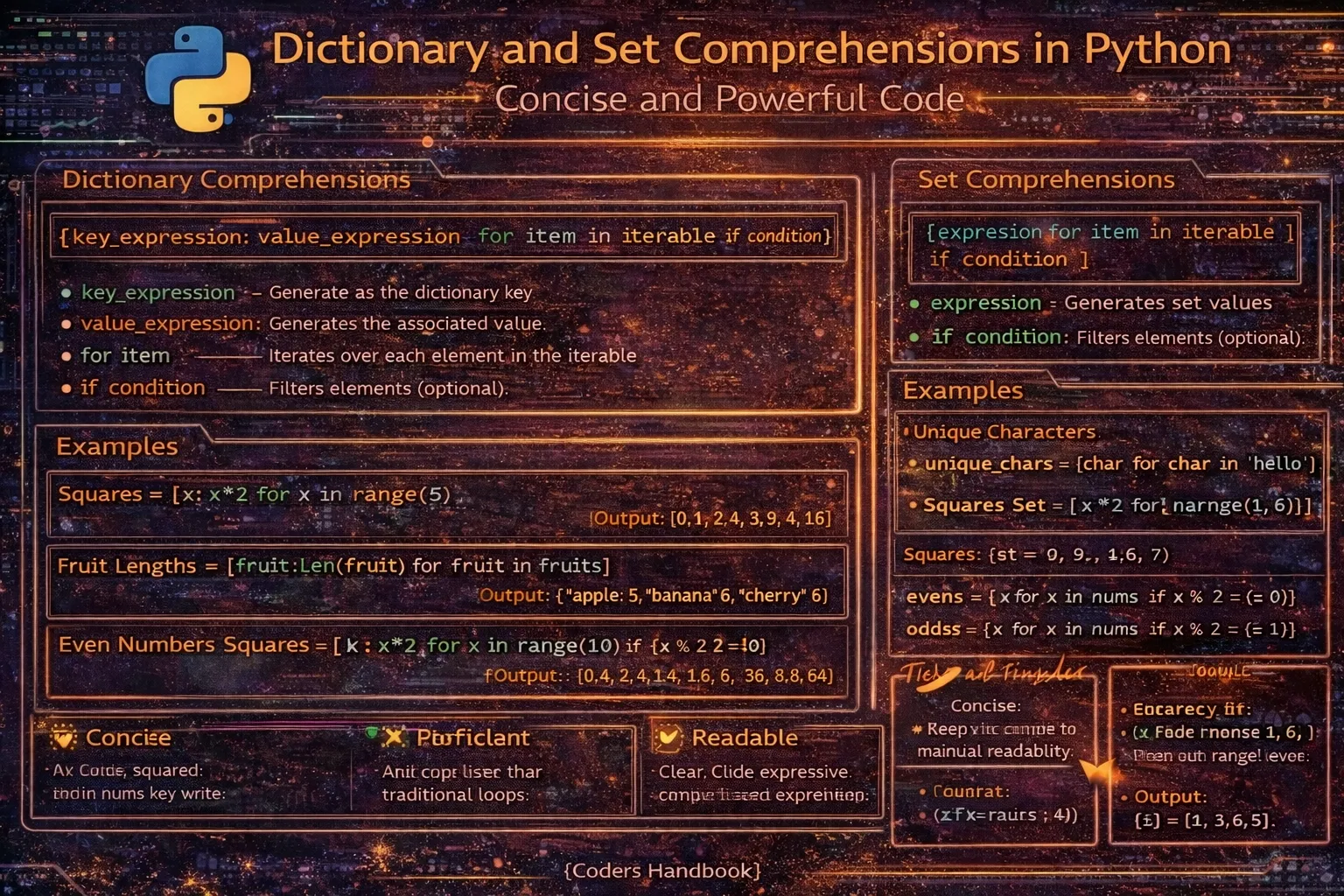
Dictionary and set comprehensions extend Python's comprehension syntax beyond lists to create mappings and unique collections efficiently through concise single-line expressions. Dictionary comprehensions using {key: value for item in iterable} syntax enable elegant dictionary creation, transformation, filtering, and inversion without explicit loops or dictionary initialization. Set comprehensions with {expression for item in iterable} pattern create unique element collections with automatic deduplication, perfect for extracting distinct values, performing set operations, or removing duplicates from sequences. These comprehensions embody Pythonic principles of readability and expressiveness, transforming multi-line dictionary and set construction into readable one-liners that clearly express intent while maintaining or improving performance through optimized implementation.
This comprehensive guide explores dictionary comprehension syntax with key-value pair generation from iterables, creating dictionaries from parallel sequences using zip(), transforming existing dictionary keys or values, inverting dictionaries swapping keys with values, filtering dictionaries by keys or values, nested dictionary comprehensions for hierarchical structures, set comprehension syntax creating unique collections automatically, filtering sets with conditional logic, removing duplicates from lists through set conversion, set operations combining comprehensions with union and intersection, practical applications including data transformation and lookups, performance characteristics demonstrating efficiency gains, and best practices balancing conciseness with readability. Whether you're building data processing pipelines transforming records, creating lookup tables for fast access, extracting unique values from datasets, restructuring API responses, implementing caching mechanisms, or performing data validation with set membership testing, mastering dictionary and set comprehensions provides powerful tools for writing efficient, readable Python code handling mappings and unique collections elegantly.
Dictionary Comprehension Basics
Dictionary comprehensions follow the pattern {key_expr: value_expr for item in iterable} creating new dictionaries by iterating through sequences and computing key-value pairs. This syntax replaces traditional dictionary initialization with empty dictionaries followed by loops assigning key-value pairs, condensing multiple lines into one expressive statement. The key and value expressions can transform items, call functions, or perform calculations, enabling flexible dictionary construction from various data sources.
# Dictionary Comprehension Basics

# Traditional dictionary creation
squares = {}
for x in range(1, 6):
    squares[x] = x ** 2
print(squares)  # Output: {1: 1, 2: 4, 3: 9, 4: 16, 5: 25}

# Dictionary comprehension equivalent
squares = {x: x ** 2 for x in range(1, 6)}
print(squares)  # Output: {1: 1, 2: 4, 3: 9, 4: 16, 5: 25}

# Basic syntax: {key: value for item in iterable}
# Create cubes dictionary
cubes = {x: x ** 3 for x in range(1, 6)}
print(cubes)  # Output: {1: 1, 2: 8, 3: 27, 4: 64, 5: 125}

# String keys with computed values
words = ['apple', 'banana', 'cherry']
word_lengths = {word: len(word) for word in words}
print(word_lengths)  # Output: {'apple': 5, 'banana': 6, 'cherry': 6}

# Number to word mapping
number_words = {i: str(i) for i in range(5)}
print(number_words)  # Output: {0: '0', 1: '1', 2: '2', 3: '3', 4: '4'}

# Using enumerate for indexed dictionary
fruits = ['apple', 'banana', 'cherry']
fruit_index = {i: fruit for i, fruit in enumerate(fruits)}
print(fruit_index)  # Output: {0: 'apple', 1: 'banana', 2: 'cherry'}

# Reverse: fruit to index
index_dict = {fruit: i for i, fruit in enumerate(fruits)}
print(index_dict)  # Output: {'apple': 0, 'banana': 1, 'cherry': 2}

# Create dictionary from two lists using zip
keys = ['name', 'age', 'city']
values = ['Alice', 25, 'NYC']
person = {k: v for k, v in zip(keys, values)}
print(person)  # Output: {'name': 'Alice', 'age': 25, 'city': 'NYC'}

# Simpler: dict(zip(keys, values))
person = dict(zip(keys, values))

# Transform values during creation
temperatures_f = [32, 68, 86, 104]
temp_dict = {f"{temp}F": (temp - 32) * 5/9 for temp in temperatures_f}
print(temp_dict)
# Output: {'32F': 0.0, '68F': 20.0, '86F': 30.0, '104F': 40.0}

# Using functions in comprehension
def classify(num):
    return 'even' if num % 2 == 0 else 'odd'

classified = {num: classify(num) for num in range(1, 6)}
print(classified)  # Output: {1: 'odd', 2: 'even', 3: 'odd', 4: 'even', 5: 'odd'}

# Multiple expressions
names = ['Alice', 'Bob', 'Charlie']
name_info = {name: {'length': len(name), 'upper': name.upper()}
             for name in names}
print(name_info)
# Output: {'Alice': {'length': 5, 'upper': 'ALICE'}, ...}

# From list of tuples
pairs = [('a', 1), ('b', 2), ('c', 3)]
dict_from_tuples = {k: v for k, v in pairs}
print(dict_from_tuples)  # Output: {'a': 1, 'b': 2, 'c': 3}

# Constant values
default_config = {key: 0 for key in ['width', 'height', 'depth']}
print(default_config) # Output: {'width': 0, 'height': 0, 'depth': 0}Transforming and Filtering Dictionaries
Dictionary comprehensions excel at transforming existing dictionaries by modifying keys, values, or both, and filtering based on conditions. The pattern {new_key: new_value for key, value in dict.items() if condition} enables selective dictionary reconstruction with transformations. Common operations include inverting dictionaries, filtering by value thresholds, transforming keys to different cases, and extracting subsets matching specific criteria.
# Transforming and Filtering Dictionaries

# Transform dictionary values
prices = {'apple': 1.20, 'banana': 0.50, 'orange': 1.50}
prices_with_tax = {item: price * 1.08 for item, price in prices.items()}
print(prices_with_tax)
# Output: {'apple': 1.296, 'banana': 0.54, 'orange': 1.62}

# Transform dictionary keys
data = {'Name': 'Alice', 'Age': 25, 'City': 'NYC'}
lowercase_keys = {key.lower(): value for key, value in data.items()}
print(lowercase_keys)
# Output: {'name': 'Alice', 'age': 25, 'city': 'NYC'}

# Invert dictionary (swap keys and values)
original = {'a': 1, 'b': 2, 'c': 3}
inverted = {value: key for key, value in original.items()}
print(inverted)  # Output: {1: 'a', 2: 'b', 3: 'c'}

# Filter dictionary by values
scores = {'Alice': 85, 'Bob': 92, 'Charlie': 78, 'Diana': 95}
passed = {name: score for name, score in scores.items() if score >= 80}
print(passed)  # Output: {'Alice': 85, 'Bob': 92, 'Diana': 95}

# Filter by keys
user_data = {'name': 'Alice', 'age': 25, 'password': 'secret', 'email': '[email protected]'}
public_data = {k: v for k, v in user_data.items() if k != 'password'}
print(public_data)
# Output: {'name': 'Alice', 'age': 25, 'email': '[email protected]'}

# Multiple conditions
inventory = {'apple': 50, 'banana': 0, 'orange': 25, 'grape': 5}
in_stock = {item: qty for item, qty in inventory.items()
            if qty > 0 and qty < 30}
print(in_stock)  # Output: {'orange': 25, 'grape': 5}

# Transform both keys and values
temperatures = {'NYC': 32, 'LA': 68, 'Chicago': 14}
celsius = {city.lower(): (temp - 32) * 5/9
           for city, temp in temperatures.items()}
print(celsius)
# Output: {'nyc': 0.0, 'la': 20.0, 'chicago': -10.0}

# Conditional value transformation
numbers = {1: 10, 2: 20, 3: 30, 4: 40}
doubled_odds = {k: v * 2 if k % 2 != 0 else v
                for k, v in numbers.items()}
print(doubled_odds)  # Output: {1: 20, 2: 20, 3: 60, 4: 40}

# Extract subset of keys
full_config = {
    'host': 'localhost',
    'port': 5432,
    'user': 'admin',
    'password': 'secret',
    'database': 'mydb'
}
required_keys = ['host', 'port', 'database']
connection_config = {k: full_config[k] for k in required_keys}
print(connection_config)
# Output: {'host': 'localhost', 'port': 5432, 'database': 'mydb'}

# Safe extraction with get()
connection_config = {k: full_config.get(k, 'default')
                     for k in required_keys}

# Merge and transform dictionaries
dict1 = {'a': 1, 'b': 2}
dict2 = {'c': 3, 'd': 4}
merged = {k: v * 10 for d in [dict1, dict2] for k, v in d.items()}
print(merged)  # Output: {'a': 10, 'b': 20, 'c': 30, 'd': 40}

# Remove None values
data = {'name': 'Alice', 'age': None, 'city': 'NYC', 'phone': None}
cleaned = {k: v for k, v in data.items() if v is not None}
print(cleaned)  # Output: {'name': 'Alice', 'city': 'NYC'}

# Type conversion
string_dict = {'1': 'one', '2': 'two', '3': 'three'}
int_dict = {int(k): v for k, v in string_dict.items()}
print(int_dict) # Output: {1: 'one', 2: 'two', 3: 'three'}{v: k for k, v in dict.items()}, duplicate values become problematic as only the last key survives. Ensure values are unique before inverting.Nested Dictionary Comprehensions
Nested dictionary comprehensions create dictionaries of dictionaries or dictionaries with complex values using nested comprehension syntax. These enable building hierarchical data structures like multiplication tables, nested configurations, or grouped data. While powerful, nested comprehensions rapidly decrease readability, suggesting traditional loops for deeply nested structures requiring multiple levels of iteration and transformation.
# Nested Dictionary Comprehensions

# Create multiplication table
mult_table = {i: {j: i * j for j in range(1, 6)} for i in range(1, 6)}
print(mult_table)
# Output: {
#   1: {1: 1, 2: 2, 3: 3, 4: 4, 5: 5},
#   2: {1: 2, 2: 4, 3: 6, 4: 8, 5: 10},
#   ...
# }

# Access nested values
print(mult_table[3][4])  # Output: 12

# Create nested configuration
servers = ['web', 'db', 'cache']
config = {server: {'host': f'{server}.example.com', 'port': 8000 + i}
          for i, server in enumerate(servers)}
print(config)
# Output: {
#   'web': {'host': 'web.example.com', 'port': 8000},
#   'db': {'host': 'db.example.com', 'port': 8001},
#   'cache': {'host': 'cache.example.com', 'port': 8002}
# }

# Group data by category
items = [
    {'name': 'Apple', 'category': 'Fruit', 'price': 1.20},
    {'name': 'Carrot', 'category': 'Vegetable', 'price': 0.80},
    {'name': 'Banana', 'category': 'Fruit', 'price': 0.50}
]

# Get unique categories first
categories = {item['category'] for item in items}

# Group by category
grouped = {cat: [item['name'] for item in items if item['category'] == cat]
           for cat in categories}
print(grouped)
# Output: {'Fruit': ['Apple', 'Banana'], 'Vegetable': ['Carrot']}

# Create matrix as nested dict
matrix_dict = {i: {j: 0 for j in range(3)} for i in range(3)}
print(matrix_dict)
# Output: {0: {0: 0, 1: 0, 2: 0}, 1: {0: 0, 1: 0, 2: 0}, 2: {0: 0, 1: 0, 2: 0}}

# Transform nested structures
users = {
    'alice': {'age': 25, 'city': 'NYC'},
    'bob': {'age': 30, 'city': 'LA'}
}

# Add computed fields
enhanced = {name: {**data, 'adult': data['age'] >= 18}
            for name, data in users.items()}
print(enhanced)
# Output: {
#   'alice': {'age': 25, 'city': 'NYC', 'adult': True},
#   'bob': {'age': 30, 'city': 'LA', 'adult': True}
# }

# Create lookup tables
products = [
    {'id': 1, 'name': 'Laptop', 'price': 999},
    {'id': 2, 'name': 'Mouse', 'price': 25}
]

product_lookup = {p['id']: {'name': p['name'], 'price': p['price']}
                  for p in products}
print(product_lookup)
# Output: {1: {'name': 'Laptop', 'price': 999}, 2: {'name': 'Mouse', 'price': 25}}

# Nested with conditions
student_scores = {
    'Alice': [85, 90, 88],
    'Bob': [92, 88, 95],
    'Charlie': [78, 82, 75]
}

averages = {name: {'average': sum(scores) / len(scores),
                   'passed': sum(scores) / len(scores) >= 80}
            for name, scores in student_scores.items()}
print(averages)
Set Comprehension Basics
Set comprehensions use {expression for item in iterable} syntax creating sets with automatic duplicate removal, similar to list comprehensions but producing unique value collections. Sets provide O(1) membership testing, making them ideal for checking existence, removing duplicates, or performing mathematical set operations. Set comprehensions combine iteration, transformation, and deduplication in one concise expression.
# Set Comprehension Basics

# Traditional set creation
squares_set = set()
for x in range(10):
    squares_set.add(x ** 2)
print(squares_set)  # Output: {0, 1, 4, 9, 16, 25, 36, 49, 64, 81}

# Set comprehension equivalent
squares_set = {x ** 2 for x in range(10)}
print(squares_set)  # Output: {0, 1, 4, 9, 16, 25, 36, 49, 64, 81}

# Basic syntax: {expression for item in iterable}
# Automatic deduplication
numbers = [1, 2, 2, 3, 3, 3, 4, 4, 4, 4]
unique = {x for x in numbers}
print(unique)  # Output: {1, 2, 3, 4}

# Simpler: set(numbers)
unique = set(numbers)

# Transform and deduplicate
words = ['Hello', 'WORLD', 'hello', 'Python', 'world']
lowercase_unique = {word.lower() for word in words}
print(lowercase_unique)  # Output: {'hello', 'world', 'python'}

# Extract unique lengths
words = ['a', 'to', 'cat', 'python', 'code', 'hi']
lengths = {len(word) for word in words}
print(lengths)  # Output: {1, 2, 3, 4, 6}

# Get first characters
names = ['Alice', 'Bob', 'Charlie', 'Amanda', 'David']
first_letters = {name[0] for name in names}
print(first_letters)  # Output: {'A', 'B', 'C', 'D'}

# Mathematical operations
even_squares = {x ** 2 for x in range(20) if x % 2 == 0}
print(even_squares)  # Output: {0, 4, 16, 36, 64, 100, 144, 196, 256, 324}

# Remove duplicates from nested list
nested = [[1, 2, 2], [3, 3, 4], [4, 5, 5]]
unique_nums = {num for sublist in nested for num in sublist}
print(unique_nums)  # Output: {1, 2, 3, 4, 5}

# Extract unique values from dict
user_cities = {'Alice': 'NYC', 'Bob': 'LA', 'Charlie': 'NYC', 'Diana': 'Chicago'}
cities = {city for city in user_cities.values()}
print(cities)  # Output: {'NYC', 'LA', 'Chicago'}

# String operations
sentence = "hello world hello python"
unique_words = {word for word in sentence.split()}
print(unique_words)  # Output: {'hello', 'world', 'python'}

# Unique characters
text = "hello"
chars = {char for char in text}
print(chars)  # Output: {'h', 'e', 'l', 'o'}

# Type conversion
string_numbers = ['1', '2', '2', '3', '3', '3']
unique_ints = {int(s) for s in string_numbers}
print(unique_ints)  # Output: {1, 2, 3}

# From range
multiples_of_5 = {x for x in range(0, 51, 5)}
print(multiples_of_5) # Output: {0, 5, 10, 15, 20, 25, 30, 35, 40, 45, 50}{transform(x) for x in items} guarantees uniqueness.Filtering and Set Operations
Set comprehensions with conditional logic using if clauses enable filtering unique values matching specific criteria. Combined with Python's set operations like union, intersection, and difference, comprehensions create powerful data filtering and comparison tools. These patterns are especially useful for finding common elements, unique differences, or combining datasets while maintaining uniqueness constraints.
# Filtering and Set Operations

# Filter with condition
numbers = range(20)
even_nums = {x for x in numbers if x % 2 == 0}
print(even_nums)  # Output: {0, 2, 4, 6, 8, 10, 12, 14, 16, 18}

# Multiple conditions
multiples = {x for x in range(1, 101) if x % 3 == 0 and x % 5 == 0}
print(multiples)  # Output: {15, 30, 45, 60, 75, 90}

# Filter strings by length
words = ['a', 'to', 'cat', 'python', 'code', 'hi']
long_words = {word for word in words if len(word) > 2}
print(long_words)  # Output: {'cat', 'python', 'code'}

# Filter and transform
values = [-5, -2, 0, 3, 7, -1, 10]
positive_squares = {x ** 2 for x in values if x > 0}
print(positive_squares)  # Output: {9, 49, 100}

# Extract valid emails
emails = ['[email protected]', 'invalid', '[email protected]', 'no-at']
valid = {email for email in emails if '@' in email and '.' in email}
print(valid)  # Output: {'[email protected]', '[email protected]'}

# Set union with comprehensions
list1 = [1, 2, 3, 4]
list2 = [3, 4, 5, 6]
combined = {x for x in list1} | {x for x in list2}
print(combined)  # Output: {1, 2, 3, 4, 5, 6}

# Or simpler:
combined = set(list1) | set(list2)

# Set intersection
common = {x for x in list1} & {x for x in list2}
print(common)  # Output: {3, 4}

# Set difference
only_in_first = {x for x in list1} - {x for x in list2}
print(only_in_first)  # Output: {1, 2}

# Symmetric difference
difference = {x for x in list1} ^ {x for x in list2}
print(difference)  # Output: {1, 2, 5, 6}

# Complex filtering with multiple lists
list1 = [1, 2, 3, 4, 5]
list2 = [4, 5, 6, 7, 8]
list3 = [5, 6, 7, 8, 9]

# Elements in all three
in_all = {x for x in list1} & {x for x in list2} & {x for x in list3}
print(in_all)  # Output: {5}

# Elements in any list
in_any = {x for x in list1} | {x for x in list2} | {x for x in list3}
print(in_any)  # Output: {1, 2, 3, 4, 5, 6, 7, 8, 9}

# Filter based on another set
all_numbers = {x for x in range(20)}
exclude = {2, 5, 7, 11, 13, 17, 19}  # Primes
non_primes = {x for x in all_numbers if x not in exclude}
print(non_primes)

# Practical: Find unique tags across posts
posts = [
    {'title': 'Post 1', 'tags': ['python', 'coding', 'tutorial']},
    {'title': 'Post 2', 'tags': ['python', 'data', 'analysis']},
    {'title': 'Post 3', 'tags': ['javascript', 'web', 'coding']}
]

all_tags = {tag for post in posts for tag in post['tags']}
print(all_tags)
# Output: {'python', 'coding', 'tutorial', 'data', 'analysis', 'javascript', 'web'}

# Find common tags
post1_tags = set(posts[0]['tags'])
post2_tags = set(posts[1]['tags'])
common_tags = post1_tags & post2_tags
print(common_tags)  # Output: {'python'}

# Conditional based on set membership
allowed = {'admin', 'user', 'guest'}
roles = ['admin', 'user', 'superuser', 'guest', 'anonymous']
valid_roles = {role for role in roles if role in allowed}
print(valid_roles)  # Output: {'admin', 'user', 'guest'}
Practical Applications
Dictionary and set comprehensions solve real-world problems including creating lookup tables for O(1) access, inverting mappings, grouping data by attributes, extracting unique values, validating data against sets, transforming API responses, and building caches. These comprehensions enable data transformation pipelines that are both readable and efficient, replacing verbose loops with expressive single-line transformations that clearly communicate intent while leveraging Python's optimized collection implementations.
# Practical Applications

# 1. Create lookup table from list of dicts
users = [
    {'id': 1, 'name': 'Alice', 'email': '[email protected]'},
    {'id': 2, 'name': 'Bob', 'email': '[email protected]'},
    {'id': 3, 'name': 'Charlie', 'email': '[email protected]'}
]

# Lookup by ID for O(1) access
user_lookup = {user['id']: user for user in users}
print(user_lookup[2])  # Fast access: O(1)
# Output: {'id': 2, 'name': 'Bob', 'email': '[email protected]'}

# 2. Invert mapping for reverse lookup
email_to_id = {user['email']: user['id'] for user in users}
print(email_to_id['[email protected]'])  # Output: 1

# 3. Extract and validate data
form_data = {
    'username': 'alice123',
    'email': '[email protected]',
    'password': 'secret',
    'csrf_token': 'abc123',
    'remember': True
}

# Extract only valid fields
valid_fields = {'username', 'email', 'password', 'remember'}
user_data = {k: v for k, v in form_data.items() if k in valid_fields}
print(user_data)
# Output: {'username': 'alice123', 'email': '[email protected]', ...}

# 4. Group data by attribute
products = [
    {'name': 'Laptop', 'category': 'Electronics', 'price': 999},
    {'name': 'Shirt', 'category': 'Clothing', 'price': 29},
    {'name': 'Phone', 'category': 'Electronics', 'price': 699},
    {'name': 'Jeans', 'category': 'Clothing', 'price': 49}
]

categories = {p['category'] for p in products}
grouped = {cat: [p for p in products if p['category'] == cat]
           for cat in categories}
print(grouped['Electronics'])
# Output: [{'name': 'Laptop', ...}, {'name': 'Phone', ...}]

# 5. Build cache/memoization
import functools

cache = {}
def expensive_computation(n):
    if n not in cache:
        cache[n] = n ** 3  # Expensive operation
    return cache[n]

# Pre-populate cache with comprehension
cache = {i: i ** 3 for i in range(100)}

# 6. Transform API response
api_response = [
    {'userId': 1, 'userName': 'Alice'},
    {'userId': 2, 'userName': 'Bob'}
]

# Convert to snake_case keys
transformed = [{k.replace('u', '_u').lower(): v
                for k, v in item.items()}
               for item in api_response]
print(transformed)
# Output: [{'user_id': 1, 'user_name': 'Alice'}, ...]

# 7. Validate against whitelist
allowed_domains = {'gmail.com', 'yahoo.com', 'outlook.com'}
emails = ['[email protected]', '[email protected]', '[email protected]']
valid_emails = {email for email in emails
                if email.split('@')[1] in allowed_domains}
print(valid_emails)
# Output: {'[email protected]', '[email protected]'}

# 8. Count unique values
events = [
    {'user': 'alice', 'action': 'login'},
    {'user': 'bob', 'action': 'logout'},
    {'user': 'alice', 'action': 'logout'}
]

unique_users = {event['user'] for event in events}
print(f"Total unique users: {len(unique_users)}")
# Output: Total unique users: 2

# 9. Find duplicates
numbers = [1, 2, 3, 2, 4, 5, 3, 6]
seen = set()
duplicates = {x for x in numbers if x in seen or seen.add(x)}
print(duplicates)  # Output: {2, 3}

# Better approach:
from collections import Counter
counts = Counter(numbers)
duplicates = {num for num, count in counts.items() if count > 1}

# 10. Configuration merging
default_config = {'debug': False, 'port': 8000, 'host': 'localhost'}
user_config = {'port': 3000, 'ssl': True}

# Merge with user config override
final_config = {**default_config, **user_config}
print(final_config)
# Output: {'debug': False, 'port': 3000, 'host': 'localhost', 'ssl': True}
Best Practices
- Keep it readable: Comprehensions should be simple enough to understand at a glance. Complex logic belongs in regular loops with descriptive variable names
- Use for transformations: Comprehensions excel at transforming existing data structures. Use them for mapping, filtering, and restructuring operations
- Check for duplicates when inverting: Inverting dictionaries with
{v: k for k, v in d.items()}loses data if values aren't unique - Leverage sets for membership testing: Use set comprehensions when you need O(1) lookup. Sets are much faster than lists for
inchecks - Don't nest too deep: Nested comprehensions become unreadable quickly. Limit nesting to one or two levels maximum
- Use dict() for simple zipping: For simple key-value pairing,
dict(zip(keys, values))is clearer than comprehension - Consider collections modules: For grouping or counting,
defaultdictandCounterare often better than manual comprehensions - Use .get() for safe access: When transforming dictionaries, use
dict.get(key, default)to handle missing keys gracefully - Document complex comprehensions: If comprehension needs explanation, add comment or consider refactoring to regular loop
- Remember set limitations: Sets can only contain hashable (immutable) types. Lists and dicts can't be set elements
Conclusion
Dictionary and set comprehensions extend Python's comprehension syntax to create mappings and unique collections efficiently through concise expressions. Dictionary comprehensions using {key: value for item in iterable} enable creating dictionaries from sequences, transforming existing dictionary keys or values, inverting dictionaries swapping keys with values, filtering by conditions, and building lookup tables for O(1) access patterns. Set comprehensions with {expression for item in iterable} create unique element collections with automatic deduplication, perfect for extracting distinct values, removing duplicates from sequences, and performing mathematical set operations like union, intersection, and difference.
Nested dictionary comprehensions enable hierarchical structures like multiplication tables or grouped data, though readability decreases rapidly beyond two nesting levels suggesting traditional loops for complex operations. Practical applications include creating lookup tables from lists of dictionaries for fast access, inverting mappings for reverse lookups, extracting and validating form data against whitelists, grouping data by attributes, building caches for memoization, transforming API responses to different formats, validating emails against allowed domains, and configuration merging with override precedence. Best practices emphasize keeping comprehensions simple and readable avoiding complexity requiring comments, using them for transformations rather than side effects, checking for duplicate values when inverting dictionaries, leveraging sets for fast membership testing with O(1) lookup, limiting nesting depth to maintain clarity, using dict(zip()) for simple key-value pairing, considering collections module alternatives like defaultdict and Counter for grouping and counting, using .get() for safe dictionary access, documenting complex comprehensions or refactoring to loops, and remembering set limitations requiring hashable immutable elements. By mastering dictionary comprehension syntax for mappings, set comprehension patterns for unique collections, transformation and filtering techniques, nested structures for hierarchical data, practical applications solving real-world problems, and best practices balancing conciseness with clarity, you gain powerful tools for writing elegant, efficient Python code handling dictionaries and sets Pythonically while maintaining the readability and maintainability essential for professional software development.
$ share --platform
$ cat /comments/ (0)
$ cat /comments/
// No comments found. Be the first!