Python Variables and Data Types: Complete Beginner's Guide
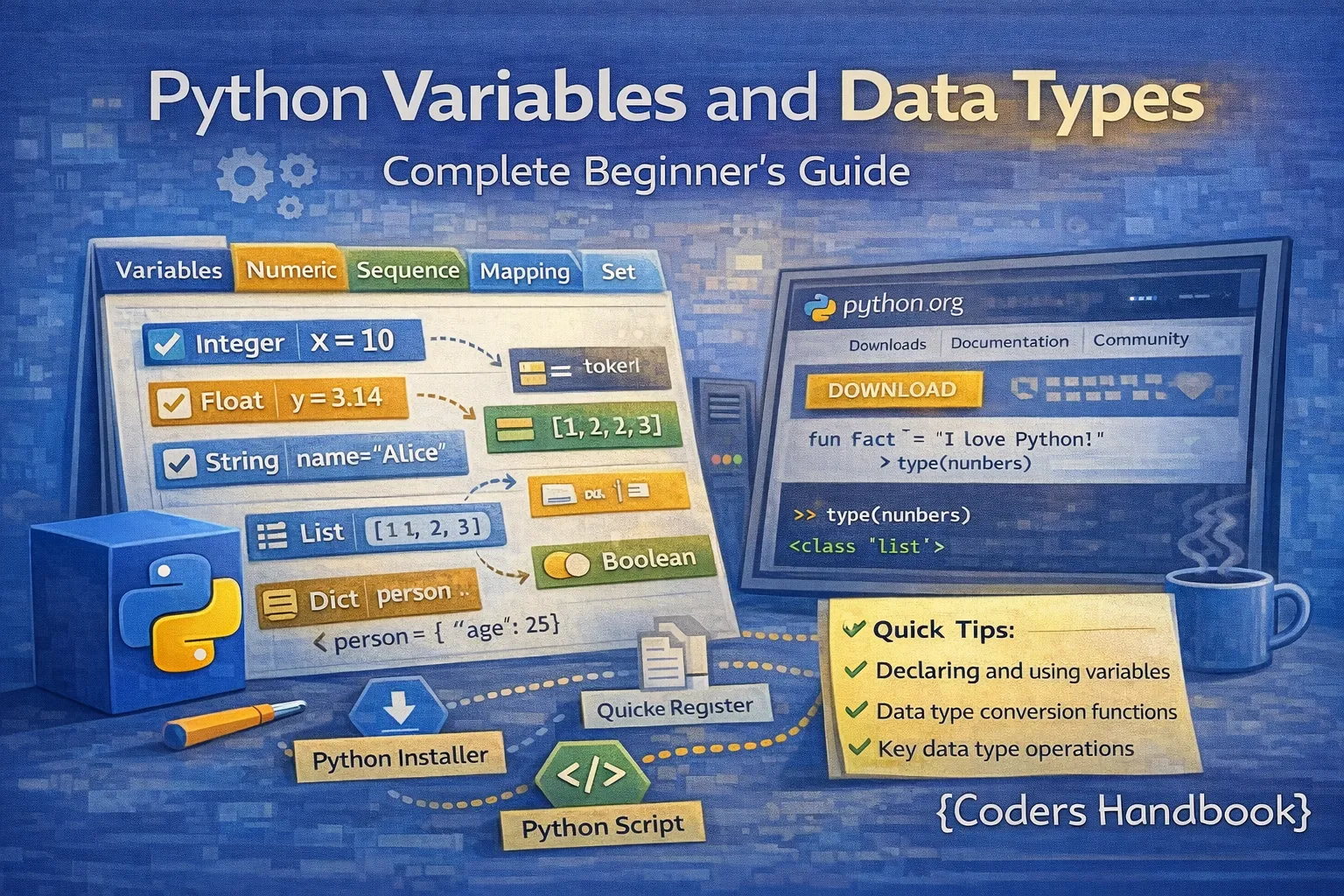
Variables and data types form the foundation of Python programming, allowing you to store, manipulate, and process information in your programs. Unlike statically typed languages that require explicit type declarations, Python uses dynamic typing where variables automatically adapt to the type of data assigned to them, making code more flexible and easier to write. Understanding Python's built-in data types—integers, floats, strings, booleans, and complex numbers—along with how to convert between them is essential for writing effective programs. This comprehensive guide explores variable naming conventions, dynamic typing behavior, type conversion techniques, and practical examples demonstrating how Python handles different data types seamlessly.
Understanding Python Variables
A variable in Python is a named reference to a value stored in computer memory, acting as a container that holds data you can use throughout your program. Python creates variables the moment you assign a value to them using the assignment operator (=), without requiring any explicit declaration or type specification. The Python interpreter automatically determines the data type based on the assigned value, and this type can change if you reassign the variable to a different type of value.
# Creating variables in Python - no declaration needed
name = "Alice"           # String variable
age = 25                 # Integer variable
height = 5.6            # Float variable
is_student = True        # Boolean variable

# Print variables
print("Name:", name)
print("Age:", age)
print("Height:", height)
print("Is Student:", is_student)

# Check the type of each variable using type() function
print("\nVariable Types:")
print("Type of name:", type(name))           # <class 'str'>
print("Type of age:", type(age))             # <class 'int'>
print("Type of height:", type(height))       # <class 'float'>
print("Type of is_student:", type(is_student)) # <class 'bool'>

# Output:
# Name: Alice
# Age: 25
# Height: 5.6
# Is Student: True
#
# Variable Types:
# Type of name: <class 'str'>
# Type of age: <class 'int'>
# Type of height: <class 'float'>
# Type of is_student: <class 'bool'>
Variable Naming Rules and Conventions
Python has specific rules for naming variables that you must follow, plus conventions that make your code more readable and professional. Variable names can contain letters (A-Z, a-z), digits (0-9), and underscores (_), but cannot start with a digit or contain spaces or special characters. Python is case-sensitive, meaning 'temperature', 'Temperature', and 'TEMPERATURE' are three different variables.
- Must start with a letter or underscore: Valid examples are
name,_count,user_age; invalid examples are1name,@email - Use descriptive names: Choose
student_countoversc, ortemperatureovertfor clarity - Follow snake_case convention: Separate words with underscores like
user_name,total_price,max_temperature - Avoid Python keywords: Don't use reserved words like
if,for,class,def,returnas variable names - Use lowercase for variables: Constants use UPPERCASE like
MAX_SIZE = 100,PI = 3.14159 - Keep names concise but meaningful: Balance brevity with clarity to make code self-documenting
# Good variable names - descriptive and follow conventions
student_name = "John Doe"
total_marks = 450
average_score = 89.5
is_passed = True
MAX_ATTEMPTS = 3  # Constant in UPPERCASE

# Poor variable names - avoid these
x = "John Doe"     # Not descriptive
tm = 450           # Unclear abbreviation
s1 = 89.5          # Meaningless name

# Invalid variable names - will cause SyntaxError
# 1student = "Alice"    # Cannot start with digit
# student-name = "Bob"  # Cannot contain hyphens
# for = 10              # Cannot use Python keyword

# Case sensitivity demonstration
message = "Hello"
Message = "Hi"
MESSAGE = "Hey"
print(message, Message, MESSAGE)  # Three different variables
# Output: Hello Hi Hey
Dynamic Typing in Python
Python's dynamic typing means variables don't have fixed types and can be reassigned to values of different types during program execution. This flexibility allows you to write more concise code and change a variable's type simply by assigning a new value, as Python automatically determines the appropriate type based on the assigned data. While this makes Python easier to learn and use, you must be careful to track what type a variable currently holds to avoid unexpected behavior.
# Dynamic typing - variable type changes with reassignment
x = 42                    # x is an integer
print("x =", x, "| Type:", type(x))
# Output: x = 42 | Type: <class 'int'>

x = "Hello Python"        # Now x is a string
print("x =", x, "| Type:", type(x))
# Output: x = Hello Python | Type: <class 'str'>

x = 3.14                  # Now x is a float
print("x =", x, "| Type:", type(x))
# Output: x = 3.14 | Type: <class 'float'>

x = True                  # Now x is a boolean
print("x =", x, "| Type:", type(x))
# Output: x = True | Type: <class 'bool'>

# This flexibility is powerful but requires careful tracking
# Compare to statically typed languages where this would cause errors

# Type hints (optional) - help document expected types
def greet(name: str) -> str:
    """Function with type hints for better code documentation."""
    return f"Hello, {name}!"

result = greet("Alice")
print(result) # Output: Hello, Alice!type() function to check types when needed, and consider type hints for larger projects to improve code clarity.Numeric Data Types
Python provides three numeric data types: integers for whole numbers, floats for decimal numbers, and complex numbers for mathematical computations involving imaginary components. Each type serves different purposes and has distinct characteristics in terms of precision, memory usage, and supported operations.
Integer (int) Data Type
Integers are whole numbers without decimal points, both positive and negative, with unlimited precision in Python 3. Python automatically handles large integers without overflow issues, making it excellent for mathematical computations requiring exact values.
# Integer examples
positive_num = 100
negative_num = -50
zero = 0
large_number = 123456789012345678901234567890  # Unlimited precision

print("Positive:", positive_num, "|", type(positive_num))
print("Negative:", negative_num, "|", type(negative_num))
print("Large:", large_number, "|", type(large_number))

# Integer arithmetic
a = 10
b = 3

print("\nInteger Operations:")
print(f"{a} + {b} = {a + b}")     # Addition: 13
print(f"{a} - {b} = {a - b}")     # Subtraction: 7
print(f"{a} * {b} = {a * b}")     # Multiplication: 30
print(f"{a} / {b} = {a / b}")     # Division: 3.333... (returns float)
print(f"{a} // {b} = {a // b}")   # Floor division: 3 (integer)
print(f"{a} % {b} = {a % b}")     # Modulus: 1
print(f"{a} ** {b} = {a ** b}")   # Exponentiation: 1000
Float Data Type
Floats represent decimal numbers and scientific notation, stored with finite precision that can introduce small rounding errors. They're essential for calculations requiring fractional values like measurements, percentages, and scientific computations.
# Float examples
temperature = 98.6
pi = 3.14159
scientific = 1.5e-4  # Scientific notation: 0.00015

print("Temperature:", temperature, "|", type(temperature))
print("Pi:", pi, "|", type(pi))
print("Scientific:", scientific, "|", type(scientific))

# Float arithmetic
x = 10.5
y = 2.5

print("\nFloat Operations:")
print(f"{x} + {y} = {x + y}")      # 13.0
print(f"{x} * {y} = {x * y}")      # 26.25
print(f"{x} / {y} = {x / y}")      # 4.2

# Floating point precision issues
result = 0.1 + 0.2
print(f"\n0.1 + 0.2 = {result}")    # 0.30000000000000004
print(f"Rounded: {round(result, 2)}")  # 0.3

# Use round() for display or comparison
print(f"Is 0.1 + 0.2 == 0.3? {result == 0.3}")  # False
print(f"Is round(0.1 + 0.2, 2) == 0.3? {round(result, 2) == 0.3}")  # True
Complex Numbers
Complex numbers consist of real and imaginary parts, written as 'a + bj' where 'a' is the real component and 'b' is the imaginary component. Python uses 'j' (not 'i') to denote the imaginary unit, and provides built-in support for complex arithmetic useful in scientific and engineering applications.
# Complex number examples
z1 = 3 + 2j              # Using j notation
z2 = complex(3, 2)       # Using complex() constructor
z3 = complex(5, -1)      # Another complex number

print("z1:", z1, "|", type(z1))
print("z2:", z2, "|", type(z2))
print("z1 == z2?", z1 == z2)  # True

# Accessing real and imaginary parts
print("\nReal part of z1:", z1.real)      # 3.0
print("Imaginary part of z1:", z1.imag)  # 2.0

# Complex arithmetic
print("\nComplex Operations:")
print(f"z1 + z3 = {z1 + z3}")            # (8+1j)
print(f"z1 * z3 = {z1 * z3}")            # (17+7j)
print(f"z1 / z3 = {z1 / z3}")            # (0.5+0.5j)

# Conjugate
print(f"Conjugate of z1: {z1.conjugate()}")  # (3-2j)

# Absolute value (magnitude)
import cmath
magnitude = abs(z1)
phase = cmath.phase(z1)
print(f"Magnitude of z1: {magnitude:.2f}")
print(f"Phase of z1: {phase:.2f} radians")
String Data Type
Strings represent text data enclosed in single quotes ('...'), double quotes ("..."), or triple quotes ('''...''' or """...""") for multiline strings. Strings are immutable sequences of characters that support powerful operations including concatenation, slicing, formatting, and numerous built-in methods for text manipulation.
# String examples - single, double, and triple quotes
name = 'Alice'
message = "Hello, World!"
multiline = '''This is a
multiline string
spanning three lines'''

print("Name:", name, "|", type(name))
print("Message:", message)
print("Multiline:\n", multiline)

# String operations
first_name = "John"
last_name = "Doe"

# Concatenation
full_name = first_name + " " + last_name
print("\nFull name:", full_name)  # John Doe

# Repetition
print("Ha" * 3)  # HaHaHa

# String formatting (f-strings)
age = 25
formatted = f"My name is {full_name} and I'm {age} years old."
print(formatted)

# String methods
text = "  Python Programming  "
print("Original:", f"'{text}'")
print("Uppercase:", text.upper())          # "  PYTHON PROGRAMMING  "
print("Lowercase:", text.lower())          # "  python programming  "
print("Stripped:", text.strip())           # "Python Programming"
print("Replace:", text.replace("Python", "Java"))  # "  Java Programming  "

# String indexing and slicing
word = "Python"
print("\nFirst character:", word[0])       # P
print("Last character:", word[-1])        # n
print("Slice [0:3]:", word[0:3])          # Pyt
print("Length:", len(word))               # 6
Boolean Data Type
The boolean type has only two values: True and False (with capital first letters), used for logical operations and conditional statements. Booleans result from comparison operations and control program flow through if statements, while loops, and logical expressions using operators like 'and', 'or', and 'not'.
# Boolean examples
is_active = True
has_permission = False

print("is_active:", is_active, "|", type(is_active))
print("has_permission:", has_permission, "|", type(has_permission))

# Comparison operators return booleans
age = 25
print("\nComparison Operations:")
print(f"age > 18: {age > 18}")      # True
print(f"age == 30: {age == 30}")    # False
print(f"age != 25: {age != 25}")    # False
print(f"age <= 25: {age <= 25}")    # True

# Logical operators
print("\nLogical Operations:")
print(f"True and False: {True and False}")   # False
print(f"True or False: {True or False}")     # True
print(f"not True: {not True}")               # False

# Boolean in conditionals
if is_active and age >= 18:
    print("\nUser is active and an adult")

# Truthy and Falsy values
print("\nTruthy/Falsy Values:")
print(f"bool(0): {bool(0)}")                  # False
print(f"bool(42): {bool(42)}")                # True
print(f"bool(''): {bool('')}")                # False (empty string)
print(f"bool('text'): {bool('text')}")        # True
print(f"bool([]): {bool([])}")                # False (empty list)
print(f"bool([1, 2]): {bool([1, 2])}")        # True
print(f"bool(None): {bool(None)}")            # False
Type Conversion and Casting
Type conversion allows you to transform values from one data type to another, either implicitly by Python during operations or explicitly using casting functions. Python performs implicit conversion automatically when mixing types in expressions (like adding an integer to a float), while explicit conversion uses built-in functions like int(), float(), str(), and bool() to convert values deliberately.
Implicit Type Conversion
# Implicit type conversion (automatic)
int_num = 10          # Integer
float_num = 3.5       # Float

# Python automatically converts int to float
result = int_num + float_num
print(f"Result: {result}")           # 13.5
print(f"Type: {type(result)}")       # <class 'float'>

# Integer promoted to float to avoid data loss
print(f"\n10 + 3.5 = {10 + 3.5}")   # 13.5 (float)
print(f"10 * 2.0 = {10 * 2.0}")      # 20.0 (float)
print(f"5 / 2 = {5 / 2}")            # 2.5 (float, even with integers)

# Boolean to integer in arithmetic (True=1, False=0)
print(f"\nTrue + 5 = {True + 5}")    # 6
print(f"False * 10 = {False * 10}")  # 0
Explicit Type Conversion (Casting)
# Explicit type conversion using casting functions

# String to Integer
str_num = "100"
int_num = int(str_num)
print(f"String '{str_num}' to int: {int_num} | Type: {type(int_num)}")

# String to Float
str_float = "98.6"
float_num = float(str_float)
print(f"String '{str_float}' to float: {float_num} | Type: {type(float_num)}")

# Integer to String
age = 25
age_str = str(age)
print(f"Int {age} to string: '{age_str}' | Type: {type(age_str)}")

# Float to Integer (truncates decimal)
pi = 3.14159
pi_int = int(pi)
print(f"\nFloat {pi} to int: {pi_int} (decimal removed)")

# Integer to Float
whole = 100
whole_float = float(whole)
print(f"Int {whole} to float: {whole_float}")

# String to Boolean (non-empty strings are True)
print(f"\nbool('Hello'): {bool('Hello')}")   # True
print(f"bool(''): {bool('')}")               # False
print(f"bool('0'): {bool('0')}")             # True (non-empty string!)

# Number to Boolean
print(f"bool(0): {bool(0)}")                 # False
print(f"bool(42): {bool(42)}")               # True
print(f"bool(-1): {bool(-1)}")               # True

# Common conversion errors to avoid
try:
    invalid = int("Hello")  # Cannot convert non-numeric string
except ValueError as e:
    print(f"\nError: {e}")

try:
    invalid = float("3.14.15")  # Invalid float format
except ValueError as e:
    print(f"Error: {e}")

# Practical example: User input conversion
user_input = "42"  # input() always returns string
user_number = int(user_input)  # Convert to integer for calculation
result = user_number * 2
print(f"\nUser entered {user_input}, doubled is {result}")Practical Examples
# Real-world example combining multiple data types

# Student information system
student_name = "Alice Johnson"        # String
student_id = 12345                    # Integer
gpa = 3.85                            # Float
is_enrolled = True                    # Boolean
credit_hours = 18                     # Integer

# Display student information
print("=== Student Information ===")
print(f"Name: {student_name}")
print(f"ID: {student_id}")
print(f"GPA: {gpa}")
print(f"Enrolled: {is_enrolled}")
print(f"Credit Hours: {credit_hours}")

# Calculate tuition (explicit conversion)
tuition_per_credit = 500.50
total_tuition = credit_hours * tuition_per_credit  # int * float = float
print(f"\nTotal Tuition: ${total_tuition:.2f}")

# Check academic standing
if gpa >= 3.5 and is_enrolled:
    standing = "Dean's List"
elif gpa >= 2.0:
    standing = "Good Standing"
else:
    standing = "Academic Probation"

print(f"Academic Standing: {standing}")

# Format as report (type conversion to string)
report = f"""
Student Report
--------------
Name: {student_name}
ID: #{str(student_id)}
GPA: {str(gpa)}
Credits: {str(credit_hours)}
Tuition: ${str(total_tuition)}
Status: {standing}
"""
print(report)

# Temperature conversion example
celsius = 25.0
fahrenheit = (celsius * 9/5) + 32
print(f"\n{celsius}°C = {fahrenheit}°F")

# Type checking and conversion
def safe_divide(a, b):
    """Safely divide two values with type checking."""
    try:
        # Convert to float for precise division
        num1 = float(a)
        num2 = float(b)

        if num2 == 0:
            return "Error: Division by zero"

        return num1 / num2
    except ValueError:
        return "Error: Invalid input types"

print(f"\nsafe_divide('10', '2'): {safe_divide('10', '2')}")
print(f"safe_divide(10, 3): {safe_divide(10, 3)}")
print(f"safe_divide(5, 0): {safe_divide(5, 0)}")
print(f"safe_divide('abc', 2): {safe_divide('abc', 2)}")
Conclusion
Mastering Python variables and data types is fundamental to becoming an effective programmer, as these concepts form the building blocks of every Python program you'll write. This guide covered essential variable naming rules including the requirement to start with letters or underscores, the convention to use descriptive snake_case names, and the prohibition against using Python keywords, all of which contribute to readable and maintainable code. Understanding Python's dynamic typing reveals how variables can change types through reassignment, offering flexibility that makes Python particularly beginner-friendly while requiring awareness of current variable types to prevent logical errors. The five basic data types—integers for whole numbers with unlimited precision, floats for decimal values with consideration for rounding issues, complex numbers for advanced mathematical applications using real and imaginary components, strings for text manipulation with powerful built-in methods, and booleans for logical operations controlling program flow—each serve specific purposes in programming.
Type conversion enables transforming data between types either implicitly through Python's automatic promotion during mixed-type operations (like converting integers to floats in arithmetic) or explicitly using casting functions like int(), float(), str(), and bool() when you need precise control over data types. Always validate input data before conversion to handle potential ValueError exceptions gracefully, especially when processing user input or external data sources. The practical examples demonstrated how real-world programs combine multiple data types in student information systems, temperature conversions, and safe mathematical operations with proper error handling. As you continue learning Python, these foundational concepts will support understanding more advanced topics like collections (lists, dictionaries, sets), object-oriented programming with custom classes, and data processing with libraries like pandas and NumPy. Practice creating variables with meaningful names, experiment with type conversions, and use the type() function to verify data types whenever uncertain, building the strong foundation necessary for tackling complex programming challenges confidently.
$ share --platform
$ cat /comments/ (0)
$ cat /comments/
// No comments found. Be the first!