List Comprehensions in Python: Writing Elegant Code
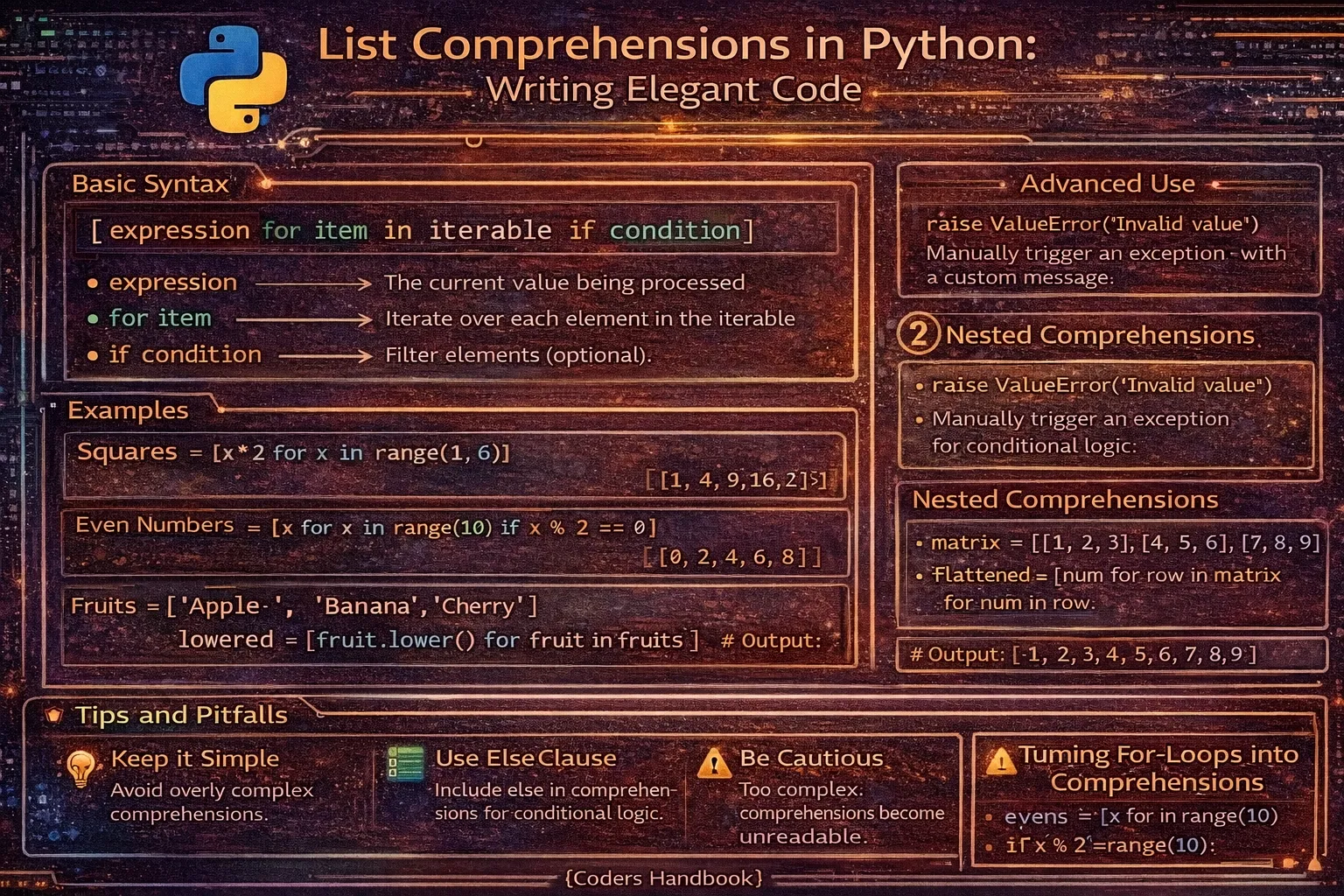
List comprehensions are one of Python's most elegant features providing concise syntax for creating lists from existing iterables through transformation, filtering, and mapping operations in a single readable line. This syntactic sugar replaces verbose multi-line for loops with compact expressions that are not only more readable but often faster due to optimized internal implementation. List comprehensions embody Python's philosophy of beautiful, expressive code enabling developers to write transformations that are immediately understandable, reducing cognitive load while improving code maintainability and demonstrating mastery of Pythonic idioms valued in professional development.
This comprehensive guide explores basic list comprehension syntax with expression-for-in structure creating transformed lists, conditional comprehensions using if clauses for filtering elements, if-else expressions for conditional transformations, nested comprehensions iterating over multiple sequences including flattening nested structures, comprehensions with multiple conditions combining filtering logic, dictionary and set comprehensions applying similar patterns to other collection types, performance characteristics comparing comprehensions to traditional loops demonstrating speed advantages, readability considerations balancing elegance with complexity, and best practices including when to prefer traditional loops over comprehensions. Whether you're processing data transforming API responses, filtering user input, generating mathematical sequences, restructuring nested data, or building pipelines manipulating collections, mastering list comprehensions provides essential tools for writing concise, efficient, and Pythonic code that expresses intent clearly while leveraging Python's optimized internal iteration mechanisms for superior performance.
Basic List Comprehension Syntax
The fundamental list comprehension syntax follows the pattern [expression for item in iterable] where the expression transforms each item, the for clause iterates through the iterable, and square brackets create a new list. This concise form replaces traditional for loops that initialize empty lists and append items, reducing multiple lines to one readable expression while maintaining or improving performance through optimized implementation.
# Basic List Comprehension Syntax

# Traditional for loop approach
numbers = [1, 2, 3, 4, 5]
squares = []
for n in numbers:
    squares.append(n ** 2)
print(squares)  # Output: [1, 4, 9, 16, 25]

# List comprehension equivalent (more concise)
squares = [n ** 2 for n in numbers]
print(squares)  # Output: [1, 4, 9, 16, 25]

# Basic syntax: [expression for item in iterable]
# Create list of doubled values
doubled = [x * 2 for x in [1, 2, 3, 4, 5]]
print(doubled)  # Output: [2, 4, 6, 8, 10]

# String manipulation
words = ['hello', 'world', 'python']
uppercase = [word.upper() for word in words]
print(uppercase)  # Output: ['HELLO', 'WORLD', 'PYTHON']

# Get lengths
lengths = [len(word) for word in words]
print(lengths)  # Output: [5, 5, 6]

# Range with transformation
squares = [i ** 2 for i in range(10)]
print(squares)  # Output: [0, 1, 4, 9, 16, 25, 36, 49, 64, 81]

# Method calls
names = ['alice', 'bob', 'charlie']
capitalized = [name.capitalize() for name in names]
print(capitalized)  # Output: ['Alice', 'Bob', 'Charlie']

# Mathematical operations
values = [1, 2, 3, 4, 5]
results = [x * 2 + 10 for x in values]
print(results)  # Output: [12, 14, 16, 18, 20]

# Extract attributes
class Person:
    def __init__(self, name, age):
        self.name = name
        self.age = age

people = [Person('Alice', 25), Person('Bob', 30)]
names = [person.name for person in people]
print(names)  # Output: ['Alice', 'Bob']

# Tuple unpacking in comprehension
points = [(1, 2), (3, 4), (5, 6)]
x_coords = [x for x, y in points]
print(x_coords)  # Output: [1, 3, 5]

# Using functions
def process(x):
    return x ** 3

cubes = [process(n) for n in range(1, 6)]
print(cubes)  # Output: [1, 8, 27, 64, 125]

# String operations
sentence = "hello world"
chars = [c.upper() for c in sentence]
print(chars)  # Output: ['H', 'E', 'L', 'L', 'O', ' ', 'W', 'O', 'R', 'L', 'D']

# Convert types
string_numbers = ['1', '2', '3', '4']
integers = [int(s) for s in string_numbers]
print(integers)  # Output: [1, 2, 3, 4]

# Create objects
user_dicts = [{'id': i, 'name': f'User{i}'} for i in range(1, 4)]
print(user_dicts)
# Output: [{'id': 1, 'name': 'User1'}, {'id': 2, 'name': 'User2'}, ...][expression for item in iterable] should be readable at a glance. If it's getting complex, consider using a regular loop instead.Conditional List Comprehensions
Conditional comprehensions add filtering logic using if clauses that select which items to include, following the pattern [expression for item in iterable if condition]. For conditional transformations rather than filtering, the if-else expression moves before the for clause: [true_expr if condition else false_expr for item in iterable]. Understanding when to use filtering conditions versus conditional expressions enables precise list creation matching specific requirements.
# Conditional List Comprehensions

# Filtering with if clause (at the end)
# Pattern: [expression for item in iterable if condition]

# Filter even numbers
numbers = [1, 2, 3, 4, 5, 6, 7, 8, 9, 10]
evens = [n for n in numbers if n % 2 == 0]
print(evens)  # Output: [2, 4, 6, 8, 10]

# Filter odd numbers
odds = [n for n in numbers if n % 2 != 0]
print(odds)  # Output: [1, 3, 5, 7, 9]

# Filter with transformation
evens_squared = [n ** 2 for n in numbers if n % 2 == 0]
print(evens_squared)  # Output: [4, 16, 36, 64, 100]

# Filter strings by length
words = ['a', 'to', 'cat', 'python', 'code', 'hi']
long_words = [word for word in words if len(word) > 3]
print(long_words)  # Output: ['python', 'code']

# Filter positive numbers
values = [-5, -2, 0, 3, 7, -1, 10]
positive = [x for x in values if x > 0]
print(positive)  # Output: [3, 7, 10]

# Conditional transformation with if-else (at the beginning)
# Pattern: [true_expr if condition else false_expr for item in iterable]

# Label numbers as even or odd
numbers = [1, 2, 3, 4, 5]
labels = ['even' if n % 2 == 0 else 'odd' for n in numbers]
print(labels)  # Output: ['odd', 'even', 'odd', 'even', 'odd']

# Replace negative values with zero
values = [-5, 10, -3, 7, -1]
processed = [x if x >= 0 else 0 for x in values]
print(processed)  # Output: [0, 10, 0, 7, 0]

# Absolute values (custom)
abs_values = [x if x >= 0 else -x for x in values]
print(abs_values)  # Output: [5, 10, 3, 7, 1]

# Categorize numbers
numbers = [1, 5, 10, 15, 20, 25]
categories = ['small' if n < 10 else 'large' for n in numbers]
print(categories)  # Output: ['small', 'small', 'large', 'large', 'large', 'large']

# Multiple conditions (chained)
numbers = range(1, 21)
multiples = [n for n in numbers if n % 3 == 0 if n % 5 == 0]
print(multiples)  # Output: [15] (divisible by both 3 and 5)

# Equivalent using and
multiples = [n for n in numbers if n % 3 == 0 and n % 5 == 0]
print(multiples)  # Output: [15]

# Filter and transform
words = ['Hello', 'WORLD', 'Python', 'CODE']
lowercase_long = [w.lower() for w in words if len(w) > 4]
print(lowercase_long)  # Output: ['hello', 'world', 'python']

# Nested if-else
numbers = [1, 2, 3, 4, 5, 6, 7, 8, 9, 10]
labels = [
    'divisible by 3' if n % 3 == 0 else
    'divisible by 2' if n % 2 == 0 else
    'other'
    for n in numbers
]
print(labels)

# Practical: Filter valid emails
emails = ['[email protected]', 'invalid', '[email protected]', 'no-at-sign']
valid_emails = [email for email in emails if '@' in email and '.' in email]
print(valid_emails)  # Output: ['[email protected]', '[email protected]']

# Extract and filter
users = [
    {'name': 'Alice', 'age': 25, 'active': True},
    {'name': 'Bob', 'age': 17, 'active': False},
    {'name': 'Charlie', 'age': 30, 'active': True}
]
active_adult_names = [u['name'] for u in users if u['age'] >= 18 and u['active']]
print(active_adult_names) # Output: ['Alice', 'Charlie']if at the end: [x for x in items if condition]. Conditional transformation uses if-else before for: [x if condition else y for x in items].Nested List Comprehensions
Nested list comprehensions contain multiple for clauses iterating over multiple sequences, useful for flattening nested lists, creating matrices, or generating combinations. The syntax reads left to right with outer loops first: [expression for outer in outer_list for inner in inner_list]. While powerful, nested comprehensions quickly become hard to read, suggesting traditional nested loops might be clearer for complex operations.
# Nested List Comprehensions

# Flatten nested list
nested = [[1, 2, 3], [4, 5, 6], [7, 8, 9]]
flattened = [num for sublist in nested for num in sublist]
print(flattened)  # Output: [1, 2, 3, 4, 5, 6, 7, 8, 9]

# Traditional nested loops equivalent
flattened = []
for sublist in nested:
    for num in sublist:
        flattened.append(num)

# Create coordinate pairs
coords = [(x, y) for x in range(3) for y in range(3)]
print(coords)
# Output: [(0,0), (0,1), (0,2), (1,0), (1,1), (1,2), (2,0), (2,1), (2,2)]

# Matrix creation
matrix = [[i * j for j in range(1, 4)] for i in range(1, 4)]
print(matrix)
# Output: [[1, 2, 3], [2, 4, 6], [3, 6, 9]]

# Transpose matrix
matrix = [[1, 2, 3], [4, 5, 6], [7, 8, 9]]
transposed = [[row[i] for row in matrix] for i in range(len(matrix[0]))]
print(transposed)
# Output: [[1, 4, 7], [2, 5, 8], [3, 6, 9]]

# Cartesian product
colors = ['red', 'blue']
sizes = ['S', 'M', 'L']
products = [(color, size) for color in colors for size in sizes]
print(products)
# Output: [('red', 'S'), ('red', 'M'), ('red', 'L'),
#          ('blue', 'S'), ('blue', 'M'), ('blue', 'L')]

# Flatten with condition
nested = [[1, 2, 3], [4, 5, 6], [7, 8, 9]]
evens = [num for sublist in nested for num in sublist if num % 2 == 0]
print(evens)  # Output: [2, 4, 6, 8]

# Nested with multiple conditions
matrix = [[1, 2, 3], [4, 5, 6], [7, 8, 9]]
result = [num for row in matrix for num in row if num > 3 if num < 8]
print(result)  # Output: [4, 5, 6, 7]

# String manipulation
words = ['hello', 'world']
chars = [char for word in words for char in word]
print(chars)  # Output: ['h', 'e', 'l', 'l', 'o', 'w', 'o', 'r', 'l', 'd']

# Extract from nested dictionaries
data = [
    {'name': 'Alice', 'scores': [85, 90, 88]},
    {'name': 'Bob', 'scores': [92, 88, 95]}
]
all_scores = [score for person in data for score in person['scores']]
print(all_scores)  # Output: [85, 90, 88, 92, 88, 95]

# Complex example: Generate multiplication table
table = [[f"{i}x{j}={i*j}" for j in range(1, 6)] for i in range(1, 6)]
for row in table:
    print(row)
# Output:
# ['1x1=1', '1x2=2', '1x3=3', '1x4=4', '1x5=5']
# ['2x1=2', '2x2=4', '2x3=6', '2x4=8', '2x5=10']
# ...

# Flatten deeply nested structure
deep_nested = [[[1, 2], [3, 4]], [[5, 6], [7, 8]]]
flattened = [num for outer in deep_nested for middle in outer for num in middle]
print(flattened)  # Output: [1, 2, 3, 4, 5, 6, 7, 8]

# When it gets too complex, use regular loops!
# This is hard to read:
result = [x*y for x in range(10) for y in range(10) if x*y > 50 if x > y]

# Better as nested loops:
result = []
for x in range(10):
    for y in range(10):
        if x * y > 50 and x > y:
result.append(x * y)Dictionary and Set Comprehensions
Python extends comprehension syntax to dictionaries using {key: value for item in iterable} and sets using {expression for item in iterable}. Dictionary comprehensions create dictionaries efficiently, perfect for transforming data structures or creating lookups. Set comprehensions create unique value collections, automatically deduplicating items. Both follow similar patterns to list comprehensions but produce different collection types suited to specific use cases.
# Dictionary and Set Comprehensions

# === Dictionary Comprehensions ===
# Pattern: {key: value for item in iterable}

# Create dictionary from lists
names = ['Alice', 'Bob', 'Charlie']
ages = [25, 30, 35]
people = {name: age for name, age in zip(names, ages)}
print(people)  # Output: {'Alice': 25, 'Bob': 30, 'Charlie': 35}

# Square numbers dictionary
squares = {x: x**2 for x in range(1, 6)}
print(squares)  # Output: {1: 1, 2: 4, 3: 9, 4: 16, 5: 25}

# Invert dictionary (swap keys and values)
original = {'a': 1, 'b': 2, 'c': 3}
inverted = {value: key for key, value in original.items()}
print(inverted)  # Output: {1: 'a', 2: 'b', 3: 'c'}

# Filter dictionary
scores = {'Alice': 85, 'Bob': 92, 'Charlie': 78, 'Diana': 95}
passed = {name: score for name, score in scores.items() if score >= 80}
print(passed)  # Output: {'Alice': 85, 'Bob': 92, 'Diana': 95}

# Transform dictionary values
prices = {'apple': 1.2, 'banana': 0.5, 'orange': 1.5}
with_tax = {item: price * 1.08 for item, price in prices.items()}
print(with_tax)

# Transform dictionary keys
data = {'Name': 'Alice', 'Age': 25, 'City': 'NYC'}
lowercase_keys = {k.lower(): v for k, v in data.items()}
print(lowercase_keys)  # Output: {'name': 'Alice', 'age': 25, 'city': 'NYC'}

# Create lookup dictionary
users = [{'id': 1, 'name': 'Alice'}, {'id': 2, 'name': 'Bob'}]
user_lookup = {user['id']: user for user in users}
print(user_lookup)
# Output: {1: {'id': 1, 'name': 'Alice'}, 2: {'id': 2, 'name': 'Bob'}}

# Count occurrences
words = ['apple', 'banana', 'apple', 'cherry', 'banana', 'apple']
word_count = {word: words.count(word) for word in words}
print(word_count)  # Output: {'apple': 3, 'banana': 2, 'cherry': 1}

# Better: Use collections.Counter for counting
from collections import Counter
word_count = Counter(words)

# Conditional dictionary comprehension
numbers = [1, 2, 3, 4, 5]
labeled = {n: 'even' if n % 2 == 0 else 'odd' for n in numbers}
print(labeled)  # Output: {1: 'odd', 2: 'even', 3: 'odd', 4: 'even', 5: 'odd'}

# === Set Comprehensions ===
# Pattern: {expression for item in iterable}

# Create set of squares
squares = {x**2 for x in range(10)}
print(squares)  # Output: {0, 1, 4, 9, 16, 25, 36, 49, 64, 81}

# Extract unique values
numbers = [1, 2, 2, 3, 3, 3, 4, 4, 4, 4]
unique = {x for x in numbers}
print(unique)  # Output: {1, 2, 3, 4}

# Set with transformation
words = ['hello', 'world', 'hello', 'python']
unique_lengths = {len(word) for word in words}
print(unique_lengths)  # Output: {5, 6}

# Filter and create set
numbers = range(20)
multiples_of_3 = {n for n in numbers if n % 3 == 0}
print(multiples_of_3)  # Output: {0, 3, 6, 9, 12, 15, 18}

# Set of first letters
names = ['Alice', 'Bob', 'Charlie', 'Alice', 'David']
first_letters = {name[0] for name in names}
print(first_letters)  # Output: {'A', 'B', 'C', 'D'}

# Flatten and deduplicate
nested = [[1, 2, 2], [3, 3, 4], [4, 5, 5]]
unique_nums = {num for sublist in nested for num in sublist}
print(unique_nums)  # Output: {1, 2, 3, 4, 5}

# Complex filtering
words = ['Python', 'is', 'awesome', 'and', 'powerful']
long_word_chars = {char.lower() for word in words if len(word) > 3 for char in word}
print(long_word_chars)
Performance and Best Practices
List comprehensions are generally faster than equivalent for loops because Python optimizes their internal implementation, avoiding repeated attribute lookups and function calls. However, performance advantages diminish with complex logic, and readability should trump minor speed gains. Best practices include keeping comprehensions simple and readable, preferring traditional loops when logic becomes complex, avoiding side effects, and recognizing when generator expressions might be more memory-efficient for large sequences.
# Performance and Best Practices

import time

# Performance comparison
def timing_comparison():
    """Compare for loop vs list comprehension performance."""

    # For loop
    start = time.time()
    result = []
    for i in range(1000000):
        result.append(i * 2)
    loop_time = time.time() - start

    # List comprehension
    start = time.time()
    result = [i * 2 for i in range(1000000)]
    comp_time = time.time() - start

    print(f"For loop: {loop_time:.4f}s")
    print(f"List comp: {comp_time:.4f}s")
    print(f"Speedup: {loop_time/comp_time:.2f}x")

# List comprehension is typically 20-30% faster

# GOOD: Simple and readable
squares = [x**2 for x in range(10)]
evens = [x for x in range(20) if x % 2 == 0]
uppercase = [s.upper() for s in ['hello', 'world']]

# BAD: Too complex, hard to read
result = [x*y for x in range(10) for y in range(10)
          if x > y if x*y > 50 if x % 2 == 0]

# Better as regular loop:
result = []
for x in range(10):
    if x % 2 == 0:
        for y in range(10):
            if x > y and x * y > 50:
                result.append(x * y)

# AVOID: Side effects in comprehensions
# Don't do this:
values = []
[values.append(x) for x in range(10)]  # Creates list of None

# Use regular loop for side effects:
for x in range(10):
    values.append(x)

# Use generator expressions for memory efficiency
# List comprehension (creates entire list in memory)
large_list = [x**2 for x in range(1000000)]

# Generator expression (generates values on demand)
large_gen = (x**2 for x in range(1000000))

# Good for sum, max, any, etc.
total = sum(x**2 for x in range(1000000))  # Memory efficient

# Best practices checklist:
# ✓ Keep it simple and readable
# ✓ Use for simple transformations and filtering
# ✓ One or two levels of nesting maximum
# ✓ Avoid side effects
# ✓ Consider generator expressions for large data
# ✗ Don't use for complex logic
# ✗ Don't use when regular loops are clearer
# ✗ Don't use for executing functions with side effects

# When to use list comprehension:
# - Simple transformation: [x * 2 for x in nums]
# - Simple filtering: [x for x in nums if x > 0]
# - Mapping: [str(x) for x in nums]
# - Extract attributes: [obj.name for obj in objects]

# When to use regular loops:
# - Complex logic requiring multiple statements
# - Operations with side effects
# - Multiple conditions making comprehension unclear
# - When readability suffers

# Memory: Use generator expressions
# Instead of:
numbers = [x for x in range(10000000)]  # Uses lots of memory
for num in numbers:
    process(num)

# Use:
for num in (x for x in range(10000000)):  # Memory efficient
    process(num)

# Or simply:
for num in range(10000000):
    process(num)
Best Practices Summary
- Keep it simple: List comprehensions should be readable at a glance. If you need to think hard to understand it, use a regular loop
- Limit nesting: Maximum two levels of nesting. Beyond that, comprehensions become unreadable and hard to debug
- No side effects: Don't use comprehensions for operations with side effects like printing, writing files, or modifying external state
- Use for transformations: Comprehensions are perfect for transforming one list into another: mapping, filtering, or extracting attributes
- Conditional placement matters: Filtering uses
ifat end. Conditional values use if-else before for clause - Consider generator expressions: Use
(x for x in items)instead of[x for x in items]for large datasets to save memory - Don't overuse: Not every loop needs to be a comprehension. Use them when they improve clarity, not just to show off
- Performance is secondary: While comprehensions are faster, the difference is usually negligible. Prioritize readability
- Document complex ones: If a comprehension needs explanation, add a comment or better yet, refactor to regular loop
- Use dict/set comprehensions: Don't limit yourself to lists. Dict and set comprehensions are equally powerful and Pythonic
Conclusion
List comprehensions are Python's elegant syntax for creating lists through transformation, filtering, and mapping operations using the pattern [expression for item in iterable] replacing verbose for loops with concise single-line expressions. Conditional comprehensions enable filtering with if clauses at the end [x for x in items if condition] or conditional transformations with if-else before the for clause [x if condition else y for x in items], providing precise control over which items to include and how to transform them. Nested comprehensions using multiple for clauses like [item for outer in outer_list for item in inner_list] flatten nested structures, generate combinations, and create matrices, though readability decreases rapidly beyond two nesting levels suggesting traditional nested loops for complex operations.
Dictionary comprehensions {key: value for item in iterable} and set comprehensions {expression for item in iterable} extend the pattern to other collection types, enabling efficient dictionary transformations, inversions, lookups, and set-based unique value extraction with automatic deduplication. Performance comparisons show list comprehensions typically run 20-30% faster than equivalent for loops due to optimized internal implementation, though advantages diminish with complex logic and readability should always trump minor performance gains. Best practices emphasize keeping comprehensions simple and readable preferring them for straightforward transformations and filtering, limiting nesting to two levels maximum, avoiding side effects like printing or file writing, using generator expressions for memory efficiency with large datasets, recognizing when traditional loops provide better clarity, and understanding that Pythonic code values readability over cleverness. By mastering basic comprehension syntax for simple transformations, conditional patterns for filtering and conditional values, nested comprehensions for multiple iterations while respecting complexity limits, dictionary and set variants for appropriate collection types, and performance characteristics balanced with readability considerations, you gain powerful tools for writing concise, efficient, and Pythonic code that transforms data elegantly while maintaining the clarity and maintainability essential for professional software development.
$ share --platform
$ cat /comments/ (0)
$ cat /comments/
// No comments found. Be the first!