Tauri 2.0 WebRTC Video and Audio Streaming
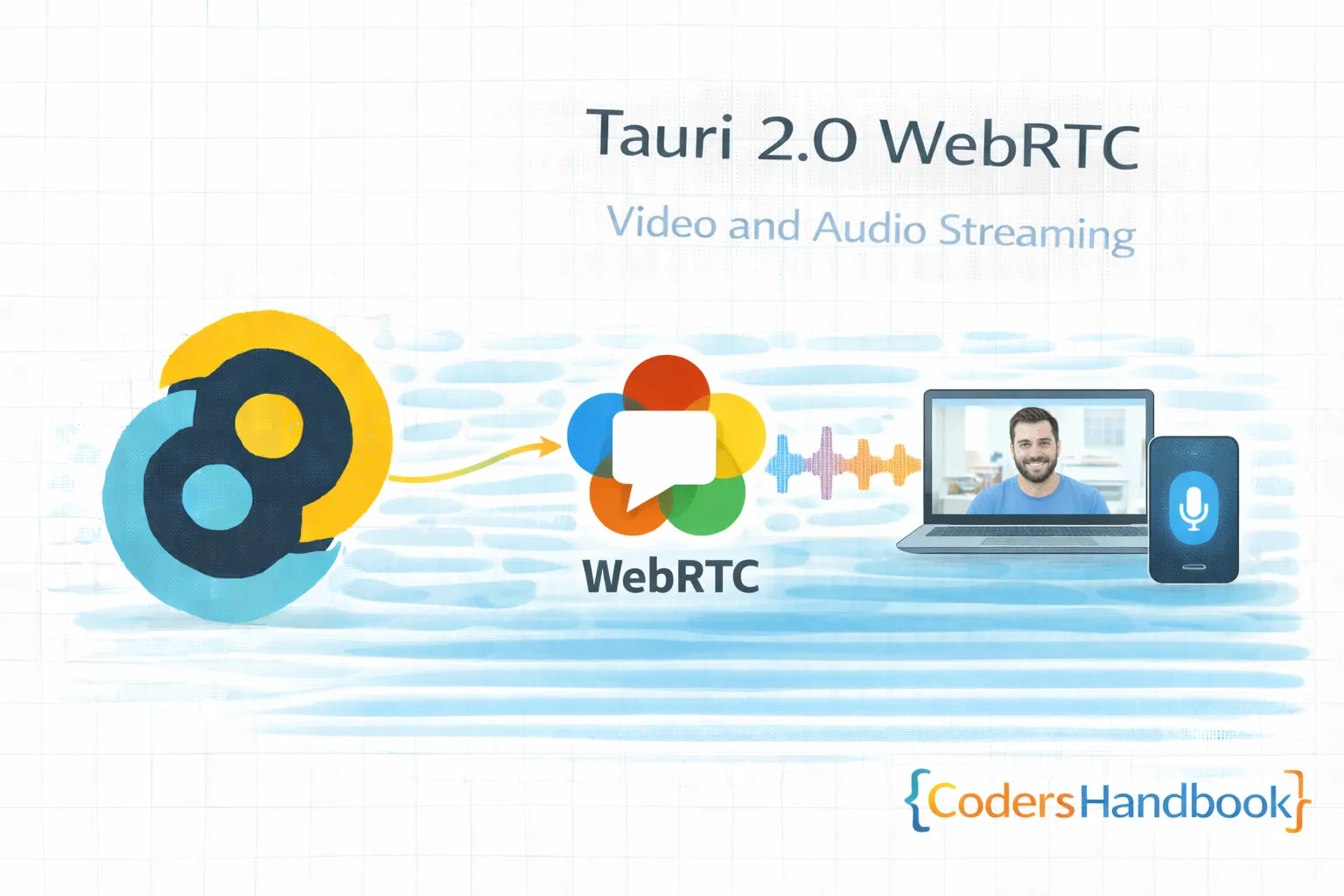
WebRTC integration in Tauri 2.0 enables real-time video and audio communication creating peer-to-peer connections for streaming media—essential technology for building communication applications, video conferencing tools, screen sharing features, and collaborative platforms maintaining low-latency connections users expect. WebRTC combines peer-to-peer connections establishing direct media streams between clients, signaling servers coordinating connection establishment, media streaming capturing and transmitting video and audio, ICE candidates handling NAT traversal and firewall issues, data channels enabling arbitrary data exchange, and browser APIs integrating with web technologies delivering comprehensive real-time communication solution. This comprehensive guide covers understanding WebRTC architecture and signaling flow, implementing peer-to-peer video calls with camera access, building audio streaming with microphone capture, screen sharing functionality capturing desktop content, establishing signaling server for connection coordination, handling ICE candidates and STUN/TURN servers, implementing data channels for chat and file transfer, troubleshooting connection issues and firewall problems, and real-world examples including video chat application, screen sharing tool, and multi-party conferencing maintaining professional real-time communication through proper WebRTC implementation. Mastering WebRTC patterns enables building communication applications delivering real-time experiences. Before proceeding, understand IPC communication, HTTP client, and web development fundamentals.
WebRTC Architecture Fundamentals
WebRTC provides peer-to-peer real-time communication in browsers. Understanding WebRTC architecture enables implementing direct media connections maintaining low latency through browser APIs and peer-to-peer technology.
// WebRTC Architecture Overview

// Core components:

// 1. RTCPeerConnection
//    - Manages peer-to-peer connection
//    - Handles ICE candidates
//    - Establishes media streams

// 2. getUserMedia() / getDisplayMedia()
//    - Captures camera/microphone
//    - Captures screen content
//    - Returns MediaStream

// 3. Signaling Server
//    - Exchanges connection information (SDP)
//    - Coordinates ICE candidates
//    - Not part of WebRTC spec (implementation choice)

// 4. STUN/TURN Servers
//    - STUN: Discovers public IP address
//    - TURN: Relays traffic when P2P fails

// Connection establishment flow:

// Peer A (Caller)                    Signaling Server                    Peer B (Callee)
//    |                                      |                                      |
//    | 1. Create RTCPeerConnection          |                                      |
//    |---------------------------------->   |                                      |
//    |                                      |                                      |
//    | 2. Create Offer (SDP)                |                                      |
//    |---------------------------------->   |                                      |
//    |                                      |                                      |
//    | 3. Send Offer via signaling          |                                      |
//    |====================================> |                                      |
//    |                                      | ====================================>|
//    |                                      |                  4. Receive Offer   |
//    |                                      |                                      |
//    |                                      |                  5. Create Answer   |
//    |                                      | <====================================|
//    | 6. Receive Answer                    |                                      |
//    | <====================================|                                      |
//    |                                      |                                      |
//    | 7. Exchange ICE candidates           |                                      |
//    | <===================================>|<===================================> |
//    |                                      |                                      |
//    | 8. Establish P2P connection          |                                      |
//    |<===================================================================>        |
//    |                                      |                                      |
//    | 9. Media streaming (direct)          |                                      |
//    |<===================================================================>        |

// Basic WebRTC setup in Tauri frontend

// Get user media (camera/microphone)
const getUserMedia = async () => {
  try {
    const stream = await navigator.mediaDevices.getUserMedia({
      video: {
        width: { ideal: 1280 },
        height: { ideal: 720 },
        frameRate: { ideal: 30 }
      },
      audio: {
        echoCancellation: true,
        noiseSuppression: true,
        autoGainControl: true
      }
    });

    return stream;
  } catch (error) {
    console.error('Error accessing media devices:', error);
    throw error;
  }
};

// Get display media (screen sharing)
const getDisplayMedia = async () => {
  try {
    const stream = await navigator.mediaDevices.getDisplayMedia({
      video: {
        cursor: 'always'
      },
      audio: false  // Some browsers support audio
    });

    return stream;
  } catch (error) {
    console.error('Error capturing screen:', error);
    throw error;
  }
};

// Create RTCPeerConnection
const createPeerConnection = () => {
  const configuration = {
    iceServers: [
      // Google's public STUN server
      { urls: 'stun:stun.l.google.com:19302' },
      { urls: 'stun:stun1.l.google.com:19302' },

      // TURN server (if needed)
      {
        urls: 'turn:your-turn-server.com:3478',
        username: 'username',
        credential: 'password'
      }
    ]
  };

  const peerConnection = new RTCPeerConnection(configuration);

  return peerConnection;
};

// Session Description Protocol (SDP)
// Contains:
// - Media formats (codecs)
// - Network information
// - Session timing
// - Encryption keys

// ICE (Interactive Connectivity Establishment)
// Candidates types:
// - Host: Local IP address
// - Server Reflexive (srflx): Public IP via STUN
// - Relay: TURN server address

// NAT Traversal strategies:
// 1. STUN: Discover public IP for direct connection
// 2. TURN: Relay traffic through server (fallback)
// 3. ICE: Try all candidates, use best one
Implementing Video Calls
Video calls require camera access, peer connection establishment, and media stream handling. Understanding video call implementation enables building one-on-one video chat maintaining audio-video synchronization through proper WebRTC configuration.
// src/App.jsx - Video call component
import { invoke } from '@tauri-apps/api/core';
import { useState, useRef, useEffect } from 'react';

function VideoCall() {
  const [isCallActive, setIsCallActive] = useState(false);
  const [isMuted, setIsMuted] = useState(false);
  const [isVideoOff, setIsVideoOff] = useState(false);

  const localVideoRef = useRef(null);
  const remoteVideoRef = useRef(null);
  const peerConnectionRef = useRef(null);
  const localStreamRef = useRef(null);
  const signalingSocketRef = useRef(null);

  // Initialize WebRTC
  useEffect(() => {
    initializeSignaling();

    return () => {
      cleanup();
    };
  }, []);

  const initializeSignaling = async () => {
    // Connect to signaling server (WebSocket)
    const socket = new WebSocket('ws://localhost:8080');

    socket.onopen = () => {
      console.log('Signaling connection established');
    };

    socket.onmessage = async (event) => {
      const data = JSON.parse(event.data);
      await handleSignalingMessage(data);
    };

    signalingSocketRef.current = socket;
  };

  const startCall = async () => {
    try {
      // Get local media stream
      const stream = await navigator.mediaDevices.getUserMedia({
        video: true,
        audio: true
      });

      localStreamRef.current = stream;
      localVideoRef.current.srcObject = stream;

      // Create peer connection
      const peerConnection = new RTCPeerConnection({
        iceServers: [
          { urls: 'stun:stun.l.google.com:19302' }
        ]
      });

      // Add local stream tracks to peer connection
      stream.getTracks().forEach(track => {
        peerConnection.addTrack(track, stream);
      });

      // Handle remote stream
      peerConnection.ontrack = (event) => {
        if (remoteVideoRef.current) {
          remoteVideoRef.current.srcObject = event.streams[0];
        }
      };

      // Handle ICE candidates
      peerConnection.onicecandidate = (event) => {
        if (event.candidate) {
          sendSignalingMessage({
            type: 'ice-candidate',
            candidate: event.candidate
          });
        }
      };

      // Handle connection state changes
      peerConnection.onconnectionstatechange = () => {
        console.log('Connection state:', peerConnection.connectionState);

        if (peerConnection.connectionState === 'failed') {
          console.error('Connection failed');
          endCall();
        }
      };

      peerConnectionRef.current = peerConnection;

      // Create and send offer
      const offer = await peerConnection.createOffer();
      await peerConnection.setLocalDescription(offer);

      sendSignalingMessage({
        type: 'offer',
        sdp: offer
      });

      setIsCallActive(true);
    } catch (error) {
      console.error('Error starting call:', error);
      alert('Failed to start call: ' + error.message);
    }
  };

  const handleSignalingMessage = async (data) => {
    const peerConnection = peerConnectionRef.current;

    if (!peerConnection) {
      console.warn('Peer connection not initialized');
      return;
    }

    switch (data.type) {
      case 'offer':
        // Received offer from remote peer
        await peerConnection.setRemoteDescription(
          new RTCSessionDescription(data.sdp)
        );

        // Create and send answer
        const answer = await peerConnection.createAnswer();
        await peerConnection.setLocalDescription(answer);

        sendSignalingMessage({
          type: 'answer',
          sdp: answer
        });

        setIsCallActive(true);
        break;

      case 'answer':
        // Received answer from remote peer
        await peerConnection.setRemoteDescription(
          new RTCSessionDescription(data.sdp)
        );
        break;

      case 'ice-candidate':
        // Received ICE candidate
        await peerConnection.addIceCandidate(
          new RTCIceCandidate(data.candidate)
        );
        break;

      case 'end-call':
        endCall();
        break;
    }
  };

  const sendSignalingMessage = (message) => {
    if (signalingSocketRef.current?.readyState === WebSocket.OPEN) {
      signalingSocketRef.current.send(JSON.stringify(message));
    }
  };

  const toggleMute = () => {
    if (localStreamRef.current) {
      const audioTrack = localStreamRef.current.getAudioTracks()[0];
      if (audioTrack) {
        audioTrack.enabled = !audioTrack.enabled;
        setIsMuted(!audioTrack.enabled);
      }
    }
  };

  const toggleVideo = () => {
    if (localStreamRef.current) {
      const videoTrack = localStreamRef.current.getVideoTracks()[0];
      if (videoTrack) {
        videoTrack.enabled = !videoTrack.enabled;
        setIsVideoOff(!videoTrack.enabled);
      }
    }
  };

  const endCall = () => {
    // Stop local stream
    if (localStreamRef.current) {
      localStreamRef.current.getTracks().forEach(track => track.stop());
      localStreamRef.current = null;
    }

    // Close peer connection
    if (peerConnectionRef.current) {
      peerConnectionRef.current.close();
      peerConnectionRef.current = null;
    }

    // Clear video elements
    if (localVideoRef.current) {
      localVideoRef.current.srcObject = null;
    }
    if (remoteVideoRef.current) {
      remoteVideoRef.current.srcObject = null;
    }

    // Notify remote peer
    sendSignalingMessage({ type: 'end-call' });

    setIsCallActive(false);
    setIsMuted(false);
    setIsVideoOff(false);
  };

  const cleanup = () => {
    endCall();

    if (signalingSocketRef.current) {
      signalingSocketRef.current.close();
    }
  };

  return (
    <div className="video-call">
      <div className="video-container">
        <video
          ref={remoteVideoRef}
          autoPlay
          playsInline
          className="remote-video"
        />

        <video
          ref={localVideoRef}
          autoPlay
          playsInline
          muted
          className="local-video"
        />
      </div>

      <div className="controls">
        {!isCallActive ? (
          <button onClick={startCall}>Start Call</button>
        ) : (
          <>
            <button onClick={toggleMute}>
              {isMuted ? 'Unmute' : 'Mute'}
            </button>
            <button onClick={toggleVideo}>
              {isVideoOff ? 'Start Video' : 'Stop Video'}
            </button>
            <button onClick={endCall} className="end-call">
              End Call
            </button>
          </>
        )}
      </div>
    </div>
  );
}

export default VideoCall;
Signaling Server Implementation
Signaling servers coordinate connection establishment between peers. Understanding signaling implementation enables building server infrastructure handling offer/answer exchange maintaining peer coordination through WebSocket communication.
// signaling-server.js - Simple Node.js signaling server

const WebSocket = require('ws');
const express = require('express');
const http = require('http');

const app = express();
const server = http.createServer(app);
const wss = new WebSocket.Server({ server });

// Store connected clients
const clients = new Map();

wss.on('connection', (ws) => {
  // Generate unique client ID
  const clientId = generateId();
  clients.set(clientId, ws);

  console.log(`Client ${clientId} connected. Total clients: ${clients.size}`);

  // Send client ID to the client
  ws.send(JSON.stringify({
    type: 'connected',
    clientId: clientId
  }));

  ws.on('message', (message) => {
    try {
      const data = JSON.parse(message);
      handleMessage(clientId, data);
    } catch (error) {
      console.error('Error parsing message:', error);
    }
  });

  ws.on('close', () => {
    console.log(`Client ${clientId} disconnected`);
    clients.delete(clientId);

    // Notify other clients
    broadcast(clientId, {
      type: 'peer-disconnected',
      clientId: clientId
    });
  });

  ws.on('error', (error) => {
    console.error(`WebSocket error for client ${clientId}:`, error);
  });
});

function handleMessage(senderId, data) {
  const { type, targetId, ...payload } = data;

  switch (type) {
    case 'offer':
    case 'answer':
    case 'ice-candidate':
      // Forward signaling message to target peer
      if (targetId && clients.has(targetId)) {
        const targetWs = clients.get(targetId);
        targetWs.send(JSON.stringify({
          type: type,
          senderId: senderId,
          ...payload
        }));
      }
      break;

    case 'get-peers':
      // Send list of available peers
      const peers = Array.from(clients.keys())
        .filter(id => id !== senderId);

      const ws = clients.get(senderId);
      ws.send(JSON.stringify({
        type: 'peers-list',
        peers: peers
      }));
      break;

    default:
      console.log(`Unknown message type: ${type}`);
  }
}

function broadcast(excludeId, message) {
  clients.forEach((ws, clientId) => {
    if (clientId !== excludeId && ws.readyState === WebSocket.OPEN) {
      ws.send(JSON.stringify(message));
    }
  });
}

function generateId() {
  return Math.random().toString(36).substring(2, 15);
}

const PORT = process.env.PORT || 8080;
server.listen(PORT, () => {
  console.log(`Signaling server running on port ${PORT}`);
});

// Enhanced signaling with rooms (for multi-party calls)

class Room {
  constructor(id) {
    this.id = id;
    this.participants = new Map();
  }

  addParticipant(clientId, ws) {
    this.participants.set(clientId, ws);

    // Notify existing participants
    this.broadcast(clientId, {
      type: 'participant-joined',
      participantId: clientId
    });
  }

  removeParticipant(clientId) {
    this.participants.delete(clientId);

    this.broadcast(clientId, {
      type: 'participant-left',
      participantId: clientId
    });
  }

  broadcast(excludeId, message) {
    this.participants.forEach((ws, clientId) => {
      if (clientId !== excludeId && ws.readyState === WebSocket.OPEN) {
        ws.send(JSON.stringify(message));
      }
    });
  }

  getParticipants() {
    return Array.from(this.participants.keys());
  }
}

const rooms = new Map();

function handleRoomMessage(senderId, data) {
  const { type, roomId, ...payload } = data;

  switch (type) {
    case 'join-room':
      let room = rooms.get(roomId);
      if (!room) {
        room = new Room(roomId);
        rooms.set(roomId, room);
      }

      const ws = clients.get(senderId);
      room.addParticipant(senderId, ws);

      // Send current participants to new joiner
      ws.send(JSON.stringify({
        type: 'room-participants',
        participants: room.getParticipants().filter(id => id !== senderId)
      }));
      break;

    case 'leave-room':
      const existingRoom = rooms.get(roomId);
      if (existingRoom) {
        existingRoom.removeParticipant(senderId);

        if (existingRoom.participants.size === 0) {
          rooms.delete(roomId);
        }
      }
      break;
  }
}

// Rust signaling server using Tauri backend
// src-tauri/src/signaling.rs

use tokio_tungstenite::{accept_async, tungstenite::Message};
use futures_util::{StreamExt, SinkExt};
use std::collections::HashMap;
use std::sync::{Arc, Mutex};

type Clients = Arc<Mutex<HashMap<String, tokio::sync::mpsc::UnboundedSender<Message>>>>;

pub async fn start_signaling_server(port: u16) {
    let clients: Clients = Arc::new(Mutex::new(HashMap::new()));

    let addr = format!("127.0.0.1:{}", port);
    let listener = tokio::net::TcpListener::bind(&addr).await.unwrap();

    println!("Signaling server listening on {}", addr);

    while let Ok((stream, _)) = listener.accept().await {
        let clients = clients.clone();

        tokio::spawn(async move {
            handle_connection(stream, clients).await;
        });
    }
}

async fn handle_connection(
    stream: tokio::net::TcpStream,
    clients: Clients
) {
    let ws_stream = accept_async(stream).await.unwrap();
    let (mut ws_sender, mut ws_receiver) = ws_stream.split();

    let client_id = uuid::Uuid::new_v4().to_string();

    let (tx, mut rx) = tokio::sync::mpsc::unbounded_channel();
    clients.lock().unwrap().insert(client_id.clone(), tx);

    // Send messages from channel to WebSocket
    tokio::spawn(async move {
        while let Some(msg) = rx.recv().await {
            if ws_sender.send(msg).await.is_err() {
                break;
            }
        }
    });

    // Handle incoming messages
    while let Some(msg) = ws_receiver.next().await {
        if let Ok(msg) = msg {
            if let Message::Text(text) = msg {
                // Handle signaling message
                // Forward to target peer
            }
        }
    }

    // Cleanup
    clients.lock().unwrap().remove(&client_id);
}
Screen Sharing Implementation
Screen sharing captures desktop content for remote viewing. Understanding screen capture enables implementing desktop sharing maintaining video quality through proper media stream configuration and display media API.
// Screen sharing component
import { useState, useRef } from 'react';

function ScreenShare() {
  const [isSharing, setIsSharing] = useState(false);
  const videoRef = useRef(null);
  const streamRef = useRef(null);
  const peerConnectionRef = useRef(null);

  const startScreenShare = async () => {
    try {
      // Request screen capture
      const stream = await navigator.mediaDevices.getDisplayMedia({
        video: {
          cursor: 'always',  // Include cursor
          displaySurface: 'monitor',  // Prefer full monitor
          logicalSurface: true,
          width: { ideal: 1920 },
          height: { ideal: 1080 },
          frameRate: { ideal: 30 }
        },
        audio: {
          echoCancellation: true,
          noiseSuppression: true,
          sampleRate: 44100
        }
      });

      streamRef.current = stream;
      videoRef.current.srcObject = stream;

      // Handle stream ending (user stops sharing)
      stream.getVideoTracks()[0].addEventListener('ended', () => {
        stopScreenShare();
      });

      // Add stream to peer connection if exists
      if (peerConnectionRef.current) {
        replaceTrack(stream);
      }

      setIsSharing(true);
    } catch (error) {
      console.error('Error starting screen share:', error);

      if (error.name === 'NotAllowedError') {
        alert('Screen sharing permission denied');
      } else if (error.name === 'NotFoundError') {
        alert('No screen available to share');
      } else {
        alert('Failed to start screen sharing');
      }
    }
  };

  const stopScreenShare = () => {
    if (streamRef.current) {
      streamRef.current.getTracks().forEach(track => track.stop());
      streamRef.current = null;
      videoRef.current.srcObject = null;
    }

    setIsSharing(false);
  };

  const replaceTrack = async (newStream) => {
    const videoTrack = newStream.getVideoTracks()[0];

    const senders = peerConnectionRef.current.getSenders();
    const videoSender = senders.find(sender =>
      sender.track?.kind === 'video'
    );

    if (videoSender) {
      await videoSender.replaceTrack(videoTrack);
    }
  };

  return (
    <div className="screen-share">
      <video
        ref={videoRef}
        autoPlay
        playsInline
        className="screen-preview"
      />

      {!isSharing ? (
        <button onClick={startScreenShare}>
          Start Screen Share
        </button>
      ) : (
        <button onClick={stopScreenShare}>
          Stop Screen Share
        </button>
      )}
    </div>
  );
}

// Combined camera and screen share with switching
function MediaSelector() {
  const [currentSource, setCurrentSource] = useState('camera');
  const videoRef = useRef(null);
  const streamRef = useRef(null);

  const switchToCamera = async () => {
    stopCurrentStream();

    const stream = await navigator.mediaDevices.getUserMedia({
      video: true,
      audio: true
    });

    videoRef.current.srcObject = stream;
    streamRef.current = stream;
    setCurrentSource('camera');
  };

  const switchToScreen = async () => {
    stopCurrentStream();

    const stream = await navigator.mediaDevices.getDisplayMedia({
      video: true,
      audio: true
    });

    videoRef.current.srcObject = stream;
    streamRef.current = stream;
    setCurrentSource('screen');
  };

  const stopCurrentStream = () => {
    if (streamRef.current) {
      streamRef.current.getTracks().forEach(track => track.stop());
    }
  };

  return (
    <div>
      <video ref={videoRef} autoPlay playsInline />

      <div className="source-selector">
        <button
          onClick={switchToCamera}
          disabled={currentSource === 'camera'}
        >
          Camera
        </button>

        <button
          onClick={switchToScreen}
          disabled={currentSource === 'screen'}
        >
          Screen
        </button>
      </div>
    </div>
  );
}

export default ScreenShare;
WebRTC Data Channels
Data channels enable arbitrary data exchange over peer connections. Understanding data channels enables implementing chat, file transfer, and real-time collaboration maintaining low-latency data transmission through peer-to-peer channels.
// WebRTC Data Channel for chat and file transfer

class DataChannelManager {
  constructor(peerConnection) {
    this.peerConnection = peerConnection;
    this.dataChannel = null;
    this.messageHandlers = [];
    this.fileHandlers = [];
  }

  // Create data channel (caller side)
  createDataChannel(label = 'dataChannel') {
    this.dataChannel = this.peerConnection.createDataChannel(label, {
      ordered: true,  // Guaranteed order
      maxRetransmits: 3  // Retry count
    });

    this.setupDataChannelEvents();
    return this.dataChannel;
  }

  // Handle data channel (callee side)
  handleDataChannel() {
    this.peerConnection.ondatachannel = (event) => {
      this.dataChannel = event.channel;
      this.setupDataChannelEvents();
    };
  }

  setupDataChannelEvents() {
    this.dataChannel.onopen = () => {
      console.log('Data channel opened');
    };

    this.dataChannel.onclose = () => {
      console.log('Data channel closed');
    };

    this.dataChannel.onerror = (error) => {
      console.error('Data channel error:', error);
    };

    this.dataChannel.onmessage = (event) => {
      this.handleMessage(event.data);
    };
  }

  handleMessage(data) {
    try {
      const message = JSON.parse(data);

      switch (message.type) {
        case 'chat':
          this.messageHandlers.forEach(handler =>
            handler(message.content)
          );
          break;

        case 'file-metadata':
          this.handleFileMetadata(message);
          break;

        case 'file-chunk':
          this.handleFileChunk(message);
          break;
      }
    } catch (error) {
      console.error('Error handling message:', error);
    }
  }

  // Send chat message
  sendMessage(text) {
    if (this.dataChannel?.readyState === 'open') {
      this.dataChannel.send(JSON.stringify({
        type: 'chat',
        content: text,
        timestamp: Date.now()
      }));
    }
  }

  // Send file
  async sendFile(file) {
    if (this.dataChannel?.readyState !== 'open') {
      throw new Error('Data channel not open');
    }

    const CHUNK_SIZE = 16384; // 16KB chunks
    const totalChunks = Math.ceil(file.size / CHUNK_SIZE);

    // Send file metadata
    this.dataChannel.send(JSON.stringify({
      type: 'file-metadata',
      name: file.name,
      size: file.size,
      type: file.type,
      totalChunks: totalChunks
    }));

    // Send file in chunks
    let offset = 0;
    let chunkIndex = 0;

    while (offset < file.size) {
      const chunk = file.slice(offset, offset + CHUNK_SIZE);
      const arrayBuffer = await chunk.arrayBuffer();

      // Send chunk with metadata
      this.dataChannel.send(JSON.stringify({
        type: 'file-chunk',
        index: chunkIndex,
        totalChunks: totalChunks
      }));

      // Wait for buffered amount to reduce
      while (this.dataChannel.bufferedAmount > CHUNK_SIZE * 8) {
        await new Promise(resolve => setTimeout(resolve, 10));
      }

      this.dataChannel.send(arrayBuffer);

      offset += CHUNK_SIZE;
      chunkIndex++;
    }
  }

  // Handle incoming file
  fileMetadata = null;
  fileChunks = [];

  handleFileMetadata(metadata) {
    this.fileMetadata = metadata;
    this.fileChunks = [];

    console.log('Receiving file:', metadata.name);
  }

  handleFileChunk(chunkMeta) {
    // Actual chunk data comes in next message
    // Store and reconstruct file when complete
    if (chunkMeta.index === chunkMeta.totalChunks - 1) {
      this.reconstructFile();
    }
  }

  reconstructFile() {
    const blob = new Blob(this.fileChunks, {
      type: this.fileMetadata.type
    });

    // Trigger download
    const url = URL.createObjectURL(blob);
    const a = document.createElement('a');
    a.href = url;
    a.download = this.fileMetadata.name;
    a.click();

    URL.revokeObjectURL(url);

    // Notify handlers
    this.fileHandlers.forEach(handler =>
      handler(this.fileMetadata, blob)
    );

    // Cleanup
    this.fileMetadata = null;
    this.fileChunks = [];
  }

  // Register handlers
  onMessage(handler) {
    this.messageHandlers.push(handler);
  }

  onFile(handler) {
    this.fileHandlers.push(handler);
  }
}

// Usage in React component
function ChatWithFileTransfer() {
  const [messages, setMessages] = useState([]);
  const [inputText, setInputText] = useState('');
  const dataChannelRef = useRef(null);
  const peerConnectionRef = useRef(null);

  useEffect(() => {
    // Initialize data channel
    const dcManager = new DataChannelManager(peerConnectionRef.current);
    dcManager.createDataChannel();

    dcManager.onMessage((message) => {
      setMessages(prev => [...prev, message]);
    });

    dcManager.onFile((metadata, blob) => {
      console.log('File received:', metadata.name);
    });

    dataChannelRef.current = dcManager;
  }, []);

  const sendMessage = () => {
    if (inputText.trim()) {
      dataChannelRef.current?.sendMessage(inputText);
      setMessages(prev => [...prev, inputText]);
      setInputText('');
    }
  };

  const handleFileSelect = (event) => {
    const file = event.target.files[0];
    if (file) {
      dataChannelRef.current?.sendFile(file);
    }
  };

  return (
    <div className="chat">
      <div className="messages">
        {messages.map((msg, i) => (
          <div key={i} className="message">{msg}</div>
        ))}
      </div>

      <div className="input">
        <input
          value={inputText}
          onChange={(e) => setInputText(e.target.value)}
          onKeyPress={(e) => e.key === 'Enter' && sendMessage()}
          placeholder="Type a message..."
        />

        <button onClick={sendMessage}>Send</button>

        <input
          type="file"
          onChange={handleFileSelect}
          style={{ display: 'none' }}
          id="file-input"
        />
        <label htmlFor="file-input">
          <button>Send File</button>
        </label>
      </div>
    </div>
  );
}

export default ChatWithFileTransfer;
WebRTC Best Practices
- Use STUN Servers: Enable NAT traversal with public STUN servers
- Implement TURN Fallback: Handle restrictive firewalls with relay
- Handle Errors Gracefully: Provide fallback for permission denials
- Optimize Media Quality: Adapt to network conditions dynamically
- Clean Up Resources: Stop tracks and close connections properly
- Monitor Connection State: Handle disconnections and reconnections
- Secure Signaling: Use WSS and authentication for signaling
- Test Cross-Browser: Verify compatibility across browsers
- Implement Timeouts: Handle connection failures gracefully
- Use Data Channels Wisely: Choose appropriate reliability options
Next Steps
- IPC Communication: Frontend-backend with IPC guide
- HTTP Client: API requests with HTTP guide
- CI/CD: Automated deployment with GitHub Actions
- Getting Started: Review basics with first app
Conclusion
Mastering WebRTC integration in Tauri 2.0 enables building real-time communication applications delivering video, audio, and data streaming through peer-to-peer connections creating responsive communication experiences maintaining low latency users expect. WebRTC implementation combines peer-to-peer connections establishing direct media streams between clients, signaling servers coordinating connection establishment and ICE candidate exchange, media streaming capturing and transmitting video and audio with quality optimization, screen sharing functionality enabling desktop content capture, data channels providing arbitrary data exchange for chat and file transfer, and proper error handling maintaining connection reliability delivering comprehensive real-time communication solution. Understanding WebRTC patterns including RTCPeerConnection management, getUserMedia and getDisplayMedia APIs, signaling server implementation with WebSocket communication, ICE candidate handling with STUN/TURN servers, data channel usage for non-media data, and best practices maintaining connection reliability establishes foundation for professional communication applications delivering trusted real-time experiences maintaining user engagement through proper WebRTC implementation communication features depend on!
$ share --platform
$ cat /comments/ (0)
$ cat /comments/
// No comments found. Be the first!