Tauri 2.0 Auto Updates Implementing App Update System
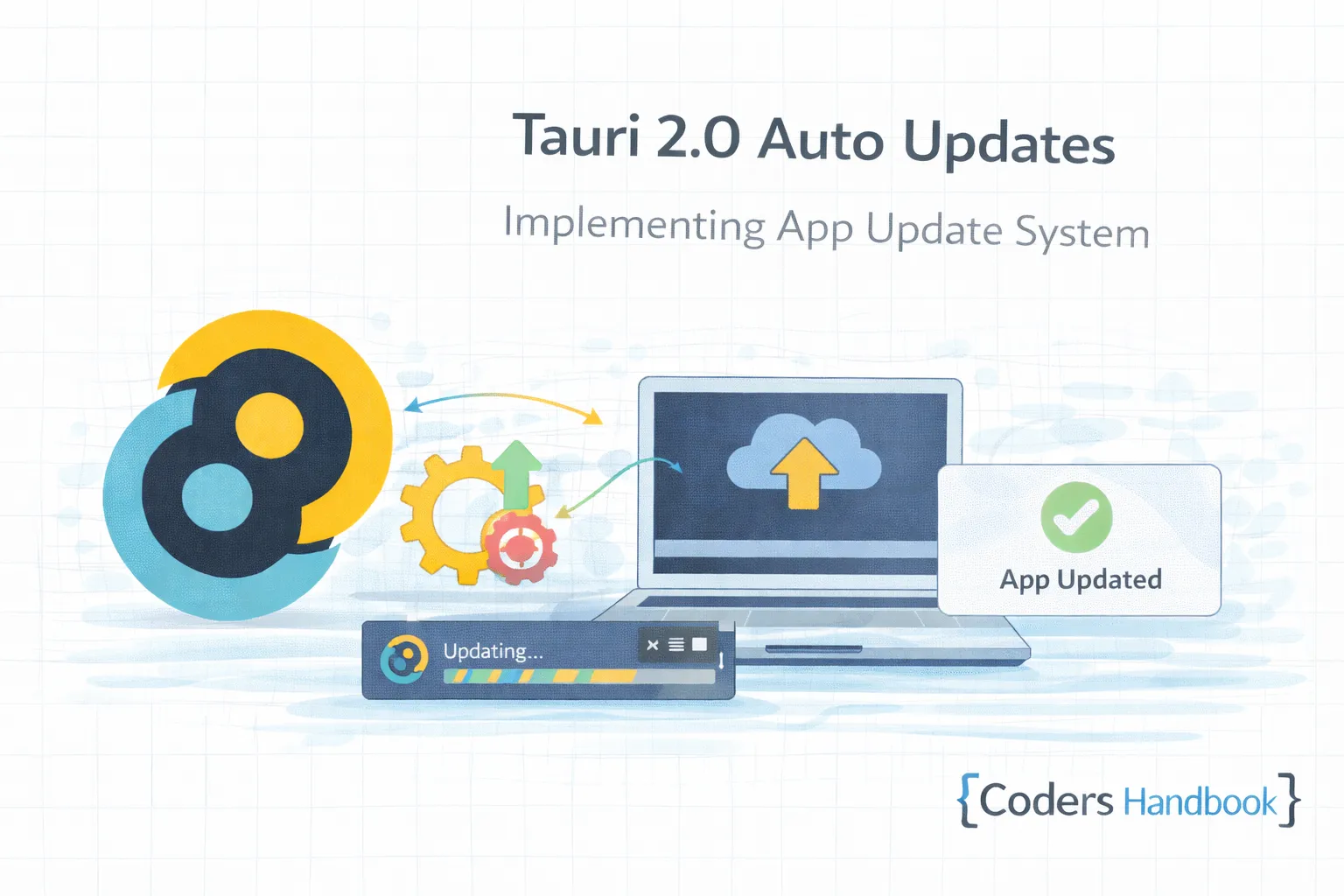
Auto-update system in Tauri 2.0 enables desktop applications to automatically check for new versions, download updates, and install seamlessly maintaining users on latest releases with bug fixes, security patches, and new features without requiring manual downloads or installations—essential feature for production applications requiring continuous delivery, security compliance, feature rollouts, and user retention maintaining application freshness through automated update delivery. Tauri updater combines cryptographic signature verification ensuring update authenticity preventing malicious updates, incremental delta updates reducing download size, silent background downloads avoiding interruption, rollback protection maintaining stability, and cross-platform support working on Windows, macOS, and Linux with platform-specific installers creating secure update mechanism users trust. This comprehensive guide covers understanding update architecture and signing process, generating signing keys with secure storage, configuring updater in tauri.conf.json with endpoints, implementing version checking at application startup, downloading updates with progress tracking, installing updates with user confirmation or silent mode, handling update errors with retry logic, rollback mechanisms reverting failed updates, building update server serving version manifests and binaries, GitHub Releases integration for automated distribution, and creating real-world update workflows including forced updates for critical patches, optional updates with user choice, and beta channel management maintaining controlled release cycles. Mastering update patterns enables building professional desktop applications maintaining currency through automated delivery while respecting user control and maintaining security through cryptographic verification preventing unauthorized modifications. Before proceeding, understand project structure and security configuration.
Updater Configuration and Setup
Updater configuration requires generating signing keys, configuring update endpoints, and enabling updater in tauri.conf.json. Understanding update architecture integrated with build process enables building secure update systems maintaining cryptographic verification throughout update lifecycle.
# Generate signing keys for updates
# Install Tauri CLI
cargo install tauri-cli

# Generate key pair
tauri signer generate -w ~/.tauri/myapp.key

# Output:
# Public key: dW50cnVzdGVkIGNvbW1lbnQ6IG1pbmlzaWduIHB1YmxpYyBrZXk6...
# Private key saved to: ~/.tauri/myapp.key
# Password: [enter secure password]

# IMPORTANT: Keep private key secure!
# - Never commit to version control
# - Store in secure location
# - Use environment variables in CI/CD

# src-tauri/tauri.conf.json
# Configure updater
{
  "tauri": {
    "updater": {
      "active": true,
      "endpoints": [
        "https://updates.myapp.com/{{target}}/{{current_version}}"
      ],
      "dialog": true,
      "pubkey": "YOUR_PUBLIC_KEY_HERE"
    },
    "bundle": {
      "identifier": "com.example.myapp"
    }
  },
  "package": {
    "productName": "My App",
    "version": "1.0.0"
  }
}

# Update endpoint format variables:
# {{target}} - Platform target (e.g., "x86_64-pc-windows-msvc")
# {{current_version}} - Current app version
# {{arch}} - Architecture (e.g., "x86_64")
# {{os}} - OS (e.g., "windows", "macos", "linux")

# Example endpoints:
# GitHub Releases:
"https://github.com/user/repo/releases/latest/download/{{target}}"

# Custom server:
"https://api.myapp.com/updates/{{os}}/{{arch}}/{{current_version}}"

# Multiple endpoints (fallback):
"endpoints": [
  "https://updates1.myapp.com/{{target}}/{{current_version}}",
  "https://updates2.myapp.com/{{target}}/{{current_version}}"
]

# Sign updates during build
# Set environment variables
export TAURI_PRIVATE_KEY="$(cat ~/.tauri/myapp.key)"
export TAURI_KEY_PASSWORD="your-secure-password"

# Build with signing
npm run tauri build

# Output includes:
# - Application binary
# - Update signature (.sig file)
# - Update archive (.tar.gz or .zip)

# Windows
set TAURI_PRIVATE_KEY=<private-key-content>
set TAURI_KEY_PASSWORD=your-password
npm run tauri build
Checking for Updates
Update checking queries update server comparing current version with latest available version. Understanding check mechanism enables building update-aware applications maintaining version awareness through periodic checks or manual triggers respecting user preferences.
// Frontend: Check for updates
import { checkUpdate, installUpdate } from "@tauri-apps/api/updater";
import { relaunch } from "@tauri-apps/api/process";

interface UpdateManifest {
  version: string;
  date: string;
  body?: string;
}

class UpdateService {
  async checkForUpdates(): Promise<{
    shouldUpdate: boolean;
    manifest?: UpdateManifest;
  }> {
    try {
      const { shouldUpdate, manifest } = await checkUpdate();

      if (shouldUpdate) {
        console.log(`Update available: ${manifest?.version}`);
        console.log(`Release notes:\n${manifest?.body}`);
        return { shouldUpdate: true, manifest };
      } else {
        console.log("App is up to date");
        return { shouldUpdate: false };
      }
    } catch (error) {
      console.error("Failed to check for updates:", error);
      return { shouldUpdate: false };
    }
  }

  async promptAndInstall() {
    const { shouldUpdate, manifest } = await this.checkForUpdates();

    if (!shouldUpdate || !manifest) {
      return;
    }

    const message = `
Version ${manifest.version} is available!

${manifest.body || "Bug fixes and improvements"}

Would you like to update now?
    `.trim();

    const shouldInstall = confirm(message);

    if (shouldInstall) {
      await this.downloadAndInstall();
    }
  }

  async downloadAndInstall() {
    try {
      console.log("Downloading update...");
      this.showProgress("Downloading update...");

      await installUpdate();

      console.log("Update installed, restarting...");
      await relaunch();
    } catch (error) {
      console.error("Update failed:", error);
      alert("Failed to install update. Please try again later.");
    }
  }

  private showProgress(message: string) {
    // Show progress UI
    console.log(message);
  }
}

// Usage: Check on startup
const updater = new UpdateService();

window.addEventListener("DOMContentLoaded", async () => {
  // Wait a bit before checking
  setTimeout(async () => {
    await updater.promptAndInstall();
  }, 3000);
});

// Manual check button
document.getElementById("check-updates")?.addEventListener("click", async () => {
  await updater.promptAndInstall();
});

// Rust: Manual update checking
use tauri::updater::{UpdateResponse, UpdaterBuilder};

#[tauri::command]
async fn check_for_updates_manual(
    app: tauri::AppHandle,
) -> Result<String, String> {
    let updater = app.updater();

    match updater.check().await {
        Ok(update) => {
            if update.is_update_available() {
                Ok(format!(
                    "Update available: version {}",
                    update.latest_version()
                ))
            } else {
                Ok("No updates available".to_string())
            }
        }
        Err(e) => Err(format!("Update check failed: {}", e)),
    }
}

#[tauri::command]
async fn get_current_version(
    app: tauri::AppHandle,
) -> String {
    app.package_info().version.to_string()
}
Update Events and Progress Tracking
Update events provide progress feedback during download and installation. Understanding event handling enables building responsive update UI maintaining user awareness through progress indicators and status updates throughout update process.
// Rust: Listen to update events
use tauri::updater::UpdaterEvent;

fn setup_updater(app: &tauri::App) {
    let handle = app.handle();

    app.updater()
        .on_update_event(move |event| {
            match event {
                UpdaterEvent::UpdateAvailable { version, date, body } => {
                    println!("Update available: version {}", version);
                    println!("Release date: {}", date);
                    println!("Release notes: {}", body);

                    // Emit to frontend
                    handle
                        .emit_all(
                            "update-available",
                            serde_json::json!({
                                "version": version,
                                "date": date,
                                "body": body,
                            }),
                        )
                        .ok();
                }
                UpdaterEvent::Pending => {
                    println!("Update is pending download...");
                    handle.emit_all("update-pending", ()).ok();
                }
                UpdaterEvent::DownloadProgress {
                    chunk_length,
                    content_length,
                } => {
                    let progress = if let Some(total) = content_length {
                        (chunk_length as f64 / total as f64) * 100.0
                    } else {
                        0.0
                    };

                    println!("Download progress: {:.1}%", progress);

                    handle
                        .emit_all(
                            "update-download-progress",
                            serde_json::json!({
                                "downloaded": chunk_length,
                                "total": content_length,
                                "progress": progress,
                            }),
                        )
                        .ok();
                }
                UpdaterEvent::Downloaded => {
                    println!("Update downloaded successfully");
                    handle.emit_all("update-downloaded", ()).ok();
                }
                UpdaterEvent::Updated => {
                    println!("Update installed, restarting...");
                    handle.emit_all("update-installed", ()).ok();
                }
                UpdaterEvent::AlreadyUpToDate => {
                    println!("App is already up to date");
                    handle.emit_all("update-not-needed", ()).ok();
                }
                UpdaterEvent::Error(error) => {
                    eprintln!("Update error: {}", error);
                    handle
                        .emit_all(
                            "update-error",
                            serde_json::json!({ "error": error }),
                        )
                        .ok();
                }
            }
        });
}

fn main() {
    tauri::Builder::default()
        .setup(|app| {
            setup_updater(app);
            Ok(())
        })
        .run(tauri::generate_context!())
        .expect("error while running tauri application");
}

// Frontend: Listen to update events
import { listen } from "@tauri-apps/api/event";

class UpdateProgressUI {
  private progressBar: HTMLProgressElement;
  private statusText: HTMLElement;

  constructor() {
    this.progressBar = document.getElementById(
      "update-progress"
    ) as HTMLProgressElement;
    this.statusText = document.getElementById(
      "update-status"
    ) as HTMLElement;
    this.setupListeners();
  }

  private async setupListeners() {
    await listen("update-available", (event) => {
      const { version, body } = event.payload as any;
      this.showUpdateDialog(version, body);
    });

    await listen("update-pending", () => {
      this.setStatus("Preparing update...");
      this.showProgress();
    });

    await listen("update-download-progress", (event) => {
      const { progress } = event.payload as any;
      this.updateProgress(progress);
      this.setStatus(`Downloading... ${progress.toFixed(1)}%`);
    });

    await listen("update-downloaded", () => {
      this.setStatus("Update downloaded, installing...");
    });

    await listen("update-installed", () => {
      this.setStatus("Update installed! Restarting...");
    });

    await listen("update-error", (event) => {
      const { error } = event.payload as any;
      this.showError(error);
    });
  }

  private showUpdateDialog(version: string, body: string) {
    const dialog = document.getElementById("update-dialog");
    if (dialog) {
      dialog.innerHTML = `
        <h2>Update Available</h2>
        <p>Version ${version} is ready to install</p>
        <pre>${body}</pre>
        <button id="install-update">Install Now</button>
        <button id="remind-later">Remind Me Later</button>
      `;
      dialog.style.display = "block";
    }
  }

  private showProgress() {
    this.progressBar.style.display = "block";
  }

  private updateProgress(percent: number) {
    this.progressBar.value = percent;
  }

  private setStatus(text: string) {
    this.statusText.textContent = text;
  }

  private showError(error: string) {
    alert(`Update failed: ${error}`);
    this.progressBar.style.display = "none";
  }
}

// Initialize
const updateUI = new UpdateProgressUI();
Update Server Response Format
Update server must return JSON manifest describing latest version with download URLs and signatures for each platform. Understanding manifest format enables building custom update servers or integrating with existing infrastructure maintaining controlled update distribution.
// Update server response format
// https://updates.myapp.com/darwin/1.0.0
{
  "version": "1.0.1",
  "pub_date": "2026-01-28T12:00:00Z",
  "notes": "Bug fixes and performance improvements\n\n- Fixed memory leak\n- Improved startup time\n- Updated dependencies",
  "platforms": {
    "darwin-x86_64": {
      "signature": "dW50cnVzdGVkIGNvbW1lbnQ6IHNpZ25hdHVyZSBmcm9tIHRhdXJpIHNlY3JldCBrZXkKUldTIG...",
      "url": "https://github.com/user/repo/releases/download/v1.0.1/app-x86_64.app.tar.gz"
    },
    "darwin-aarch64": {
      "signature": "dW50cnVzdGVkIGNvbW1lbnQ6IHNpZ25hdHVyZSBmcm9tIHRhdXJpIHNlY3JldCBrZXkKUldTIG...",
      "url": "https://github.com/user/repo/releases/download/v1.0.1/app-aarch64.app.tar.gz"
    },
    "linux-x86_64": {
      "signature": "dW50cnVzdGVkIGNvbW1lbnQ6IHNpZ25hdHVyZSBmcm9tIHRhdXJpIHNlY3JldCBrZXkKUldTIG...",
      "url": "https://github.com/user/repo/releases/download/v1.0.1/app-amd64.AppImage.tar.gz"
    },
    "windows-x86_64": {
      "signature": "dW50cnVzdGVkIGNvbW1lbnQ6IHNpZ25hdHVyZSBmcm9tIHRhdXJpIHNlY3JldCBrZXkKUldTIG...",
      "url": "https://github.com/user/repo/releases/download/v1.0.1/app-x64.msi.zip"
    }
  }
}

// Node.js/Express update server example
const express = require('express');
const app = express();

// Update manifest
const latestVersion = {
  version: '1.0.1',
  pub_date: new Date().toISOString(),
  notes: 'Bug fixes and improvements',
  platforms: {
    'darwin-x86_64': {
      signature: 'SIGNATURE_HERE',
      url: 'https://cdn.myapp.com/releases/v1.0.1/macos-x64.tar.gz',
    },
    'windows-x86_64': {
      signature: 'SIGNATURE_HERE',
      url: 'https://cdn.myapp.com/releases/v1.0.1/windows-x64.msi.zip',
    },
  },
};

// Update endpoint
app.get('/updates/:target/:currentVersion', (req, res) => {
  const { target, currentVersion } = req.params;

  console.log(`Update check: ${target} from ${currentVersion}`);

  // Check if update needed
  if (currentVersion >= latestVersion.version) {
    return res.status(204).send(); // No update
  }

  // Return update manifest
  res.json(latestVersion);
});

app.listen(3000, () => {
  console.log('Update server running on port 3000');
});

// Python/Flask update server
from flask import Flask, jsonify, request
from datetime import datetime

app = Flask(__name__)

LATEST_VERSION = {
    'version': '1.0.1',
    'pub_date': datetime.utcnow().isoformat() + 'Z',
    'notes': 'Bug fixes and improvements',
    'platforms': {
        'darwin-x86_64': {
            'signature': 'SIGNATURE_HERE',
            'url': 'https://cdn.myapp.com/releases/v1.0.1/macos-x64.tar.gz',
        },
        'windows-x86_64': {
            'signature': 'SIGNATURE_HERE',
            'url': 'https://cdn.myapp.com/releases/v1.0.1/windows-x64.msi.zip',
        },
    },
}

@app.route('/updates/<target>/<current_version>')
def check_update(target, current_version):
    print(f'Update check: {target} from {current_version}')

    # Version comparison
    if current_version >= LATEST_VERSION['version']:
        return '', 204  # No update

    return jsonify(LATEST_VERSION)

if __name__ == '__main__':
    app.run(port=3000)
GitHub Releases Integration
GitHub Releases provides free update hosting with automatic manifest generation. Understanding GitHub integration enables building update distribution without custom servers maintaining automated workflows through GitHub Actions.
# .github/workflows/release.yml
# GitHub Actions for automated releases

name: Release

on:
  push:
    tags:
      - 'v*'

jobs:
  release:
    permissions:
      contents: write
    strategy:
      fail-fast: false
      matrix:
        platform: [macos-latest, ubuntu-latest, windows-latest]

    runs-on: ${{ matrix.platform }}

    steps:
      - uses: actions/checkout@v3

      - name: Setup Node
        uses: actions/setup-node@v3
        with:
          node-version: 18

      - name: Install Rust
        uses: dtolnay/rust-toolchain@stable

      - name: Install dependencies (Ubuntu)
        if: matrix.platform == 'ubuntu-latest'
        run: |
          sudo apt-get update
          sudo apt-get install -y libgtk-3-dev libwebkit2gtk-4.0-dev \
            libappindicator3-dev librsvg2-dev patchelf

      - name: Install frontend dependencies
        run: npm ci

      - name: Build app
        uses: tauri-apps/tauri-action@v0
        env:
          GITHUB_TOKEN: ${{ secrets.GITHUB_TOKEN }}
          TAURI_PRIVATE_KEY: ${{ secrets.TAURI_PRIVATE_KEY }}
          TAURI_KEY_PASSWORD: ${{ secrets.TAURI_KEY_PASSWORD }}
        with:
          tagName: ${{ github.ref_name }}
          releaseName: 'App v__VERSION__'
          releaseBody: 'See the assets to download this version.'
          releaseDraft: false
          prerelease: false

# Configure updater to use GitHub
# src-tauri/tauri.conf.json
{
  "tauri": {
    "updater": {
      "active": true,
      "endpoints": [
        "https://github.com/username/repo/releases/latest/download/latest.json"
      ],
      "pubkey": "YOUR_PUBLIC_KEY"
    }
  }
}

# The tauri-action automatically:
# - Builds for each platform
# - Signs updates with TAURI_PRIVATE_KEY
# - Creates GitHub Release
# - Uploads platform-specific artifacts
# - Generates latest.json manifest

# Manual release process:
# 1. Update version in tauri.conf.json and package.json
# 2. Commit changes
# 3. Create and push tag
git tag v1.0.1
git push origin v1.0.1

# 4. GitHub Actions builds and creates release automatically

# Store secrets in GitHub repository settings:
# Settings > Secrets and variables > Actions
# - TAURI_PRIVATE_KEY: Your private signing key
# - TAURI_KEY_PASSWORD: Password for the key
Update Strategies and Best Practices
| Strategy | When to Use | Implementation | User Experience |
|---|---|---|---|
| Silent Updates | Minor patches | Auto-download, install on restart | Seamless, no interruption |
| Optional Updates | Feature releases | Prompt user, allow skip | User choice, flexible |
| Forced Updates | Critical security | Block app until updated | Mandatory, immediate |
| Scheduled Updates | Regular maintenance | Update during off-hours | Minimal disruption |
| Beta Channel | Early adopters | Separate update endpoint | Opt-in testing |
Auto-Update Best Practices
- Secure Key Storage: Never commit private signing keys to version control
- Version Validation: Implement proper semantic versioning for updates
- Rollback Mechanism: Maintain ability to revert failed updates
- Progress Feedback: Show download progress maintaining user awareness
- Error Handling: Gracefully handle update failures with retry logic
- User Control: Allow users to skip optional updates
- Release Notes: Provide clear changelog explaining changes
- Gradual Rollout: Release to percentage of users first
- Network Efficiency: Use delta updates reducing download size
- Testing: Test update process thoroughly before release
Next Steps
- Splash Screen: Show during updates with loading screen
- Events: Coordinate with event system
- Commands: Custom update logic with Rust commands
- Security: Protect with secure configuration
- Getting Started: Review complete tutorial
Conclusion
Mastering auto-update system in Tauri 2.0 enables building professional desktop applications maintaining currency through automated update delivery while respecting user control and maintaining security through cryptographic signature verification preventing unauthorized modifications creating trusted update mechanism users rely on. Update system combines cryptographic signing ensuring update authenticity with public-private key pairs, version checking comparing current against latest available, background downloads avoiding user interruption, installation with user confirmation or silent mode, and cross-platform support handling Windows MSI, macOS DMG, and Linux AppImage updates maintaining consistent experience across platforms. Understanding update patterns including configuration with secure key management, checking with periodic or manual triggers, progress tracking with event-driven UI, server integration with GitHub Releases or custom endpoints, and update strategies from silent background updates to forced critical patches establishes foundation for building professional desktop applications delivering continuous improvements maintaining application freshness through automated update delivery respecting user preferences and maintaining security throughout update lifecycle. Your Tauri applications now possess powerful auto-update capabilities enabling features like seamless version upgrades, security patch distribution, feature rollouts, and user retention through automated delivery maintaining application currency with minimal user friction integrated with secure cryptographic verification preventing malicious updates delivering professional desktop experiences users trust!
$ share --platform
$ cat /comments/ (0)
$ cat /comments/
// No comments found. Be the first!