Tauri 2.0 Performance Optimization Fast Desktop Apps
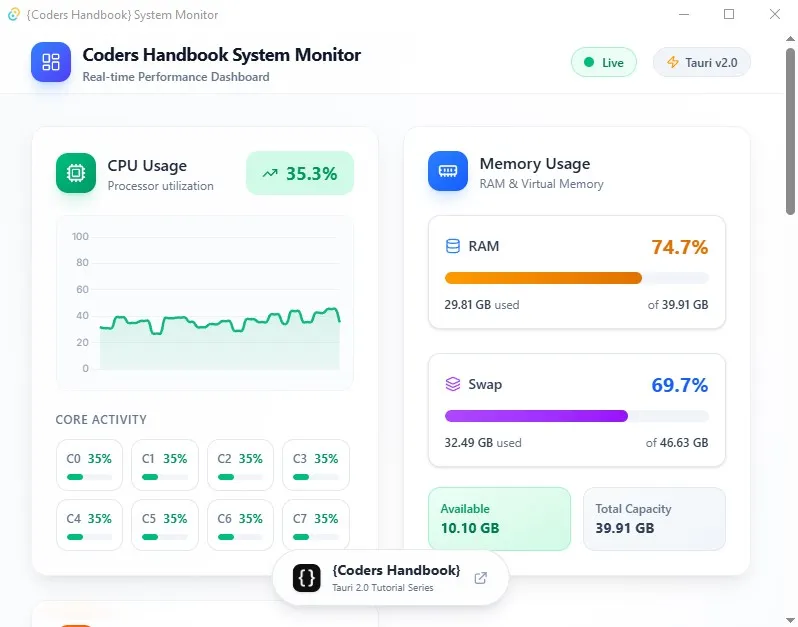
Performance optimization in Tauri 2.0 ensures desktop applications run fast and efficiently minimizing resource usage, reducing bundle size, and maximizing responsiveness delivering smooth user experience competitive with native applications—essential practice for production software maintaining user satisfaction, battery life on laptops, and competitiveness with alternatives requiring disciplined optimization throughout development lifecycle maintaining performance benchmarks. Performance strategy combines bundle size reduction eliminating unnecessary dependencies and optimizing build output, memory management preventing leaks and minimizing allocations, async operation optimization preventing UI blocking with proper thread usage, frontend optimization with code splitting and lazy loading, backend optimization with efficient algorithms and caching, startup time reduction with parallel initialization and deferred loading, and profiling tools identifying performance bottlenecks delivering comprehensive performance management. This comprehensive guide covers understanding performance architecture and measurement, reducing bundle size through dependency auditing and compression, optimizing Rust backend with release builds and efficient data structures, frontend optimization with React.memo and virtualization, implementing code splitting with dynamic imports, caching strategies reducing redundant operations, profiling with Chrome DevTools and cargo-flamegraph, startup optimization with splash screens and lazy initialization, and real-world examples including image processor with streaming, data table with virtualization, and file watcher with debouncing maintaining responsive applications through systematic performance optimization. Mastering performance patterns enables building professional desktop applications delivering native-like speed and efficiency maintaining competitive advantage through superior user experience. Before proceeding, understand commands, events, and logging for profiling.
Bundle Size Optimization
Bundle size affects download time and disk space usage. Understanding size optimization enables building compact applications through dependency pruning, tree-shaking, and compression maintaining fast distribution and installation.
// Cargo.toml - Optimize Rust build
[profile.release]
opt-level = "z"     # Optimize for size
lto = true          # Link-time optimization
codegen-units = 1   # Better optimization, slower builds
panic = "abort"     # Smaller binary size
strip = true        # Remove debug symbols

# Alternative: Optimize for speed
[profile.release]
opt-level = 3       # Maximum optimization
lto = "fat"         # Aggressive LTO

// Analyze bundle size
// Install: cargo install cargo-bloat
// Run: cargo bloat --release

// tauri.conf.json - Build optimization
{
  "tauri": {
    "bundle": {
      "targets": "all",
      "resources": [],  // Only include necessary resources
      "externalBin": [],
      "icon": [
        "icons/32x32.png",
        "icons/128x128.png",
        "icons/icon.icns",
        "icons/icon.ico"
      ]
    }
  },
  "build": {
    "beforeBuildCommand": "npm run build",
    "beforeDevCommand": "npm run dev",
    "devPath": "http://localhost:5173",
    "distDir": "../dist"
  }
}

// Frontend build optimization
// vite.config.ts
import { defineConfig } from 'vite';
import react from '@vitejs/plugin-react';

export default defineConfig({
  plugins: [react()],
  build: {
    target: 'esnext',
    minify: 'terser',
    terserOptions: {
      compress: {
        drop_console: true,  // Remove console.log in production
        drop_debugger: true,
      },
    },
    rollupOptions: {
      output: {
        manualChunks: {
          vendor: ['react', 'react-dom'],
          tauri: ['@tauri-apps/api'],
        },
      },
    },
    chunkSizeWarningLimit: 1000,
  },
});

// Analyze frontend bundle
// Install: npm install --save-dev rollup-plugin-visualizer
import { visualizer } from 'rollup-plugin-visualizer';

export default defineConfig({
  plugins: [
    react(),
    visualizer({
      open: true,
      gzipSize: true,
      brotliSize: true,
    }),
  ],
});

// Dynamic imports for code splitting
import { lazy, Suspense } from 'react';

const HeavyComponent = lazy(() => import('./HeavyComponent'));

function App() {
  return (
    <Suspense fallback={<div>Loading...</div>}>
      <HeavyComponent />
    </Suspense>
  );
}

// Lazy load libraries
let pdfLib: typeof import('pdf-lib') | null = null;

async function loadPdfLib() {
  if (!pdfLib) {
    pdfLib = await import('pdf-lib');
  }
  return pdfLib;
}

// Use lightweight alternatives
// Instead of moment.js (288KB), use date-fns (12KB)
import { format, parseISO } from 'date-fns';

const formatted = format(new Date(), 'yyyy-MM-dd');

// Tree-shaking - Import only what you need
// ❌ Bad: Imports entire library
import _ from 'lodash';
const result = _.chunk(array, 2);

// ✅ Good: Imports only chunk function
import chunk from 'lodash/chunk';
const result = chunk(array, 2);

// Remove unused dependencies
// Run: npm prune
// Audit: npm ls --depth=0

// Compress assets
// Install image optimization: npm install --save-dev imagemin
import imagemin from 'imagemin';
import imageminPngquant from 'imagemin-pngquant';
import imageminJpegtran from 'imagemin-jpegtran';

await imagemin(['src/images/*.{jpg,png}'], {
  destination: 'dist/images',
  plugins: [
    imageminJpegtran(),
    imageminPngquant({
      quality: [0.6, 0.8],
    }),
  ],
});
Rust Backend Performance
Rust backend optimization focuses on efficient algorithms, memory usage, and async operations. Understanding backend optimization enables building fast command handlers maintaining low latency and high throughput.
// Efficient data structures
use std::collections::HashMap;
use std::sync::{Arc, Mutex};

// Use Arc for shared ownership without copying
pub struct AppState {
    cache: Arc<Mutex<HashMap<String, String>>>,
}

// Avoid cloning large data
// ❌ Bad: Clones entire vector
fn process_data(data: Vec<String>) -> Vec<String> {
    data.clone()
}

// ✅ Good: Uses references
fn process_data(data: &[String]) -> Vec<String> {
    data.to_vec()  // Only clone when necessary
}

// String vs &str
// ❌ Bad: Allocates String unnecessarily
fn greet(name: String) -> String {
    format!("Hello, {}!", name)
}

// ✅ Good: Uses string slice
fn greet(name: &str) -> String {
    format!("Hello, {}!", name)
}

// Caching expensive operations
use once_cell::sync::Lazy;
use std::sync::Mutex;

static CACHE: Lazy<Mutex<HashMap<String, String>>> = Lazy::new(|| {
    Mutex::new(HashMap::new())
});

#[tauri::command]
fn get_cached_data(key: String) -> Result<String, String> {
    let mut cache = CACHE.lock().unwrap();

    if let Some(value) = cache.get(&key) {
        return Ok(value.clone());
    }

    // Compute expensive result
    let result = expensive_computation(&key);
    cache.insert(key, result.clone());

    Ok(result)
}

fn expensive_computation(key: &str) -> String {
    // Heavy computation
    format!("Computed: {}", key)
}

// Async operations for non-blocking
use tokio::fs;
use tokio::io::AsyncReadExt;

#[tauri::command]
async fn read_large_file(path: String) -> Result<Vec<u8>, String> {
    let mut file = fs::File::open(path)
        .await
        .map_err(|e| e.to_string())?;

    let mut contents = Vec::new();
    file.read_to_end(&mut contents)
        .await
        .map_err(|e| e.to_string())?;

    Ok(contents)
}

// Parallel processing with rayon
use rayon::prelude::*;

#[tauri::command]
fn process_items(items: Vec<String>) -> Vec<String> {
    items.par_iter()
        .map(|item| process_single_item(item))
        .collect()
}

fn process_single_item(item: &str) -> String {
    // CPU-intensive processing
    item.to_uppercase()
}

// Efficient iteration
// ❌ Bad: Creates intermediate vectors
let result: Vec<_> = data
    .iter()
    .map(|x| x * 2)
    .collect::<Vec<_>>()
    .iter()
    .filter(|x| *x > 10)
    .collect();

// ✅ Good: Single pass
let result: Vec<_> = data
    .iter()
    .map(|x| x * 2)
    .filter(|x| *x > 10)
    .collect();

// Memory pool for frequent allocations
use typed_arena::Arena;

fn process_with_arena() {
    let arena = Arena::new();

    for _ in 0..1000 {
        let data = arena.alloc(vec![1, 2, 3]);
        // Use data
    }
    // All arena allocations freed at once
}

// Streaming large responses
use tokio::io::{AsyncBufReadExt, BufReader};
use tauri::Manager;

#[tauri::command]
async fn stream_file(
    app: tauri::AppHandle,
    path: String,
) -> Result<(), String> {
    let file = fs::File::open(path)
        .await
        .map_err(|e| e.to_string())?;

    let reader = BufReader::new(file);
    let mut lines = reader.lines();

    while let Some(line) = lines.next_line()
        .await
        .map_err(|e| e.to_string())? {

        app.emit_all("file-line", line).ok();
    }

    Ok(())
}

// Avoid unnecessary allocations
// ❌ Bad
fn build_string() -> String {
    let mut s = String::new();
    for i in 0..1000 {
        s = s + &i.to_string(); // Reallocates each time
    }
    s
}

// ✅ Good
fn build_string() -> String {
    let mut s = String::with_capacity(4000); // Pre-allocate
    for i in 0..1000 {
        s.push_str(&i.to_string());
    }
    s
}

// Profile with cargo-flamegraph
// Install: cargo install flamegraph
// Run: cargo flamegraph --bin your-app
Frontend Performance Optimization
Frontend optimization prevents unnecessary re-renders and optimizes rendering performance. Understanding React optimization techniques enables building smooth UI maintaining 60fps through proper component memoization and virtualization.
// React.memo to prevent re-renders
import React, { memo } from 'react';

interface ItemProps {
  id: number;
  name: string;
  onClick: (id: number) => void;
}

const Item = memo<ItemProps>(({ id, name, onClick }) => {
  console.log(`Rendering item ${id}`);
  return (
    <div onClick={() => onClick(id)}>
      {name}
    </div>
  );
});

// useMemo for expensive computations
import { useMemo } from 'react';

function DataProcessor({ data }: { data: number[] }) {
  const processedData = useMemo(() => {
    console.log('Processing data...');
    return data.map(x => x * 2).filter(x => x > 10);
  }, [data]); // Only recompute when data changes

  return <div>{processedData.length} items</div>;
}

// useCallback for stable function references
import { useCallback, useState } from 'react';

function Parent() {
  const [count, setCount] = useState(0);

  const handleClick = useCallback((id: number) => {
    console.log('Clicked', id);
  }, []); // Function stable across renders

  return (
    <div>
      <button onClick={() => setCount(count + 1)}>Count: {count}</button>
      <Item id={1} name="Item 1" onClick={handleClick} />
    </div>
  );
}

// Virtual scrolling for large lists
import { FixedSizeList } from 'react-window';

function LargeList({ items }: { items: string[] }) {
  const Row = ({ index, style }: any) => (
    <div style={style}>{items[index]}</div>
  );

  return (
    <FixedSizeList
      height={600}
      itemCount={items.length}
      itemSize={35}
      width="100%"
    >
      {Row}
    </FixedSizeList>
  );
}

// Debouncing expensive operations
import { useState, useEffect } from 'react';

function useDebounce<T>(value: T, delay: number): T {
  const [debouncedValue, setDebouncedValue] = useState(value);

  useEffect(() => {
    const handler = setTimeout(() => {
      setDebouncedValue(value);
    }, delay);

    return () => clearTimeout(handler);
  }, [value, delay]);

  return debouncedValue;
}

// Usage
function SearchComponent() {
  const [query, setQuery] = useState('');
  const debouncedQuery = useDebounce(query, 300);

  useEffect(() => {
    if (debouncedQuery) {
      // Execute search
      invoke('search', { query: debouncedQuery });
    }
  }, [debouncedQuery]);

  return (
    <input
      value={query}
      onChange={(e) => setQuery(e.target.value)}
      placeholder="Search..."
    />
  );
}

// Lazy loading images
function LazyImage({ src, alt }: { src: string; alt: string }) {
  return (
    <img
      src={src}
      alt={alt}
      loading="lazy"
      decoding="async"
    />
  );
}

// Intersection Observer for lazy loading
import { useEffect, useRef, useState } from 'react';

function useLazyLoad() {
  const [isVisible, setIsVisible] = useState(false);
  const ref = useRef<HTMLDivElement>(null);

  useEffect(() => {
    const observer = new IntersectionObserver(
      ([entry]) => {
        if (entry.isIntersecting) {
          setIsVisible(true);
          observer.disconnect();
        }
      },
      { threshold: 0.1 }
    );

    if (ref.current) {
      observer.observe(ref.current);
    }

    return () => observer.disconnect();
  }, []);

  return { ref, isVisible };
}

// Usage
function LazyComponent() {
  const { ref, isVisible } = useLazyLoad();

  return (
    <div ref={ref}>
      {isVisible ? <HeavyComponent /> : <div>Loading...</div>}
    </div>
  );
}

// Optimize re-renders with React.memo and custom comparison
const ExpensiveComponent = memo(
  ({ data }: { data: ComplexData }) => {
    return <div>{/* Render logic */}</div>;
  },
  (prevProps, nextProps) => {
    // Custom comparison - only re-render if id changes
    return prevProps.data.id === nextProps.data.id;
  }
);

// Web Workers for CPU-intensive tasks
// worker.ts
self.onmessage = (e: MessageEvent) => {
  const { data } = e;

  // CPU-intensive processing
  const result = processLargeDataset(data);

  self.postMessage(result);
};

// Component using worker
function DataProcessor() {
  const [result, setResult] = useState(null);

  useEffect(() => {
    const worker = new Worker(new URL('./worker.ts', import.meta.url));

    worker.onmessage = (e) => {
      setResult(e.data);
    };

    worker.postMessage(largeDataset);

    return () => worker.terminate();
  }, []);

  return <div>{result}</div>;
}
Startup Time Optimization
| Technique | Impact | Implementation | Complexity |
|---|---|---|---|
| Splash Screen | Perceived speed | Show UI immediately | Low |
| Lazy Loading | Faster initial load | Defer heavy imports | Medium |
| Code Splitting | Smaller initial bundle | Dynamic imports | Medium |
| Parallel Init | Faster startup | Async initialization | High |
| Caching | Skip computation | Store results | Medium |
Performance Profiling Tools
- Chrome DevTools: Profile frontend rendering and JavaScript execution
- React DevTools Profiler: Identify slow React components
- cargo-flamegraph: Visualize Rust CPU usage
- cargo-bloat: Analyze binary size contributors
- Lighthouse: Measure web performance metrics
- Bundle Analyzer: Visualize frontend bundle composition
- Performance.now(): Measure operation timing
- console.time(): Quick timing measurements
- Rust criterion: Benchmark backend operations
- Memory Profiler: Track memory usage patterns
Performance Best Practices
- Measure First: Profile before optimizing identifying real bottlenecks
- Optimize Hot Paths: Focus on frequently executed code
- Reduce Bundle Size: Audit dependencies removing unused code
- Async Operations: Keep UI responsive with non-blocking operations
- Cache Results: Avoid redundant expensive computations
- Lazy Load: Defer loading non-critical resources
- Virtualize Lists: Render only visible items in large lists
- Memoize Components: Prevent unnecessary React re-renders
- Monitor Production: Track real-world performance metrics
- Set Budgets: Define performance targets maintaining standards
Next Steps
- Testing: Performance testing with test guide
- Error Handling: Robust patterns with error handling
- Logging: Performance tracking with logging
- Commands: Efficient backend with Rust commands
- Getting Started: Review basics with first app
Conclusion
Mastering performance optimization in Tauri 2.0 enables building professional desktop applications running fast and efficiently delivering smooth user experience competitive with native applications maintaining user satisfaction through superior performance maintaining battery life and responsiveness users expect from desktop software. Performance strategy combines bundle size reduction eliminating unnecessary dependencies through tree-shaking and compression, memory management preventing leaks with proper resource cleanup, async operations maintaining UI responsiveness with non-blocking operations, frontend optimization with component memoization and virtualization, backend optimization with efficient algorithms and caching, startup time reduction with parallel initialization and lazy loading, and profiling tools identifying bottlenecks delivering comprehensive performance management. Understanding performance patterns including build optimization with release profiles and compression, Rust backend efficiency with optimal data structures and parallel processing, frontend optimization with React.memo and code splitting, startup optimization with splash screens and deferred loading, profiling tools measuring actual performance, and best practices measuring before optimizing establishes foundation for building professional desktop applications delivering native-like speed and efficiency maintaining competitive advantage through superior user experience users appreciate and competitors struggle to match!
$ share --platform
$ cat /comments/ (0)
$ cat /comments/
// No comments found. Be the first!