Tauri 2.0 Testing Unit Tests and Integration Tests
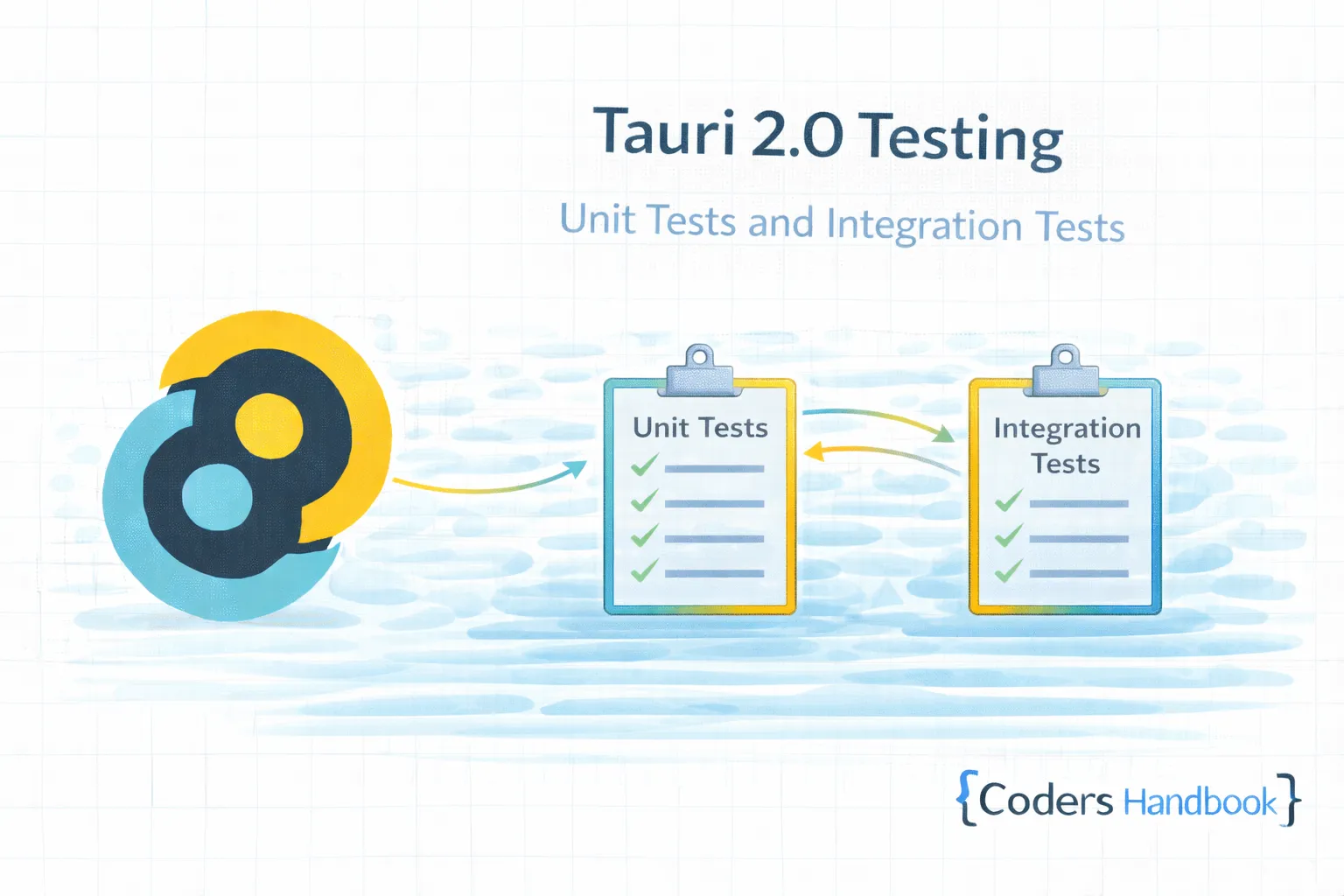
Testing in Tauri 2.0 ensures application reliability through automated unit tests verifying individual functions and integration tests validating end-to-end workflows combining Rust backend testing with frontend component testing maintaining code quality and preventing regressions—essential practice for production applications requiring confidence in functionality, catching bugs early, and enabling safe refactoring maintaining stable releases users depend on. Testing strategy combines Rust unit tests validating backend logic with isolated test cases, integration tests verifying IPC communication between frontend and backend, frontend component tests checking UI behavior and user interactions, end-to-end tests simulating complete user workflows, and mocking strategies isolating dependencies during testing delivering comprehensive test coverage. This comprehensive guide covers understanding testing architecture and test pyramid, writing Rust unit tests with assert macros and test modules, implementing integration tests with Tauri WebDriver, testing commands with mock state, testing events and IPC communication, creating frontend component tests with React Testing Library, building E2E tests with WebDriver automation, implementing test fixtures and helpers, and real-world examples including command testing with state validation, event testing with async handlers, and complete E2E workflow tests maintaining application quality through disciplined testing practices. Mastering testing patterns enables building professional desktop applications with confidence in functionality maintaining code quality through automated verification preventing regressions and bugs. Before proceeding, understand commands, events, and logging.
Rust Unit Tests for Backend Logic
Rust unit tests verify individual functions and modules with isolated test cases. Understanding unit testing enables building reliable backend logic with proper test coverage catching bugs early maintaining code quality through systematic verification.
// Basic Rust unit tests
// src-tauri/src/lib.rs
pub fn add(a: i32, b: i32) -> i32 {
    a + b
}

pub fn multiply(a: i32, b: i32) -> i32 {
    a * b
}

#[cfg(test)]
mod tests {
    use super::*;

    #[test]
    fn test_add() {
        assert_eq!(add(2, 3), 5);
        assert_eq!(add(-1, 1), 0);
        assert_eq!(add(0, 0), 0);
    }

    #[test]
    fn test_multiply() {
        assert_eq!(multiply(2, 3), 6);
        assert_eq!(multiply(-2, 3), -6);
        assert_eq!(multiply(0, 5), 0);
    }

    #[test]
    #[should_panic]
    fn test_panic_example() {
        panic!("This test expects panic");
    }

    #[test]
    fn test_with_result() -> Result<(), String> {
        if 2 + 2 == 4 {
            Ok(())
        } else {
            Err(String::from("Math is broken"))
        }
    }
}

// Run tests: cargo test

// Testing Tauri commands
use tauri::State;
use std::sync::Mutex;

pub struct AppState {
    pub counter: Mutex<i32>,
}

#[tauri::command]
pub fn increment_counter(state: State<AppState>) -> Result<i32, String> {
    let mut counter = state.counter.lock()
        .map_err(|e| format!("Lock error: {}", e))?;
    *counter += 1;
    Ok(*counter)
}

#[tauri::command]
pub fn get_counter(state: State<AppState>) -> Result<i32, String> {
    let counter = state.counter.lock()
        .map_err(|e| format!("Lock error: {}", e))?;
    Ok(*counter)
}

#[cfg(test)]
mod command_tests {
    use super::*;

    #[test]
    fn test_increment_counter() {
        let state = AppState {
            counter: Mutex::new(0),
        };

        // First increment
        let result1 = increment_counter(State::from(&state));
        assert_eq!(result1.unwrap(), 1);

        // Second increment
        let result2 = increment_counter(State::from(&state));
        assert_eq!(result2.unwrap(), 2);

        // Verify final value
        let final_value = get_counter(State::from(&state));
        assert_eq!(final_value.unwrap(), 2);
    }

    #[test]
    fn test_get_counter_initial() {
        let state = AppState {
            counter: Mutex::new(5),
        };

        let result = get_counter(State::from(&state));
        assert_eq!(result.unwrap(), 5);
    }
}

// Testing async functions
use tokio;

async fn fetch_data(url: &str) -> Result<String, String> {
    // Simulate async operation
    tokio::time::sleep(tokio::time::Duration::from_millis(100)).await;
    Ok(format!("Data from {}", url))
}

#[cfg(test)]
mod async_tests {
    use super::*;

    #[tokio::test]
    async fn test_fetch_data() {
        let result = fetch_data("https://api.example.com").await;
        assert!(result.is_ok());
        assert_eq!(result.unwrap(), "Data from https://api.example.com");
    }

    #[tokio::test]
    async fn test_multiple_fetches() {
        let results = tokio::join!(
            fetch_data("url1"),
            fetch_data("url2"),
            fetch_data("url3")
        );

        assert!(results.0.is_ok());
        assert!(results.1.is_ok());
        assert!(results.2.is_ok());
    }
}

// Testing with custom test fixtures
struct TestDatabase {
    data: Vec<String>,
}

impl TestDatabase {
    fn new() -> Self {
        TestDatabase { data: vec![] }
    }

    fn insert(&mut self, value: String) {
        self.data.push(value);
    }

    fn get(&self, index: usize) -> Option<&String> {
        self.data.get(index)
    }
}

#[cfg(test)]
mod db_tests {
    use super::*;

    fn setup() -> TestDatabase {
        let mut db = TestDatabase::new();
        db.insert("test1".to_string());
        db.insert("test2".to_string());
        db
    }

    #[test]
    fn test_database_insert() {
        let mut db = setup();
        db.insert("test3".to_string());
        assert_eq!(db.data.len(), 3);
    }

    #[test]
    fn test_database_get() {
        let db = setup();
        assert_eq!(db.get(0), Some(&"test1".to_string()));
        assert_eq!(db.get(1), Some(&"test2".to_string()));
        assert_eq!(db.get(2), None);
    }
}

// Property-based testing with proptest
// Cargo.toml: proptest = "1.0"
use proptest::prelude::*;

fn reverse_string(s: &str) -> String {
    s.chars().rev().collect()
}

#[cfg(test)]
mod prop_tests {
    use super::*;
    use proptest::prelude::*;

    proptest! {
        #[test]
        fn test_reverse_twice(s in ".*") {
            let reversed = reverse_string(&s);
            let double_reversed = reverse_string(&reversed);
            prop_assert_eq!(&s, &double_reversed);
        }

        #[test]
        fn test_reverse_length(s in ".*") {
            let reversed = reverse_string(&s);
            prop_assert_eq!(s.len(), reversed.len());
        }
    }
}

// Mock testing with mockall
// Cargo.toml: mockall = "0.12"
use mockall::*;

#[automock]
trait UserRepository {
    fn get_user(&self, id: i32) -> Option<String>;
    fn save_user(&mut self, id: i32, name: String) -> Result<(), String>;
}

#[cfg(test)]
mod mock_tests {
    use super::*;

    #[test]
    fn test_with_mock() {
        let mut mock = MockUserRepository::new();

        mock.expect_get_user()
            .with(eq(1))
            .times(1)
            .returning(|_| Some("John".to_string()));

        let result = mock.get_user(1);
        assert_eq!(result, Some("John".to_string()));
    }
}
Integration Tests with Tauri WebDriver
Integration tests verify end-to-end functionality with WebDriver automation. Understanding integration testing enables validating complete workflows including UI interactions, IPC communication, and backend processing maintaining confidence in application behavior.
// Integration test setup
// Cargo.toml
[dev-dependencies]
tauri = { version = "2.0", features = ["test"] }
tokio = { version = "1", features = ["full"] }

// tests/integration_test.rs
use tauri::test::{mock_builder, MockRuntime};

#[tokio::test]
async fn test_basic_command() {
    let app = mock_builder()
        .invoke_handler(tauri::generate_handler![my_command])
        .build(tauri::generate_context!())
        .expect("Failed to build app");

    let webview = app.get_webview_window("main").unwrap();

    // Execute command
    let result: String = webview
        .invoke("my_command", ())
        .await
        .unwrap();

    assert_eq!(result, "Expected result");
}

// Testing with WebDriver (end-to-end)
// Install: cargo install tauri-driver
// package.json
{
  "scripts": {
    "test:e2e": "tauri-driver --port 4444 & npm run test:wdio",
    "test:wdio": "wdio run wdio.conf.js"
  },
  "devDependencies": {
    "@wdio/cli": "^8.0.0",
    "@wdio/local-runner": "^8.0.0",
    "@wdio/mocha-framework": "^8.0.0",
    "@wdio/spec-reporter": "^8.0.0"
  }
}

// wdio.conf.js
export const config = {
  specs: ['./tests/e2e/**/*.spec.js'],
  maxInstances: 1,
  capabilities: [{
    'tauri:options': {
      application: '../src-tauri/target/release/app'
    }
  }],
  logLevel: 'info',
  bail: 0,
  baseUrl: 'http://localhost',
  waitforTimeout: 10000,
  connectionRetryTimeout: 120000,
  connectionRetryCount: 3,
  services: ['tauri'],
  framework: 'mocha',
  reporters: ['spec'],
  mochaOpts: {
    ui: 'bdd',
    timeout: 60000
  }
};

// tests/e2e/basic.spec.js
describe('Tauri App E2E Tests', () => {
  before(async () => {
    // Wait for app to be ready
    await browser.waitUntil(
      async () => await browser.execute(() => !!window.__TAURI__),
      { timeout: 10000 }
    );
  });

  it('should display app title', async () => {
    const title = await $('h1').getText();
    expect(title).toContain('My Tauri App');
  });

  it('should execute Tauri command', async () => {
    const result = await browser.execute(async () => {
      const { invoke } = window.__TAURI__.tauri;
      return await invoke('greet', { name: 'Test' });
    });

    expect(result).toBe('Hello, Test!');
  });

  it('should handle button click', async () => {
    const button = await $('#my-button');
    await button.click();

    const result = await $('#result').getText();
    expect(result).toBe('Button clicked!');
  });

  it('should update counter', async () => {
    // Click increment button 3 times
    const incrementBtn = await $('#increment');
    await incrementBtn.click();
    await incrementBtn.click();
    await incrementBtn.click();

    // Verify counter value
    const counter = await $('#counter').getText();
    expect(counter).toBe('3');
  });

  it('should handle file dialog', async () => {
    const selectBtn = await $('#select-file');
    await selectBtn.click();

    // Wait for dialog result
    await browser.pause(1000);

    const filePath = await $('#file-path').getText();
    expect(filePath).not.toBe('');
  });
});

// Testing IPC events
describe('Event Communication Tests', () => {
  it('should receive backend events', async () => {
    let eventReceived = false;
    let eventData = null;

    await browser.execute(() => {
      const { listen } = window.__TAURI__.event;
      return listen('test-event', (event) => {
        window.__testEventData = event.payload;
      });
    });

    // Trigger event from backend
    await browser.execute(async () => {
      const { invoke } = window.__TAURI__.tauri;
      await invoke('emit_test_event');
    });

    // Wait and check event
    await browser.waitUntil(
      async () => {
        const data = await browser.execute(() => window.__testEventData);
        return data !== undefined;
      },
      { timeout: 5000 }
    );

    const data = await browser.execute(() => window.__testEventData);
    expect(data).toBeDefined();
  });
});

// Performance testing
describe('Performance Tests', () => {
  it('should load app within 2 seconds', async () => {
    const startTime = Date.now();

    await browser.waitUntil(
      async () => await browser.execute(() => !!window.__TAURI__),
      { timeout: 10000 }
    );

    const loadTime = Date.now() - startTime;
    expect(loadTime).toBeLessThan(2000);
  });

  it('should execute command quickly', async () => {
    const startTime = Date.now();

    await browser.execute(async () => {
      const { invoke } = window.__TAURI__.tauri;
      await invoke('quick_command');
    });

    const executionTime = Date.now() - startTime;
    expect(executionTime).toBeLessThan(100);
  });
});
Frontend Component Testing
Frontend component tests verify UI behavior and user interactions. Understanding component testing enables validating React/Vue/Svelte components maintaining UI reliability through automated component verification.
// React component testing with React Testing Library
// package.json
{
  "devDependencies": {
    "@testing-library/react": "^14.0.0",
    "@testing-library/jest-dom": "^6.0.0",
    "@testing-library/user-event": "^14.0.0",
    "vitest": "^1.0.0",
    "@vitest/ui": "^1.0.0"
  }
}

// vitest.config.ts
import { defineConfig } from 'vitest/config';
import react from '@vitejs/plugin-react';

export default defineConfig({
  plugins: [react()],
  test: {
    globals: true,
    environment: 'jsdom',
    setupFiles: './src/test/setup.ts',
  },
});

// src/test/setup.ts
import '@testing-library/jest-dom';
import { vi } from 'vitest';

// Mock Tauri APIs
global.__TAURI__ = {
  tauri: {
    invoke: vi.fn(),
  },
  event: {
    listen: vi.fn(),
    emit: vi.fn(),
  },
};

// Component to test
import React, { useState } from 'react';
import { invoke } from '@tauri-apps/api/core';

interface CounterProps {
  initialValue?: number;
}

export const Counter: React.FC<CounterProps> = ({ initialValue = 0 }) => {
  const [count, setCount] = useState(initialValue);
  const [loading, setLoading] = useState(false);

  const handleIncrement = async () => {
    setLoading(true);
    try {
      const result = await invoke<number>('increment_counter');
      setCount(result);
    } catch (error) {
      console.error('Failed to increment:', error);
    } finally {
      setLoading(false);
    }
  };

  return (
    <div>
      <h1>Counter: {count}</h1>
      <button onClick={handleIncrement} disabled={loading}>
        {loading ? 'Loading...' : 'Increment'}
      </button>
    </div>
  );
};

// Counter.test.tsx
import { render, screen, waitFor } from '@testing-library/react';
import userEvent from '@testing-library/user-event';
import { vi, describe, it, expect, beforeEach } from 'vitest';
import { Counter } from './Counter';
import { invoke } from '@tauri-apps/api/core';

vi.mock('@tauri-apps/api/core');

describe('Counter Component', () => {
  beforeEach(() => {
    vi.clearAllMocks();
  });

  it('renders initial count', () => {
    render(<Counter initialValue={5} />);
    expect(screen.getByText('Counter: 5')).toBeInTheDocument();
  });

  it('increments count on button click', async () => {
    const user = userEvent.setup();
    vi.mocked(invoke).mockResolvedValue(6);

    render(<Counter initialValue={5} />);

    const button = screen.getByRole('button', { name: /increment/i });
    await user.click(button);

    await waitFor(() => {
      expect(screen.getByText('Counter: 6')).toBeInTheDocument();
    });

    expect(invoke).toHaveBeenCalledWith('increment_counter');
  });

  it('shows loading state during increment', async () => {
    const user = userEvent.setup();
    vi.mocked(invoke).mockImplementation(
      () => new Promise(resolve => setTimeout(() => resolve(6), 100))
    );

    render(<Counter />);

    const button = screen.getByRole('button');
    await user.click(button);

    expect(screen.getByText('Loading...')).toBeInTheDocument();
    expect(button).toBeDisabled();

    await waitFor(() => {
      expect(screen.getByText('Increment')).toBeInTheDocument();
    });
  });

  it('handles increment error', async () => {
    const user = userEvent.setup();
    const consoleError = vi.spyOn(console, 'error').mockImplementation(() => {});
    vi.mocked(invoke).mockRejectedValue(new Error('Backend error'));

    render(<Counter />);

    const button = screen.getByRole('button');
    await user.click(button);

    await waitFor(() => {
      expect(consoleError).toHaveBeenCalledWith(
        'Failed to increment:',
        expect.any(Error)
      );
    });

    consoleError.mockRestore();
  });
});

// Testing custom hooks
import { renderHook, waitFor } from '@testing-library/react';

function useTauriCommand<T>(command: string, args?: any) {
  const [data, setData] = useState<T | null>(null);
  const [loading, setLoading] = useState(false);
  const [error, setError] = useState<Error | null>(null);

  const execute = async () => {
    setLoading(true);
    setError(null);
    try {
      const result = await invoke<T>(command, args);
      setData(result);
    } catch (e) {
      setError(e as Error);
    } finally {
      setLoading(false);
    }
  };

  return { data, loading, error, execute };
}

describe('useTauriCommand hook', () => {
  it('executes command successfully', async () => {
    vi.mocked(invoke).mockResolvedValue('success');

    const { result } = renderHook(() =>
      useTauriCommand<string>('test_command')
    );

    expect(result.current.loading).toBe(false);
    expect(result.current.data).toBe(null);

    await result.current.execute();

    await waitFor(() => {
      expect(result.current.data).toBe('success');
      expect(result.current.loading).toBe(false);
    });
  });
});

// Run tests: npm run test
Test Coverage and Reporting
| Test Type | Purpose | Tools | Coverage Target |
|---|---|---|---|
| Unit Tests | Individual functions | cargo test | 80%+ backend code |
| Integration Tests | Command/Event flow | Tauri test utils | All IPC operations |
| Component Tests | UI components | React Testing Library | 80%+ components |
| E2E Tests | User workflows | WebDriver | Critical paths |
Testing Best Practices
- Test Pyramid: Many unit tests, fewer integration tests, minimal E2E
- Isolated Tests: Each test independent without shared state
- Clear Naming: Test names describe what they verify
- AAA Pattern: Arrange, Act, Assert structure in tests
- Mock External Deps: Isolate code under test from dependencies
- Test Edge Cases: Include boundary conditions and errors
- Fast Execution: Keep tests quick enabling frequent runs
- Deterministic: Tests produce same results every run
- CI Integration: Run tests automatically on commits
- Maintain Tests: Update tests with code changes
Next Steps
- Error Handling: Robust error patterns with error handling
- Performance: Optimization techniques with performance guide
- Logging: Debug support with logging system
- Commands: Backend logic with Rust commands
- Getting Started: Review basics with first app
Conclusion
Mastering testing in Tauri 2.0 enables building professional desktop applications with confidence in functionality maintaining code quality through automated verification preventing regressions and bugs catching issues early before reaching users delivering reliable software through disciplined testing practices. Testing strategy combines Rust unit tests validating backend logic with isolated test cases, integration tests verifying IPC communication between frontend and backend, frontend component tests checking UI behavior and interactions, end-to-end tests simulating complete user workflows, and comprehensive coverage maintaining application reliability through systematic testing. Understanding testing patterns including unit test structure with setup and assertions, integration testing with Tauri WebDriver and E2E automation, component testing with React Testing Library and mocks, coverage reporting with appropriate targets, and best practices following test pyramid maintaining fast test suites establishes foundation for building professional desktop applications delivering reliable functionality maintaining user trust through comprehensive automated testing catching bugs before deployment developers and users depend on!
$ share --platform
$ cat /comments/ (0)
$ cat /comments/
// No comments found. Be the first!