Tauri 2.0 Linux Build .deb, .rpm, and AppImage
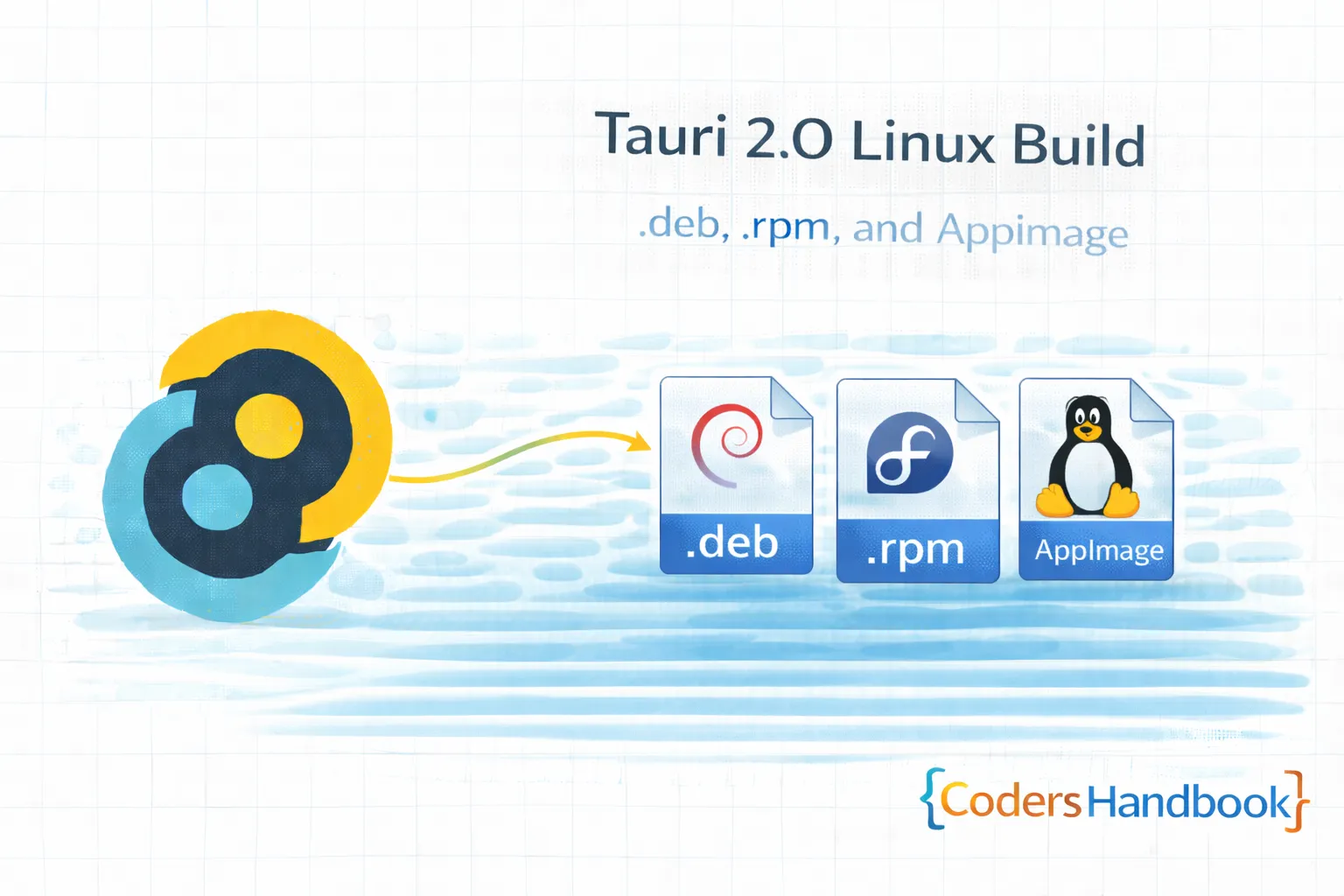
Linux build configuration in Tauri 2.0 creates distribution packages for various Linux formats supporting DEB, RPM, and AppImage enabling broad Linux distribution—essential process for reaching Linux users providing familiar installation methods, proper system integration, and portable applications maintaining Linux ecosystem standards users expect. Linux builds combine DEB packages for Debian-based distributions like Ubuntu providing APT integration, RPM packages for Red Hat-based systems like Fedora offering YUM/DNF support, AppImage creating portable self-contained applications requiring no installation, system integration with desktop entries and icon themes, dependency management handling system libraries, and repository distribution enabling automatic updates delivering comprehensive Linux distribution solution. This comprehensive guide covers understanding Linux package formats and differences, creating DEB packages with proper control files and post-installation scripts, building RPM packages with spec file configuration, generating AppImage bundles with embedded dependencies, implementing desktop entry files for application launchers, configuring MIME types and file associations, setting up package repositories for distribution, troubleshooting dependency issues, and real-world examples including multi-format build pipeline, repository setup for updates, and properly integrated Linux application maintaining professional Linux distribution through proper build configuration. Mastering Linux build patterns enables building distributable applications reaching Linux users across distributions. Before proceeding, understand build configuration, Windows build, and macOS build.
DEB Package Creation Debian and Ubuntu
DEB packages integrate with APT package manager. Understanding DEB creation enables building packages for Debian-based distributions maintaining system integration through proper package structure.
// tauri.conf.json - DEB configuration
{
  "bundle": {
    "active": true,
    "targets": ["deb"],
    "identifier": "com.mycompany.myapp",
    "icon": ["icons/icon.png"],

    "linux": {
      "deb": {
        // Package dependencies
        "depends": [
          "libwebkit2gtk-4.1-0",
          "libgtk-3-0",
          "libayatana-appindicator3-1"
        ],

        // Desktop file
        "desktop": {
          "name": "MyApp",
          "comment": "A powerful desktop application",
          "categories": ["Utility", "Development"],
          "terminal": false,
          "icon": "myapp",
          "mimeType": ["x-scheme-handler/myapp"]
        },

        // Files to include
        "files": {
          "/usr/share/doc/myapp/copyright": "COPYRIGHT",
          "/usr/share/doc/myapp/changelog.gz": "CHANGELOG.gz"
        }
      }
    }
  }
}

// Build DEB package
npm run tauri build -- --target deb

// DEB package structure:
myapp_1.0.0_amd64.deb
├── DEBIAN/
│   ├── control              # Package metadata
│   ├── postinst             # Post-installation script
│   ├── prerm                # Pre-removal script
│   └── md5sums              # File checksums
└── usr/
    ├── bin/
    │   └── myapp            # Executable
    └── share/
        ├── applications/
        │   └── myapp.desktop  # Desktop entry
        ├── icons/
        │   └── hicolor/
        │       └── 128x128/apps/
        │           └── myapp.png
        └── doc/
            └── myapp/
                └── copyright

// DEBIAN/control file
Package: myapp
Version: 1.0.0
Section: utils
Priority: optional
Architecture: amd64
Depends: libwebkit2gtk-4.1-0, libgtk-3-0
Maintainer: Your Name <[email protected]>
Description: A powerful desktop application
 MyApp provides productivity features.
Homepage: https://myapp.com

// myapp.desktop - Desktop entry file
[Desktop Entry]
Version=1.0
Type=Application
Name=MyApp
Comment=A powerful desktop application
Exec=/usr/bin/myapp %U
Icon=myapp
Terminal=false
Categories=Utility;Development;
MimeType=x-scheme-handler/myapp;
StartupNotify=true

// Install DEB package
sudo dpkg -i myapp_1.0.0_amd64.deb
sudo apt-get install -f  # Fix dependencies

// Remove package
sudo apt remove myapp

// Verify package contents
dpkg -c myapp_1.0.0_amd64.deb
RPM Package Creation Fedora and RHEL
RPM packages work with Red Hat-based distributions. Understanding RPM creation enables building packages for Fedora, RHEL, and CentOS maintaining YUM/DNF integration.
// tauri.conf.json - RPM configuration
{
  "bundle": {
    "targets": ["rpm"],
    "linux": {
      "rpm": {
        // RPM dependencies
        "depends": [
          "webkit2gtk4.1",
          "gtk3",
          "libappindicator-gtk3"
        ],

        // Desktop file
        "desktop": {
          "name": "MyApp",
          "categories": ["Utility"],
          "comment": "A powerful desktop application"
        },

        // Release number
        "release": "1",

        // Epoch
        "epoch": 0
      }
    }
  }
}

// Build RPM package
npm run tauri build -- --target rpm

// RPM spec file structure (auto-generated)
Name:           myapp
Version:        1.0.0
Release:        1%{?dist}
Summary:        A powerful desktop application
License:        MIT
URL:            https://myapp.com

Requires:       webkit2gtk4.1, gtk3

%description
MyApp provides productivity features.

%files
%{_bindir}/myapp
%{_datadir}/applications/myapp.desktop
%{_datadir}/icons/hicolor/128x128/apps/myapp.png

%post
/usr/bin/update-desktop-database &> /dev/null || :
/usr/bin/gtk-update-icon-cache %{_datadir}/icons/hicolor &> /dev/null || :

%postun
/usr/bin/update-desktop-database &> /dev/null || :
/usr/bin/gtk-update-icon-cache %{_datadir}/icons/hicolor &> /dev/null || :

%changelog
* Wed Jan 28 2026 Your Name <[email protected]> - 1.0.0-1
- Initial release

// Install RPM package
sudo rpm -i myapp-1.0.0-1.x86_64.rpm

// Or with DNF
sudo dnf install myapp-1.0.0-1.x86_64.rpm

// Remove package
sudo dnf remove myapp

// Query package info
rpm -qi myapp
AppImage Portable Applications
AppImage creates portable self-contained applications. Understanding AppImage enables building distribution-agnostic packages requiring no installation maintaining universal Linux compatibility.
// tauri.conf.json - AppImage configuration
{
  "bundle": {
    "targets": ["appimage"],
    "linux": {
      "appimage": {
        // Bundle media framework
        "bundleMediaFramework": true,

        // Additional libraries
        "libs": [],

        // Files to include
        "files": {}
      }
    }
  }
}

// Build AppImage
npm run tauri build -- --target appimage

// AppImage structure:
MyApp-1.0.0-x86_64.AppImage
├── AppRun                   # Entry point script
├── myapp.desktop            # Desktop entry
├── myapp.png                # Icon
├── usr/
│   ├── bin/
│   │   └── myapp            # Main executable
│   ├── lib/                 # Bundled libraries
│   └── share/
│       ├── applications/
│       └── icons/

// AppRun script (automatically generated)
#!/bin/bash
HERE="$(dirname "$(readlink -f "${0}")")"
export LD_LIBRARY_PATH="${HERE}/usr/lib:${LD_LIBRARY_PATH}"
export PATH="${HERE}/usr/bin:${PATH}"

export APPIMAGE="${ARGV0}"
export APPDIR="${HERE}"

exec "${HERE}/usr/bin/myapp" "$@"

// Run AppImage
chmod +x MyApp-1.0.0-x86_64.AppImage
./MyApp-1.0.0-x86_64.AppImage

// Integrate with system
./MyApp-1.0.0-x86_64.AppImage --appimage-integrate

// Extract contents
./MyApp-1.0.0-x86_64.AppImage --appimage-extract

// Custom AppImage build (advanced)
// Install appimagetool
wget https://github.com/AppImage/AppImageKit/releases/download/continuous/appimagetool-x86_64.AppImage
chmod +x appimagetool-x86_64.AppImage

// Create AppDir structure
mkdir -p MyApp.AppDir/usr/{bin,lib,share}

// Copy application
cp target/release/myapp MyApp.AppDir/usr/bin/

// Copy dependencies
ldd target/release/myapp | grep "=> /" | awk '{print $3}' | \
  xargs -I '{}' cp -v '{}' MyApp.AppDir/usr/lib/

// Create desktop entry
cat > MyApp.AppDir/myapp.desktop << EOF
[Desktop Entry]
Name=MyApp
Exec=myapp
Icon=myapp
Type=Application
Categories=Utility;
EOF

// Copy icon
cp icons/128x128.png MyApp.AppDir/myapp.png

// Create AppRun
cat > MyApp.AppDir/AppRun << 'EOF'
#!/bin/bash
HERE="$(dirname "$(readlink -f "${0}")")"
export LD_LIBRARY_PATH="${HERE}/usr/lib:${LD_LIBRARY_PATH}"
exec "${HERE}/usr/bin/myapp" "$@"
EOF
chmod +x MyApp.AppDir/AppRun

// Build AppImage
./appimagetool-x86_64.AppImage MyApp.AppDir MyApp-x86_64.AppImage
Linux Package Format Comparison
| Feature | DEB | RPM | AppImage |
|---|---|---|---|
| Distributions | Debian, Ubuntu, Mint | Fedora, RHEL, CentOS | All distributions |
| Installation | dpkg, apt | rpm, dnf, yum | Just run |
| Dependencies | System managed | System managed | Bundled |
| Updates | APT repos | DNF repos | Manual |
| Size | Smaller | Smaller | Larger |
| Integration | Full | Full | Optional |
| Portability | Distribution-specific | Distribution-specific | Universal |
| Best For | Debian-based systems | Red Hat-based systems | Universal compatibility |
Linux Build Best Practices
- Provide Multiple Formats: Offer DEB, RPM, and AppImage covering all users
- List Dependencies: Declare all required system libraries
- Desktop Integration: Include proper .desktop files
- Follow FHS: Install to standard Linux filesystem locations
- Update Caches: Run update-desktop-database in post-install
- Clean Uninstall: Remove all files in pre-remove scripts
- Test on Distributions: Verify on Ubuntu, Fedora, Arch
- Sign Packages: GPG sign for trust and verification
- Bundle Conservatively: AppImage should include only needed libs
- Proper Icons: Provide icons in multiple sizes for themes
Next Steps
- Windows Build: EXE and MSI with Windows packaging
- macOS Build: DMG and app bundles with macOS guide
- Build Config: Optimization with build configuration
- Getting Started: Review basics with first app
Conclusion
Mastering Linux build configuration in Tauri 2.0 enables building distributable applications reaching Linux users across distributions providing familiar installation methods maintaining proper system integration through multiple package formats supporting diverse Linux ecosystem. Linux builds combine DEB packages for Debian-based distributions with APT integration and proper dependency management, RPM packages for Red Hat-based systems with YUM/DNF support and spec file configuration, AppImage creating portable self-contained applications requiring no installation maintaining universal compatibility, desktop integration with proper .desktop files and icon themes, and comprehensive testing across distributions delivering trusted Linux distribution solution. Understanding Linux build patterns including DEB creation with control files and post-install scripts, RPM building with spec files and proper metadata, AppImage generation with bundled dependencies and portable execution, package format comparison choosing appropriate formats for target users, and best practices maintaining Linux standards establishes foundation for professional Linux application distribution delivering trusted installations maintaining ecosystem compatibility Linux users depend on across diverse distributions!
$ share --platform
$ cat /comments/ (0)
$ cat /comments/
// No comments found. Be the first!