Tauri 2.0 CI/CD GitHub Actions Automated Builds
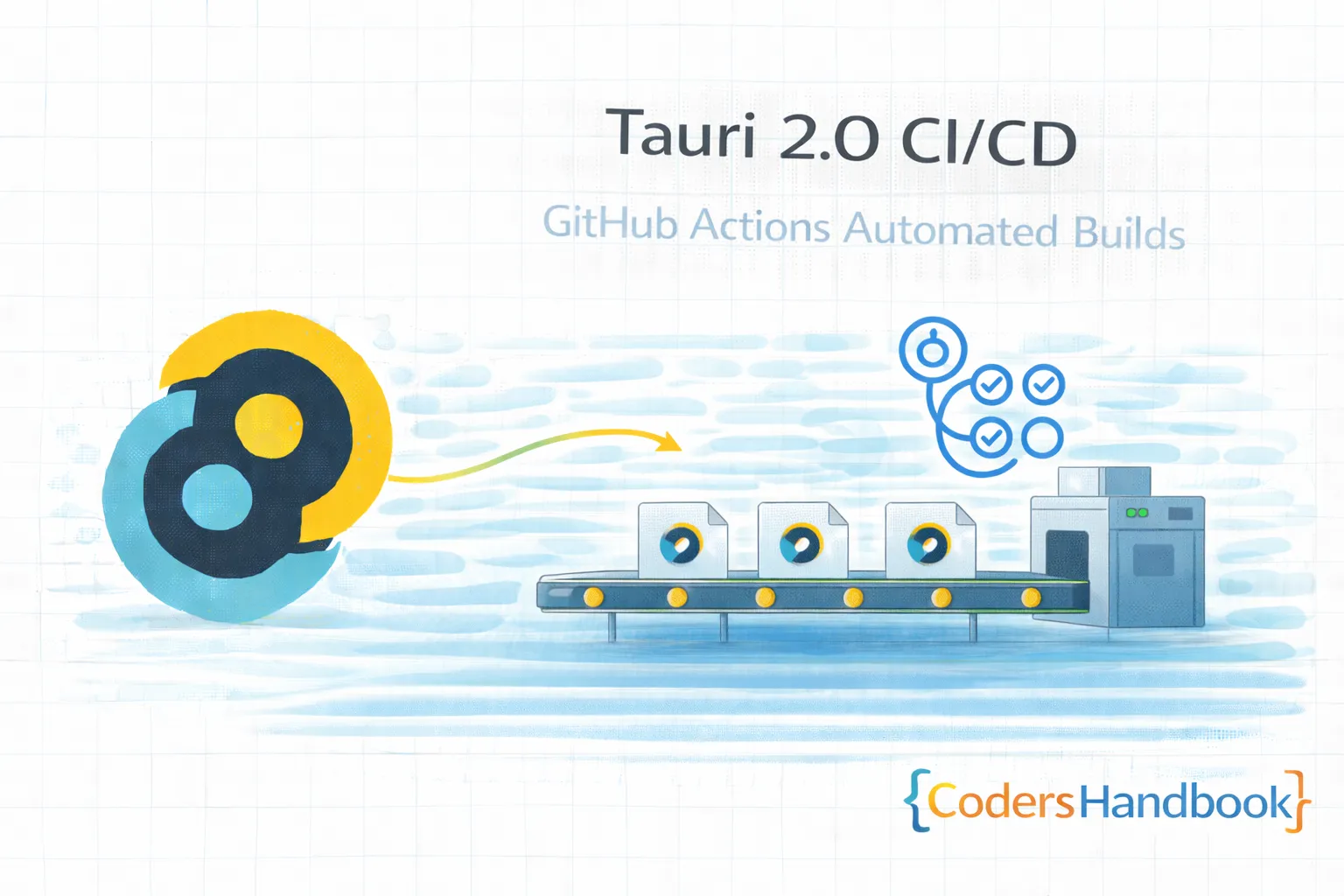
CI/CD automation in Tauri 2.0 using GitHub Actions enables automated building, testing, and releasing applications across Windows, macOS, and Linux platforms streamlining development workflow—essential process for professional deployment ensuring consistent builds, automated testing, continuous delivery, and release automation maintaining high-quality software delivery users expect. CI/CD pipelines combine automated builds compiling applications for all platforms, comprehensive testing running unit tests and integration tests, code signing and notarization ensuring security compliance, artifact management storing build outputs, release automation publishing to GitHub Releases, and deployment workflows distributing to users delivering complete automation solution. This comprehensive guide covers understanding CI/CD fundamentals and GitHub Actions workflow, setting up multi-platform builds with matrix strategy, configuring automated testing pipelines, implementing code signing in CI/CD with secure secrets management, creating automated release workflows, optimizing build performance with caching strategies, deploying to various distribution channels, troubleshooting CI/CD failures, and real-world examples including complete build pipeline, automated release with changelogs, and multi-platform signing workflow maintaining professional automation through proper CI/CD configuration. Mastering CI/CD patterns enables building reliable deployment pipelines automating software delivery. Before proceeding, understand code signing, Windows build, macOS build, and Linux build.
GitHub Actions Basics
GitHub Actions provides CI/CD automation integrated with GitHub repositories. Understanding Actions basics enables creating workflows automating build, test, and release processes maintaining consistent deployments through declarative YAML configuration.
// GitHub Actions workflow structure
// .github/workflows/build.yml

name: Build and Test  # Workflow name

on:  # Triggers
  push:
    branches: [ main, develop ]
  pull_request:
    branches: [ main ]
  release:
    types: [ created ]

jobs:  # Jobs to run
  build:
    runs-on: ubuntu-latest  # Runner environment

    steps:  # Steps within job
      - name: Checkout code
        uses: actions/checkout@v3  # Use existing action

      - name: Setup Node
        uses: actions/setup-node@v3
        with:
          node-version: 18

      - name: Install dependencies
        run: npm install  # Run command

      - name: Build
        run: npm run build

// Key concepts:

// 1. Triggers (on)
// - push: On git push
// - pull_request: On PR creation/update
// - release: On GitHub release
// - schedule: Cron schedule
// - workflow_dispatch: Manual trigger

// 2. Runners
// - ubuntu-latest: Ubuntu Linux
// - windows-latest: Windows Server
// - macos-latest: macOS (Intel)
// - macos-14: macOS (Apple Silicon)

// 3. Jobs
// - Run in parallel by default
// - Can specify dependencies with 'needs'
// - Each job runs in fresh environment

// 4. Steps
// - Sequential within job
// - Use existing actions (uses:)
// - Or run commands (run:)

// 5. Secrets
// - Stored in repository settings
// - Accessed via ${{ secrets.NAME }}
// - Never logged or exposed

// 6. Artifacts
// - Files persisted between jobs
// - Available for download after workflow
// - Automatically expire after 90 days

// 7. Matrix builds
// - Run job with multiple configurations
// - Different OS, versions, etc.
// - Runs in parallel

// Example: Basic Tauri build
name: Build

on:
  push:
    branches: [ main ]

jobs:
  build:
    runs-on: ubuntu-latest

    steps:
      - uses: actions/checkout@v3

      - name: Setup Node
        uses: actions/setup-node@v3
        with:
          node-version: 18

      - name: Setup Rust
        uses: actions-rs/toolchain@v1
        with:
          toolchain: stable

      - name: Install system dependencies
        run: |
          sudo apt-get update
          sudo apt-get install -y libwebkit2gtk-4.1-dev \
            libgtk-3-dev \
            libayatana-appindicator3-dev \
            librsvg2-dev

      - name: Install Node dependencies
        run: npm install

      - name: Build Tauri app
        run: npm run tauri build

      - name: Upload artifacts
        uses: actions/upload-artifact@v3
        with:
          name: linux-build
          path: src-tauri/target/release/bundle/
Multi-Platform Build Matrix
Matrix strategy enables building for multiple platforms simultaneously. Understanding matrix builds enables creating efficient workflows compiling applications for Windows, macOS, and Linux in parallel maintaining platform-specific configurations through matrix strategy.
// .github/workflows/multi-platform.yml

name: Multi-Platform Build

on:
  push:
    tags:
      - 'v*'

jobs:
  build:
    strategy:
      fail-fast: false
      matrix:
        platform:
          - os: ubuntu-22.04
            target: x86_64-unknown-linux-gnu
            bundles: deb,rpm,appimage
            artifact_name: linux

          - os: windows-latest
            target: x86_64-pc-windows-msvc
            bundles: nsis,msi
            artifact_name: windows

          - os: macos-latest
            target: x86_64-apple-darwin
            bundles: app,dmg
            artifact_name: macos-intel

          - os: macos-latest
            target: aarch64-apple-darwin
            bundles: app,dmg
            artifact_name: macos-silicon

    runs-on: ${{ matrix.platform.os }}

    steps:
      - uses: actions/checkout@v3

      - name: Setup Node
        uses: actions/setup-node@v3
        with:
          node-version: 18

      - name: Setup Rust
        uses: actions-rs/toolchain@v1
        with:
          toolchain: stable
          target: ${{ matrix.platform.target }}

      # Linux-specific dependencies
      - name: Install Linux dependencies
        if: matrix.platform.os == 'ubuntu-22.04'
        run: |
          sudo apt-get update
          sudo apt-get install -y libwebkit2gtk-4.1-dev \
            libgtk-3-dev \
            libayatana-appindicator3-dev \
            librsvg2-dev \
            patchelf

      # macOS-specific setup
      - name: Setup macOS targets
        if: runner.os == 'macOS'
        run: |
          rustup target add x86_64-apple-darwin
          rustup target add aarch64-apple-darwin

      - name: Install Node dependencies
        run: npm install

      # Cache Rust dependencies
      - name: Cache Rust
        uses: actions/cache@v3
        with:
          path: |
            ~/.cargo/bin/
            ~/.cargo/registry/index/
            ~/.cargo/registry/cache/
            ~/.cargo/git/db/
            src-tauri/target/
          key: ${{ runner.os }}-cargo-${{ hashFiles('**/Cargo.lock') }}

      - name: Build
        run: |
          npm run tauri build -- \
            --target ${{ matrix.platform.target }} \
            --bundles ${{ matrix.platform.bundles }}

      - name: Upload artifacts
        uses: actions/upload-artifact@v3
        with:
          name: ${{ matrix.platform.artifact_name }}
          path: src-tauri/target/${{ matrix.platform.target }}/release/bundle/

// Universal macOS binary workflow
name: macOS Universal Build

on:
  push:
    tags:
      - 'v*'

jobs:
  build-macos-universal:
    runs-on: macos-latest

    steps:
      - uses: actions/checkout@v3

      - name: Setup Node
        uses: actions/setup-node@v3
        with:
          node-version: 18

      - name: Setup Rust
        uses: actions-rs/toolchain@v1
        with:
          toolchain: stable

      - name: Add macOS targets
        run: |
          rustup target add x86_64-apple-darwin
          rustup target add aarch64-apple-darwin

      - name: Install dependencies
        run: npm install

      - name: Build Intel binary
        run: |
          npm run tauri build -- \
            --target x86_64-apple-darwin

      - name: Build Apple Silicon binary
        run: |
          npm run tauri build -- \
            --target aarch64-apple-darwin

      - name: Create universal binary
        run: |
          mkdir -p target/universal-apple-darwin/release
          lipo -create \
            target/x86_64-apple-darwin/release/myapp \
            target/aarch64-apple-darwin/release/myapp \
            -output target/universal-apple-darwin/release/myapp

      - name: Build universal app bundle
        run: |
          npm run tauri build -- \
            --target universal-apple-darwin

      - name: Upload universal DMG
        uses: actions/upload-artifact@v3
        with:
          name: macos-universal
          path: src-tauri/target/universal-apple-darwin/release/bundle/dmg/*.dmg
Automated Testing Pipeline
Automated testing ensures code quality before deployment. Understanding testing workflows enables implementing comprehensive test suites validating functionality across platforms maintaining quality standards through continuous testing automation.
// .github/workflows/test.yml

name: Test

on:
  push:
    branches: [ main, develop ]
  pull_request:
    branches: [ main ]

jobs:
  # Frontend tests
  test-frontend:
    runs-on: ubuntu-latest

    steps:
      - uses: actions/checkout@v3

      - name: Setup Node
        uses: actions/setup-node@v3
        with:
          node-version: 18

      - name: Install dependencies
        run: npm install

      - name: Run linting
        run: npm run lint

      - name: Run type checking
        run: npm run type-check

      - name: Run frontend tests
        run: npm test

      - name: Upload coverage
        uses: codecov/codecov-action@v3
        with:
          files: ./coverage/lcov.info

  # Rust backend tests
  test-backend:
    runs-on: ubuntu-latest

    steps:
      - uses: actions/checkout@v3

      - name: Setup Rust
        uses: actions-rs/toolchain@v1
        with:
          toolchain: stable
          components: clippy, rustfmt

      - name: Install system dependencies
        run: |
          sudo apt-get update
          sudo apt-get install -y libwebkit2gtk-4.1-dev \
            libgtk-3-dev

      - name: Check formatting
        working-directory: src-tauri
        run: cargo fmt -- --check

      - name: Run Clippy
        working-directory: src-tauri
        run: cargo clippy -- -D warnings

      - name: Run Rust tests
        working-directory: src-tauri
        run: cargo test

      - name: Run Rust benchmarks
        working-directory: src-tauri
        run: cargo bench --no-run

  # E2E tests (optional)
  test-e2e:
    needs: [test-frontend, test-backend]
    runs-on: ubuntu-latest

    steps:
      - uses: actions/checkout@v3

      - name: Setup Node
        uses: actions/setup-node@v3
        with:
          node-version: 18

      - name: Setup Rust
        uses: actions-rs/toolchain@v1
        with:
          toolchain: stable

      - name: Install system dependencies
        run: |
          sudo apt-get update
          sudo apt-get install -y libwebkit2gtk-4.1-dev \
            libgtk-3-dev \
            xvfb

      - name: Install dependencies
        run: npm install

      - name: Install Playwright
        run: npx playwright install --with-deps

      - name: Build app
        run: npm run tauri build

      - name: Run E2E tests
        run: xvfb-run npm run test:e2e

      - name: Upload test results
        if: failure()
        uses: actions/upload-artifact@v3
        with:
          name: e2e-results
          path: test-results/

// Combined quality checks
name: Quality Checks

on: [push, pull_request]

jobs:
  quality:
    runs-on: ubuntu-latest

    steps:
      - uses: actions/checkout@v3
        with:
          fetch-depth: 0  # For SonarQube

      - name: Setup Node
        uses: actions/setup-node@v3
        with:
          node-version: 18

      - name: Install dependencies
        run: npm install

      # Security audit
      - name: Run npm audit
        run: npm audit --audit-level=moderate

      # Dependency check
      - name: Check outdated dependencies
        run: npm outdated || true

      # Bundle size check
      - name: Check bundle size
        run: npm run build && ls -lh dist/

      # License compliance
      - name: Check licenses
        run: npx license-checker --summary
Automated Release Workflow
Automated releases streamline deployment process. Understanding release automation enables creating workflows publishing signed builds to GitHub Releases maintaining consistent versioning through automated release creation and distribution.
// .github/workflows/release.yml

name: Release

on:
  push:
    tags:
      - 'v*.*.*'

jobs:
  create-release:
    runs-on: ubuntu-latest
    outputs:
      release_id: ${{ steps.create_release.outputs.id }}
      upload_url: ${{ steps.create_release.outputs.upload_url }}

    steps:
      - uses: actions/checkout@v3

      - name: Get version from tag
        id: version
        run: echo "VERSION=${GITHUB_REF#refs/tags/v}" >> $GITHUB_OUTPUT

      - name: Generate changelog
        id: changelog
        run: |
          # Generate changelog from commits
          CHANGELOG=$(git log $(git describe --tags --abbrev=0 HEAD^)..HEAD --pretty=format:"- %s")
          echo "CHANGELOG<<EOF" >> $GITHUB_OUTPUT
          echo "$CHANGELOG" >> $GITHUB_OUTPUT
          echo "EOF" >> $GITHUB_OUTPUT

      - name: Create Release
        id: create_release
        uses: actions/create-release@v1
        env:
          GITHUB_TOKEN: ${{ secrets.GITHUB_TOKEN }}
        with:
          tag_name: ${{ github.ref }}
          release_name: Release ${{ steps.version.outputs.VERSION }}
          body: |
            ## Changes
            ${{ steps.changelog.outputs.CHANGELOG }}

            ## Installation
            Download the appropriate installer for your platform below.
          draft: false
          prerelease: false

  build-and-upload:
    needs: create-release
    strategy:
      matrix:
        include:
          - os: ubuntu-22.04
            target: x86_64-unknown-linux-gnu
            artifact_name: myapp
            asset_name: myapp-linux-x86_64

          - os: windows-latest
            target: x86_64-pc-windows-msvc
            artifact_name: myapp.exe
            asset_name: myapp-windows-x86_64.exe

          - os: macos-latest
            target: universal-apple-darwin
            artifact_name: myapp.dmg
            asset_name: myapp-macos-universal.dmg

    runs-on: ${{ matrix.os }}

    steps:
      - uses: actions/checkout@v3

      - name: Setup Node
        uses: actions/setup-node@v3
        with:
          node-version: 18

      - name: Setup Rust
        uses: actions-rs/toolchain@v1
        with:
          toolchain: stable
          target: ${{ matrix.target }}

      - name: Install Linux dependencies
        if: runner.os == 'Linux'
        run: |
          sudo apt-get update
          sudo apt-get install -y libwebkit2gtk-4.1-dev \
            libgtk-3-dev \
            libayatana-appindicator3-dev

      - name: Install dependencies
        run: npm install

      - name: Build
        run: npm run tauri build -- --target ${{ matrix.target }}

      # Sign builds (see code signing post #43)
      - name: Sign Windows
        if: runner.os == 'Windows'
        run: |
          # Sign .exe and .msi files
          # (Implementation from post #43)

      - name: Sign macOS
        if: runner.os == 'macOS'
        run: |
          # Sign and notarize .dmg
          # (Implementation from post #43)

      - name: Upload Release Asset
        uses: actions/upload-release-asset@v1
        env:
          GITHUB_TOKEN: ${{ secrets.GITHUB_TOKEN }}
        with:
          upload_url: ${{ needs.create-release.outputs.upload_url }}
          asset_path: ./path/to/${{ matrix.artifact_name }}
          asset_name: ${{ matrix.asset_name }}
          asset_content_type: application/octet-stream

// Using tauri-action (simpler alternative)
name: Release with Tauri Action

on:
  push:
    tags:
      - 'v*'

jobs:
  release:
    strategy:
      fail-fast: false
      matrix:
        platform: [ubuntu-22.04, windows-latest, macos-latest]

    runs-on: ${{ matrix.platform }}

    steps:
      - uses: actions/checkout@v3

      - name: Setup Node
        uses: actions/setup-node@v3
        with:
          node-version: 18

      - name: Setup Rust
        uses: actions-rs/toolchain@v1
        with:
          toolchain: stable

      - name: Install Linux dependencies
        if: matrix.platform == 'ubuntu-22.04'
        run: |
          sudo apt-get update
          sudo apt-get install -y libwebkit2gtk-4.1-dev \
            libgtk-3-dev \
            libayatana-appindicator3-dev

      - name: Install dependencies
        run: npm install

      - name: Build and Release
        uses: tauri-apps/tauri-action@v0
        env:
          GITHUB_TOKEN: ${{ secrets.GITHUB_TOKEN }}
          # Windows signing
          WINDOWS_CERTIFICATE: ${{ secrets.WINDOWS_CERTIFICATE }}
          WINDOWS_CERTIFICATE_PASSWORD: ${{ secrets.WINDOWS_CERTIFICATE_PASSWORD }}
          # macOS signing
          APPLE_CERTIFICATE: ${{ secrets.APPLE_CERTIFICATE }}
          APPLE_CERTIFICATE_PASSWORD: ${{ secrets.APPLE_CERTIFICATE_PASSWORD }}
          APPLE_ID: ${{ secrets.APPLE_ID }}
          APPLE_PASSWORD: ${{ secrets.APPLE_PASSWORD }}
          APPLE_TEAM_ID: ${{ secrets.APPLE_TEAM_ID }}
        with:
          tagName: v__VERSION__
          releaseName: 'MyApp v__VERSION__'
          releaseBody: 'See the CHANGELOG.md for details.'
          releaseDraft: false
          prerelease: false
Build Performance Optimization
Optimizing CI/CD builds reduces workflow duration and costs. Understanding optimization techniques enables implementing caching strategies, parallel execution, and efficient resource usage maintaining fast builds through performance optimization.
// Optimized build workflow with caching

name: Optimized Build

on: [push, pull_request]

jobs:
  build:
    runs-on: ubuntu-latest

    steps:
      - uses: actions/checkout@v3

      # Cache Node modules
      - name: Cache Node modules
        uses: actions/cache@v3
        with:
          path: ~/.npm
          key: ${{ runner.os }}-node-${{ hashFiles('**/package-lock.json') }}
          restore-keys: |
            ${{ runner.os }}-node-

      # Cache Rust build
      - name: Cache Rust
        uses: actions/cache@v3
        with:
          path: |
            ~/.cargo/bin/
            ~/.cargo/registry/index/
            ~/.cargo/registry/cache/
            ~/.cargo/git/db/
            src-tauri/target/
          key: ${{ runner.os }}-cargo-${{ hashFiles('**/Cargo.lock') }}
          restore-keys: |
            ${{ runner.os }}-cargo-

      - name: Setup Node
        uses: actions/setup-node@v3
        with:
          node-version: 18
          cache: 'npm'

      - name: Setup Rust
        uses: actions-rs/toolchain@v1
        with:
          toolchain: stable

      - name: Install dependencies
        run: npm ci  # faster than npm install

      - name: Build
        run: npm run tauri build

// Parallel job execution
name: Parallel Pipeline

on: [push]

jobs:
  # Runs in parallel
  lint:
    runs-on: ubuntu-latest
    steps:
      - uses: actions/checkout@v3
      - name: Setup Node
        uses: actions/setup-node@v3
        with:
          node-version: 18
      - run: npm ci
      - run: npm run lint

  test:
    runs-on: ubuntu-latest
    steps:
      - uses: actions/checkout@v3
      - name: Setup Node
        uses: actions/setup-node@v3
        with:
          node-version: 18
      - run: npm ci
      - run: npm test

  type-check:
    runs-on: ubuntu-latest
    steps:
      - uses: actions/checkout@v3
      - name: Setup Node
        uses: actions/setup-node@v3
        with:
          node-version: 18
      - run: npm ci
      - run: npm run type-check

  # Runs after all above complete
  build:
    needs: [lint, test, type-check]
    runs-on: ubuntu-latest
    steps:
      - uses: actions/checkout@v3
      - name: Setup Node
        uses: actions/setup-node@v3
        with:
          node-version: 18
      - run: npm ci
      - run: npm run tauri build

// Conditional execution
name: Conditional Builds

on:
  push:
    branches: [ main ]
    paths:
      - 'src/**'
      - 'src-tauri/**'
      - 'package.json'
      - 'Cargo.toml'

jobs:
  build:
    runs-on: ubuntu-latest

    steps:
      - uses: actions/checkout@v3
        with:
          fetch-depth: 0

      - name: Check changed files
        id: changes
        run: |
          echo "frontend=$(git diff --name-only HEAD~1 | grep '^src/' | wc -l)" >> $GITHUB_OUTPUT
          echo "backend=$(git diff --name-only HEAD~1 | grep '^src-tauri/' | wc -l)" >> $GITHUB_OUTPUT

      - name: Setup Node
        if: steps.changes.outputs.frontend > 0
        uses: actions/setup-node@v3
        with:
          node-version: 18

      - name: Build frontend
        if: steps.changes.outputs.frontend > 0
        run: |
          npm ci
          npm run build

      - name: Setup Rust
        if: steps.changes.outputs.backend > 0
        uses: actions-rs/toolchain@v1
        with:
          toolchain: stable

      - name: Build backend
        if: steps.changes.outputs.backend > 0
        working-directory: src-tauri
        run: cargo build --release

// Reusable workflows
// .github/workflows/reusable-build.yml
name: Reusable Build

on:
  workflow_call:
    inputs:
      os:
        required: true
        type: string
      target:
        required: true
        type: string
    secrets:
      cert:
        required: false

jobs:
  build:
    runs-on: ${{ inputs.os }}
    steps:
      - uses: actions/checkout@v3
      - name: Build
        run: npm run tauri build -- --target ${{ inputs.target }}

// .github/workflows/main.yml (calls reusable)
name: Main Pipeline

on: [push]

jobs:
  build-windows:
    uses: ./.github/workflows/reusable-build.yml
    with:
      os: windows-latest
      target: x86_64-pc-windows-msvc
    secrets:
      cert: ${{ secrets.WINDOWS_CERT }}

  build-linux:
    uses: ./.github/workflows/reusable-build.yml
    with:
      os: ubuntu-22.04
      target: x86_64-unknown-linux-gnu
CI/CD Best Practices
- Cache Dependencies: Cache npm and Cargo for faster builds
- Parallel Execution: Run independent jobs in parallel
- Fail Fast: Stop builds on first failure to save resources
- Secure Secrets: Use GitHub Secrets, never commit credentials
- Matrix Builds: Test multiple platforms simultaneously
- Artifact Management: Upload build outputs for debugging
- Automated Testing: Run tests before building releases
- Version Consistency: Use tags for release versioning
- Status Badges: Display build status in README
- Workflow Monitoring: Review failed builds promptly
Next Steps
- Code Signing: Automated signing with signing guide
- WebRTC: Real-time features with WebRTC guide
- Platform Builds: Review Windows, macOS, Linux
- Getting Started: Review basics with first app
Conclusion
Mastering CI/CD automation in Tauri 2.0 with GitHub Actions enables building reliable deployment pipelines automating build, test, and release processes across Windows, macOS, and Linux platforms streamlining development workflow maintaining consistent high-quality software delivery through automated workflows. CI/CD pipelines combine multi-platform builds using matrix strategy compiling for all platforms simultaneously, automated testing ensuring code quality through comprehensive test suites, code signing and notarization automating security compliance, release automation publishing signed builds to GitHub Releases, build optimization implementing caching and parallel execution, and artifact management storing outputs delivering complete automation solution. Understanding CI/CD patterns including GitHub Actions workflow structure, matrix strategy for parallel builds, automated testing integration, release workflow automation, performance optimization with caching, and best practices maintaining reliable pipelines establishes foundation for professional software delivery automating deployment processes maintaining consistent releases through proper CI/CD configuration development teams depend on!
$ share --platform
$ cat /comments/ (0)
$ cat /comments/
// No comments found. Be the first!