Tauri 2.0 Path API Working with File Paths
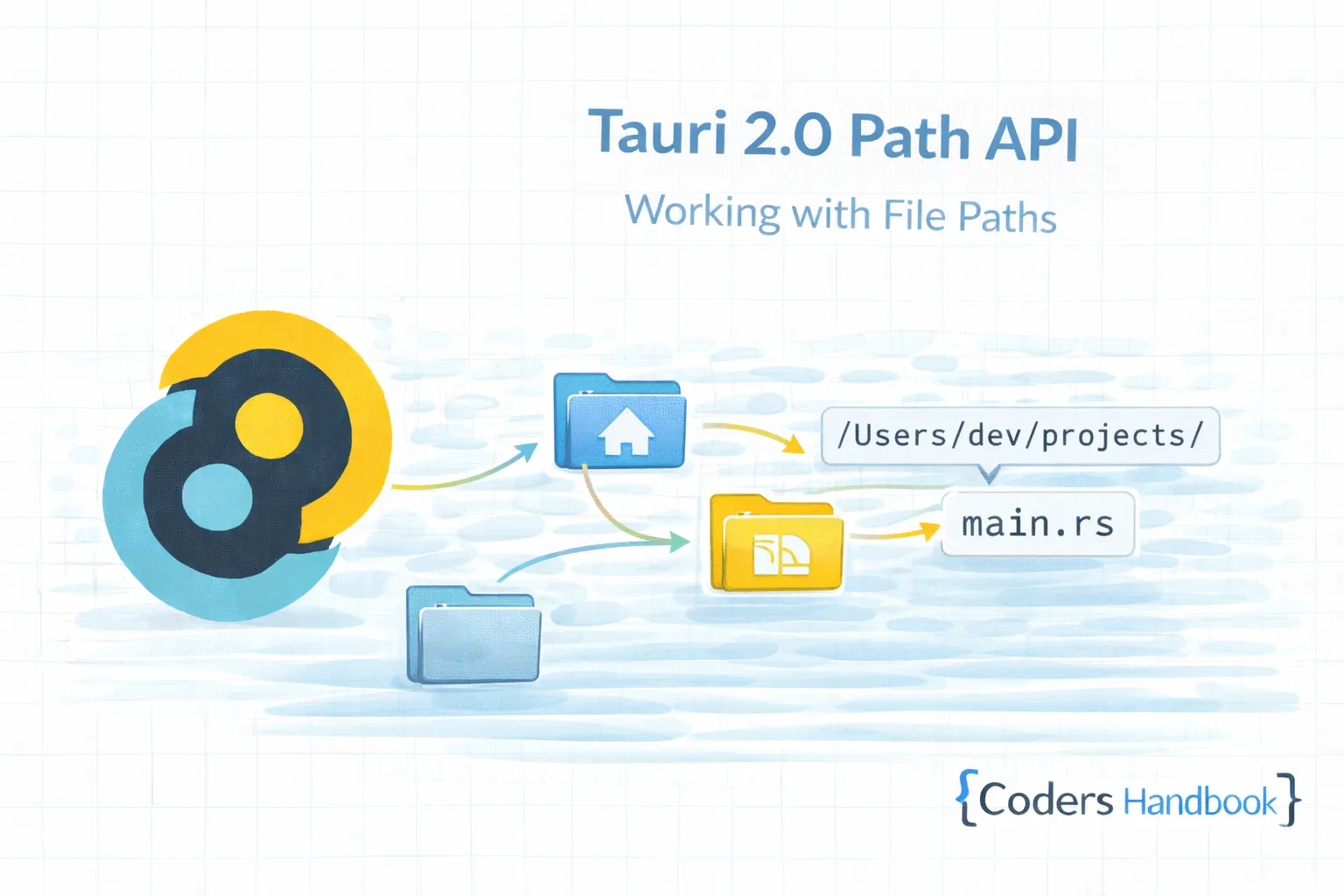
Path API in Tauri 2.0 provides cross-platform utilities for working with file system paths accessing system directories, resolving resource locations, and handling path operations maintaining consistency across Windows, macOS, and Linux—essential functionality for applications requiring file storage, configuration management, resource access, or user data handling maintaining portable path operations working reliably across different operating systems. Path system combines directory getters accessing standard system folders like app data, documents, and downloads with resource resolvers locating bundled application assets, path utilities joining and normalizing paths, and platform abstraction handling Windows backslashes versus Unix forward slashes delivering unified path management interface. This comprehensive guide covers understanding path architecture and platform differences, accessing app directories for configuration and data storage, locating resource paths for bundled assets, resolving user directories with proper permissions, handling path joining and normalization cross-platform, implementing path validation ensuring security, building configuration managers with proper storage locations, and creating real-world examples including settings system with app data storage, resource loader with asset bundling, and file organizer with directory management maintaining reliable path operations across all platforms. Mastering Path API patterns enables building professional desktop applications handling file paths correctly maintaining data persistence and resource access working identically on Windows, macOS, and Linux. Before proceeding, understand file system operations and shell API.
Accessing System Directories
System directories provide standard locations for application data, user documents, and temporary files. Understanding directory access enables building applications storing data in appropriate locations respecting platform conventions and user expectations.
// Frontend: Access system directories
import {
  appDataDir,
  appConfigDir,
  appCacheDir,
  appLogDir,
  audioDir,
  cacheDir,
  configDir,
  dataDir,
  desktopDir,
  documentDir,
  downloadDir,
  executableDir,
  fontDir,
  homeDir,
  localDataDir,
  pictureDir,
  publicDir,
  runtimeDir,
  templateDir,
  videoDir,
  resourceDir,
  tempDir,
} from '@tauri-apps/api/path';

// Get common directories
async function getCommonPaths() {
  const paths = {
    appData: await appDataDir(),      // App-specific data
    appConfig: await appConfigDir(),  // App configuration
    appCache: await appCacheDir(),    // App cache
    appLog: await appLogDir(),        // App logs
    home: await homeDir(),            // User home
    documents: await documentDir(),   // User documents
    downloads: await downloadDir(),   // Downloads folder
    desktop: await desktopDir(),      // Desktop folder
    pictures: await pictureDir(),     // Pictures folder
    videos: await videoDir(),         // Videos folder
    temp: await tempDir(),            // Temporary files
    resources: await resourceDir(),   // Bundled resources
  };

  console.log('System paths:', paths);
  return paths;
}

// Example paths on different platforms:
// Windows:
//   appData: C:\Users\Username\AppData\Roaming\com.myapp.app
//   appConfig: C:\Users\Username\AppData\Roaming\com.myapp.app
//   documents: C:\Users\Username\Documents
//   temp: C:\Users\Username\AppData\Local\Temp

// macOS:
//   appData: /Users/username/Library/Application Support/com.myapp.app
//   appConfig: /Users/username/Library/Application Support/com.myapp.app
//   documents: /Users/username/Documents
//   temp: /var/folders/...

// Linux:
//   appData: /home/username/.local/share/com.myapp.app
//   appConfig: /home/username/.config/com.myapp.app
//   documents: /home/username/Documents
//   temp: /tmp

// Save application settings
import { appConfigDir } from '@tauri-apps/api/path';
import { writeTextFile, readTextFile } from '@tauri-apps/api/fs';
import { join } from '@tauri-apps/api/path';

interface AppSettings {
  theme: string;
  language: string;
  fontSize: number;
}

class SettingsManager {
  private settingsPath: string | null = null;

  async init() {
    const configDir = await appConfigDir();
    this.settingsPath = await join(configDir, 'settings.json');
  }

  async save(settings: AppSettings): Promise<void> {
    if (!this.settingsPath) await this.init();
    await writeTextFile(this.settingsPath!, JSON.stringify(settings, null, 2));
  }

  async load(): Promise<AppSettings | null> {
    try {
      if (!this.settingsPath) await this.init();
      const content = await readTextFile(this.settingsPath!);
      return JSON.parse(content);
    } catch (error) {
      console.log('No settings file found, using defaults');
      return null;
    }
  }
}

// Usage
const settings = new SettingsManager();
await settings.save({ theme: 'dark', language: 'en', fontSize: 14 });
const loaded = await settings.load();

// React component using paths
import React, { useEffect, useState } from 'react';

const PathInfo: React.FC = () => {
  const [paths, setPaths] = useState<Record<string, string>>({});

  useEffect(() => {
    loadPaths();
  }, []);

  const loadPaths = async () => {
    setPaths({
      'App Data': await appDataDir(),
      'App Config': await appConfigDir(),
      'Documents': await documentDir(),
      'Downloads': await downloadDir(),
      'Desktop': await desktopDir(),
      'Pictures': await pictureDir(),
      'Home': await homeDir(),
    });
  };

  return (
    <div className="path-info">
      <h2>System Directories</h2>
      <table>
        <thead>
          <tr>
            <th>Directory</th>
            <th>Path</th>
          </tr>
        </thead>
        <tbody>
          {Object.entries(paths).map(([name, path]) => (
            <tr key={name}>
              <td>{name}</td>
              <td><code>{path}</code></td>
            </tr>
          ))}
        </tbody>
      </table>
    </div>
  );
};
Path Manipulation and Utilities
Path utilities provide cross-platform operations for joining, resolving, and normalizing paths. Understanding path manipulation enables building applications handling file paths correctly regardless of operating system maintaining consistent path handling.
// Path manipulation utilities
import { join, resolve, normalize, basename, dirname, extname } from '@tauri-apps/api/path';

// Join path segments
const fullPath = await join('path', 'to', 'file.txt');
// Windows: path\to\file.txt
// Unix: path/to/file.txt

// Resolve absolute path
const absolutePath = await resolve('relative', 'path', 'file.txt');

// Normalize path (remove redundant separators)
const normalized = await normalize('path//to///file.txt');
// Result: path/to/file.txt

// Get filename from path
const filename = await basename('/path/to/document.pdf');
// Result: document.pdf

// Get directory from path
const directory = await dirname('/path/to/document.pdf');
// Result: /path/to

// Get file extension
const extension = await extname('document.pdf');
// Result: .pdf

// Complete path handling example
import { appDataDir, join } from '@tauri-apps/api/path';
import { createDir, exists, writeTextFile } from '@tauri-apps/api/fs';

class FileManager {
  private baseDir: string | null = null;

  async init() {
    this.baseDir = await appDataDir();
  }

  async ensureDirectory(subPath: string): Promise<string> {
    if (!this.baseDir) await this.init();

    const fullPath = await join(this.baseDir!, subPath);

    if (!(await exists(fullPath))) {
      await createDir(fullPath, { recursive: true });
    }

    return fullPath;
  }

  async getFilePath(category: string, filename: string): Promise<string> {
    const categoryDir = await this.ensureDirectory(category);
    return await join(categoryDir, filename);
  }

  async saveFile(category: string, filename: string, content: string) {
    const filePath = await this.getFilePath(category, filename);
    await writeTextFile(filePath, content);
    return filePath;
  }
}

// Usage
const fileManager = new FileManager();
await fileManager.init();

// Save files in organized directories
await fileManager.saveFile('logs', 'app.log', 'Log content');
await fileManager.saveFile('data', 'user-data.json', JSON.stringify({ name: 'John' }));
await fileManager.saveFile('cache', 'temp.txt', 'Cached data');

// Cross-platform path builder
class PathBuilder {
  private segments: string[] = [];

  add(...parts: string[]): PathBuilder {
    this.segments.push(...parts);
    return this;
  }

  async build(): Promise<string> {
    return await join(...this.segments);
  }

  reset(): PathBuilder {
    this.segments = [];
    return this;
  }
}

// Usage
const builder = new PathBuilder();
const path1 = await builder.add('users', 'john', 'documents').build();
const path2 = await builder.reset().add('images', '2024', 'photo.jpg').build();

// Rust: Backend path operations
use std::path::{Path, PathBuf};
use tauri::api::path::{app_data_dir, app_config_dir};

#[tauri::command]
async fn get_app_file_path(
    config: tauri::Config,
    filename: String,
) -> Result<String, String> {
    let app_data = app_data_dir(&config)
        .ok_or("Could not determine app data directory")?;

    let file_path = app_data.join(filename);

    Ok(file_path.to_string_lossy().to_string())
}

#[tauri::command]
async fn join_paths(
    base: String,
    segments: Vec<String>,
) -> Result<String, String> {
    let mut path = PathBuf::from(base);

    for segment in segments {
        path.push(segment);
    }

    Ok(path.to_string_lossy().to_string())
}

#[tauri::command]
async fn get_path_info(path: String) -> Result<PathInfo, String> {
    let path_obj = Path::new(&path);

    Ok(PathInfo {
        filename: path_obj.file_name()
            .and_then(|n| n.to_str())
            .unwrap_or("")
            .to_string(),
        directory: path_obj.parent()
            .and_then(|p| p.to_str())
            .unwrap_or("")
            .to_string(),
        extension: path_obj.extension()
            .and_then(|e| e.to_str())
            .unwrap_or("")
            .to_string(),
        is_absolute: path_obj.is_absolute(),
    })
}

#[derive(serde::Serialize)]
struct PathInfo {
    filename: String,
    directory: String,
    extension: String,
    is_absolute: bool,
}
Resource and Asset Paths
Resource paths locate bundled application assets like images, fonts, or data files. Understanding resource access enables building applications with properly bundled assets accessible through consistent paths across platforms.
// Access bundled resources
import { resourceDir, join } from '@tauri-apps/api/path';
import { readTextFile, readBinaryFile } from '@tauri-apps/api/fs';
import { convertFileSrc } from '@tauri-apps/api/tauri';

// Resource manager
class ResourceManager {
  private resourcePath: string | null = null;

  async init() {
    this.resourcePath = await resourceDir();
  }

  async getResourcePath(relativePath: string): Promise<string> {
    if (!this.resourcePath) await this.init();
    return await join(this.resourcePath!, relativePath);
  }

  async loadTextResource(path: string): Promise<string> {
    const fullPath = await this.getResourcePath(path);
    return await readTextFile(fullPath);
  }

  async loadBinaryResource(path: string): Promise<Uint8Array> {
    const fullPath = await this.getResourcePath(path);
    return await readBinaryFile(fullPath);
  }

  async getAssetUrl(path: string): Promise<string> {
    const fullPath = await this.getResourcePath(path);
    return convertFileSrc(fullPath);
  }
}

// Usage
const resources = new ResourceManager();
await resources.init();

// Load text file
const readme = await resources.loadTextResource('README.txt');
console.log(readme);

// Load image for display
const imageUrl = await resources.getAssetUrl('images/logo.png');
// Use in img tag: <img src={imageUrl} />

// React component for resource images
import React, { useState, useEffect } from 'react';

interface ResourceImageProps {
  path: string;
  alt: string;
}

const ResourceImage: React.FC<ResourceImageProps> = ({ path, alt }) => {
  const [src, setSrc] = useState<string>('');

  useEffect(() => {
    loadImage();
  }, [path]);

  const loadImage = async () => {
    const resources = new ResourceManager();
    const url = await resources.getAssetUrl(path);
    setSrc(url);
  };

  return src ? <img src={src} alt={alt} /> : <div>Loading...</div>;
};

// Configuration file loader
class ConfigLoader {
  async loadAppConfig(): Promise<any> {
    try {
      const resources = new ResourceManager();
      const configText = await resources.loadTextResource('config.json');
      return JSON.parse(configText);
    } catch (error) {
      console.error('Failed to load config:', error);
      return {};
    }
  }

  async loadLanguageFile(locale: string): Promise<Record<string, string>> {
    try {
      const resources = new ResourceManager();
      const langFile = `locales/${locale}.json`;
      const content = await resources.loadTextResource(langFile);
      return JSON.parse(content);
    } catch (error) {
      console.error(`Failed to load language file for ${locale}:`, error);
      return {};
    }
  }
}

// Usage
const configLoader = new ConfigLoader();
const appConfig = await configLoader.loadAppConfig();
const translations = await configLoader.loadLanguageFile('en');
Platform-Specific Path Handling
| Platform | Path Separator | App Data Location | Example Path |
|---|---|---|---|
| Windows | Backslash (\) | %APPDATA% | C:\Users\Name\AppData\Roaming\app |
| macOS | Forward slash (/) | ~/Library/Application Support | /Users/name/Library/Application Support/app |
| Linux | Forward slash (/) | ~/.local/share | /home/name/.local/share/app |
Path API Best Practices
- Use Path API: Always use Tauri path functions for cross-platform compatibility
- Join Paths: Use join() instead of string concatenation
- Normalize Paths: Call normalize() on user-provided paths
- Check Existence: Verify files exist before accessing
- Create Directories: Ensure parent directories exist before writing
- Handle Errors: Catch path resolution failures gracefully
- Validate Input: Sanitize user-provided paths preventing traversal
- Use Appropriate Directories: Store data in correct system folders
- Cache Path Resolutions: Avoid repeated directory lookups
- Test Cross-Platform: Verify path handling on all target OSes
Next Steps
- Logging & Debugging: Development tools with logging system
- File System: File operations with filesystem API
- Shell API: Opening files with shell operations
- Commands: Backend integration with Rust commands
- Getting Started: Review basics with first app
Conclusion
Mastering Path API in Tauri 2.0 enables building professional desktop applications handling file paths correctly across Windows, macOS, and Linux maintaining consistent path operations regardless of platform differences in separators, directory structures, or naming conventions delivering reliable cross-platform file handling users expect from desktop applications. Path system combines directory getters accessing standard system folders for app data, configuration, and user documents with resource resolvers locating bundled assets, path utilities joining and normalizing paths cross-platform, and platform abstraction handling operating system differences automatically delivering unified path management interface. Understanding Path API patterns including system directory access with appropriate storage locations, path manipulation with cross-platform utilities, resource path resolution for bundled assets, platform difference handling with consistent APIs, and best practices maintaining security and compatibility establishes foundation for building professional desktop applications delivering reliable file path handling maintaining data persistence and resource access working identically across all supported platforms users depend on!
$ share --platform
$ cat /comments/ (0)
$ cat /comments/
// No comments found. Be the first!