Mastering Data Connections: Effective Joins and Modeling Techniques
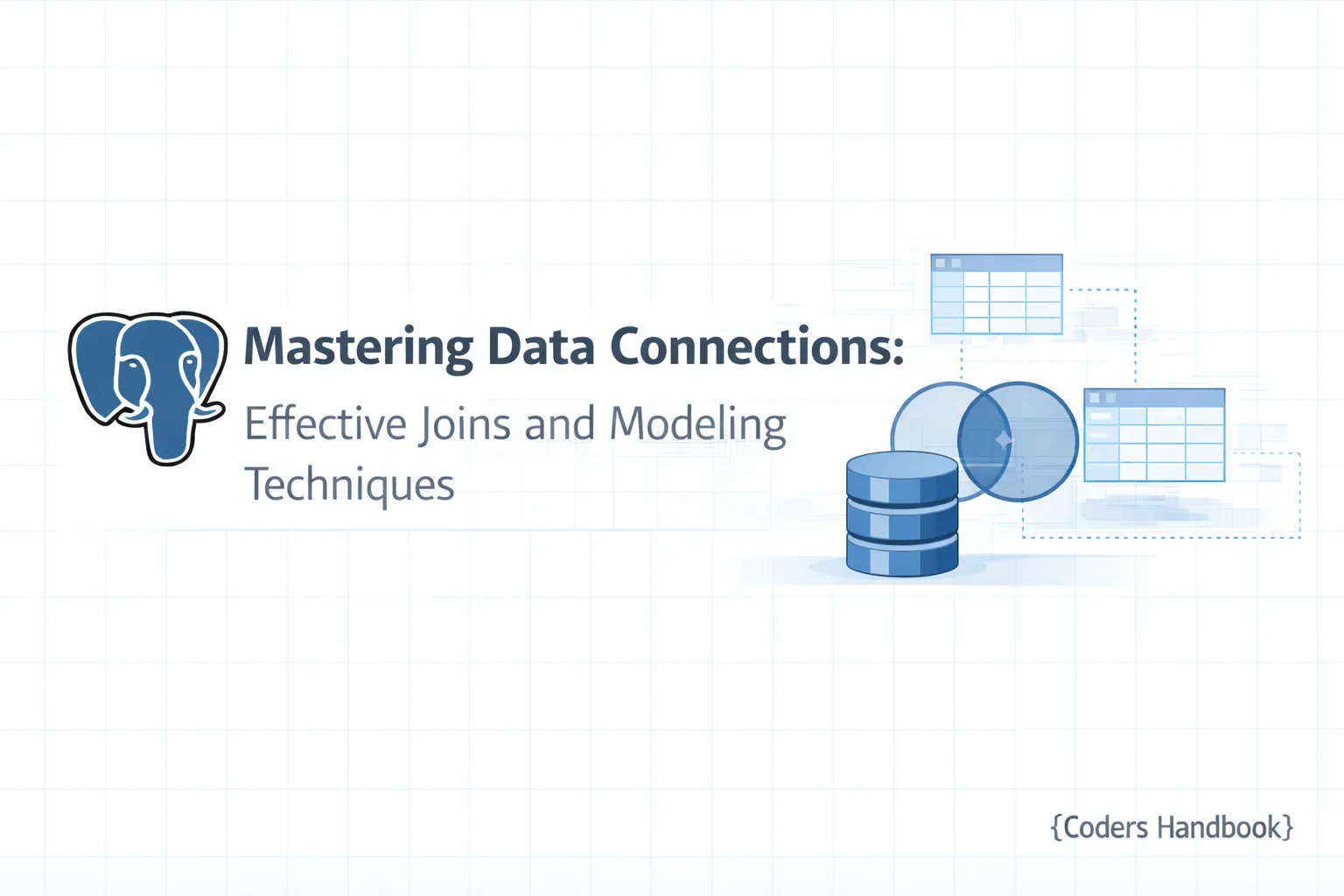
Relationships, Joins, and Data Modeling in PostgreSQL
In the world of databases, understanding how to establish effective relationships and utilize joins is crucial for creating efficient data models. In this blog post, we'll explore the intricacies of data relationships, the types of joins in SQL, and the best practices for data modeling, specifically within the context of PostgreSQL. This article is part 6 of the "PostgreSQL Complete Guide: Beginner to Advanced" tutorial series, building upon concepts introduced in previous parts.
Prerequisites
Before diving into the content, ensure you have:
- A basic understanding of PostgreSQL and SQL commands (as covered in Part 4).
- Familiarity with data structures and types (refer to Part 3).
- PostgreSQL installed and configured on your machine.
Understanding the Basics of Relationships in Data Modeling
In data modeling, a relationship defines how two or more tables interact with one another. Relationships are fundamental to organizing data efficiently and ensuring data integrity. The main types of relationships are:
- One-to-One (1:1): A single record in one table relates to a single record in another table.
- One-to-Many (1:N): A single record in one table relates to multiple records in another table.
- Many-to-Many (M:N): Multiple records in one table relate to multiple records in another table, often requiring a junction table.
Example of Relationships
For instance, consider a users and profiles table:
- One-to-One: Each user has one profile.
- One-to-Many: A user can have multiple posts.
- Many-to-Many: A student can enroll in multiple courses, and a course can have multiple students.
Types of Joins: An Overview
In SQL, a join is a way to combine rows from two or more tables based on a related column. Understanding joins is critical for retrieving data effectively. The main types of joins are:
- Inner Join: Returns records that have matching values in both tables.
- Outer Join: Includes records with no match in one of the tables.
- Left Outer Join: Returns all records from the left table and matched records from the right.
- Right Outer Join: Returns all records from the right table and matched records from the left.
- Full Outer Join: Returns all records when there is a match in either left or right table.
- Cross Join: Returns the Cartesian product of both tables.
SQL Join Examples
Let’s demonstrate these joins with SQL commands using PostgreSQL. Assume we have two tables: users and posts.
CREATE TABLE users (
    user_id SERIAL PRIMARY KEY,
    username VARCHAR(50)
);

CREATE TABLE posts (
    post_id SERIAL PRIMARY KEY,
    user_id INT REFERENCES users(user_id),
    content TEXT
);
Inner Join Example
SELECT users.username, posts.content
FROM users
INNER JOIN posts ON users.user_id = posts.user_id;
Expected Output: List of usernames and their corresponding posts.
Left Outer Join Example
SELECT users.username, posts.content
FROM users
LEFT JOIN posts ON users.user_id = posts.user_id;
Expected Output: All usernames, including those without posts, displaying NULL for the content.
The Importance of Data Relationships in Database Design
Relationships are pivotal in ensuring that data is accurate and accessible. They enforce data integrity through:
- Primary Keys (PK): Unique identifiers for table records.
- Foreign Keys (FK): Fields that link two tables together, usually referencing the primary key of another table.
Establishing Relationships with Keys
Here’s how you establish relationships with keys:
- Define a primary key in the parent table (e.g.,
users). - Create a foreign key in the child table (e.g.,
posts) that references the parent table’s primary key.
Example
ALTER TABLE posts
ADD CONSTRAINT fk_user
FOREIGN KEY (user_id)
REFERENCES users(user_id);
How to Create Effective Data Models
Creating an effective data model involves careful planning and design. Follow these steps:
- Identify Entities and Relationships:
- List all entities (e.g., users, posts, comments).
- Define relationships (1:1, 1:N, M:N).
- Normalize Data: Apply normalization techniques to reduce redundancy. Aim for at least the third normal form (3NF):
- 1NF: Ensure each table has a primary key and that all records are unique.
- 2NF: Remove partial dependencies; all non-key attributes should depend on the entire primary key.
- 3NF: Remove transitive dependencies; non-key attributes should not depend on other non-key attributes.
- Denormalization (if necessary): In some cases, for performance reasons, you might want to denormalize data. This involves combining tables to reduce the number of joins.
- Diagram Your Model: Use Entity-Relationship Diagrams (ERDs) to visualize relationships.
Common Mistakes in Relationships and Joins
- Not Enforcing Referential Integrity: Failing to establish foreign keys leads to orphaned records.
- Overusing Joins: Complex joins can lead to performance issues. Aim for simplicity.
- Ignoring Normalization: Skipping normalization can result in data anomalies.
- Misunderstanding Join Outputs: Always account for possible
NULLvalues in outer joins.
Troubleshooting Tips
- If you encounter unexpected results with joins, double-check your join conditions.
- Use
EXPLAINto analyze the performance of your queries and optimize them as needed.
Real-World Applications of Data Modeling Techniques
Data modeling techniques are applicable across various industries:
- E-Commerce: Managing users, products, and orders with effective relationships.
- Healthcare: Connecting patients, treatments, and diagnoses.
- Education: Handling students, courses, and enrollments efficiently.
Case Study: E-Commerce Database
In an e-commerce platform, a user table, an orders table, and a products table can be related through one-to-many relationships, allowing for efficient data retrieval and management.
Best Practices for Optimizing Joins in SQL
To optimize performance when using joins, consider the following best practices:
- Use Indexes: Index foreign keys to speed up joins.
- Limit Result Set: Use
WHEREclauses to filter data early in the query. - Avoid Cross Joins: Unless necessary, as they can produce large datasets.
- Analyze Query Plans: Regularly review and optimize your queries using
EXPLAIN.
Tools and Resources for Data Modeling and Analysis
- pgAdmin: A powerful tool for managing PostgreSQL databases.
- DBeaver: An open-source database tool that supports multiple databases, including PostgreSQL.
- Lucidchart: For creating ERDs visually to plan your database schema effectively.
Conclusion
Understanding relationships and joins in PostgreSQL is essential for creating robust data models. By following the techniques and best practices outlined in this article, you can design efficient databases that ensure data integrity and performance. As we move forward in this series, we will explore advanced database querying techniques and how to leverage PostgreSQL for complex data scenarios. Stay tuned for the next installment of the "PostgreSQL Complete Guide: Beginner to Advanced."
For more insights and to deepen your knowledge about PostgreSQL, feel free to leave your comments or questions below!
$ share --platform
$ cat /comments/ (0)
$ cat /comments/
// No comments found. Be the first!