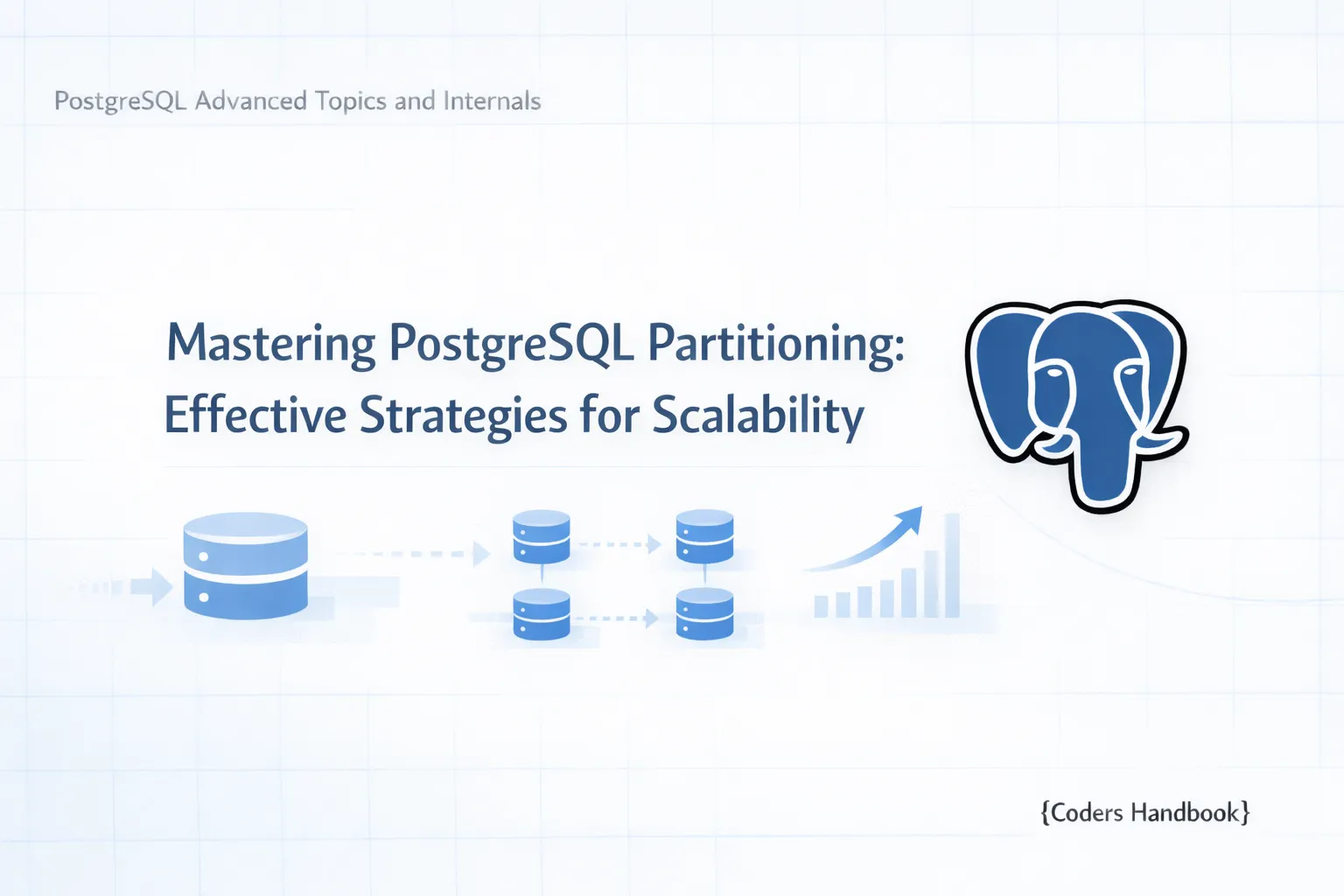
Mastering PostgreSQL Partitioning: Effective Strategies for Scalability
PostgreSQL Partitioning at Scale: What Actually Works
Prerequisites
Before diving into PostgreSQL partitioning, ensure you have the following:
- PostgreSQL Installed: A version of PostgreSQL 10 or higher is recommended, as partitioning features have improved significantly in these versions.
- Basic SQL Knowledge: Familiarity with SQL commands and PostgreSQL syntax.
- Database Setup: A PostgreSQL database set up where you can create and manipulate tables.
Understanding PostgreSQL Partitioning: An Overview
PostgreSQL partitioning is a method to divide large tables into smaller, more manageable pieces, called partitions. Each partition can be queried independently, which can lead to improved performance and easier data management. By segmenting data based on specific criteria, such as date ranges or categories, PostgreSQL can optimize the way it retrieves and processes data.
Benefits of Partitioning in PostgreSQL
- Improved Query Performance: Queries that target specific partitions can execute faster since they scan only a subset of the data.
- Easier Data Management: Maintaining partitions can simplify tasks such as archiving old data or purging obsolete records.
- Enhanced Concurrency: Multiple transactions can occur simultaneously on different partitions, reducing lock contention.
- Targeted Indexing: You can create indexes on partitions based on their structure, which can lead to better performance.
Types of Partitioning Strategies in PostgreSQL
PostgreSQL supports several partitioning strategies, each suitable for different use cases.
1. Range Partitioning
In range partitioning, data is divided based on value ranges of a certain column. This is particularly useful for time-series data.
Example: Creating monthly partitions for a sales table.
CREATE TABLE sales (
    id SERIAL PRIMARY KEY,
    sale_date DATE NOT NULL,
    amount NUMERIC
) PARTITION BY RANGE (sale_date);

CREATE TABLE sales_jan2023 PARTITION OF sales
    FOR VALUES FROM ('2023-01-01') TO ('2023-02-01');

CREATE TABLE sales_feb2023 PARTITION OF sales
    FOR VALUES FROM ('2023-02-01') TO ('2023-03-01');
2. List Partitioning
List partitioning allows you to segment data based on a specific list of values. This is useful for categorical data.
Example: Partitioning a table based on regions.
CREATE TABLE customers (
    id SERIAL PRIMARY KEY,
    region VARCHAR NOT NULL
) PARTITION BY LIST (region);

CREATE TABLE customers_north PARTITION OF customers
    FOR VALUES IN ('North');

CREATE TABLE customers_south PARTITION OF customers
    FOR VALUES IN ('South');
3. Hash Partitioning
Hash partitioning uses a hash function to distribute data evenly across a specified number of partitions. This is useful for balancing loads.
Example: Hash partitioning on user IDs.
CREATE TABLE users (
    id SERIAL PRIMARY KEY,
    username VARCHAR NOT NULL
) PARTITION BY HASH (id);

CREATE TABLE users_p0 PARTITION OF users FOR VALUES WITH (MODULUS 4, REMAINDER 0);
CREATE TABLE users_p1 PARTITION OF users FOR VALUES WITH (MODULUS 4, REMAINDER 1);
Best Practices for Implementing Partitioning at Scale
- Choose the Right Strategy: Assess your data access patterns and select a partitioning strategy that aligns with your queries.
- Plan for Growth: Create partitions that can accommodate future data. For example, if using range partitioning for dates, create partitions for upcoming months.
- Monitor Partition Size: Regularly check the size of your partitions. Ideally, keep partitions under a certain size (e.g., 1GB) to maintain performance.
- Use Indexes Wisely: Each partition can have its own indexes, but avoid over-indexing, which can slow down insert operations.
Common Pitfalls and How to Avoid Them
- Improper Partitioning Key: Choosing an inappropriate partitioning key can lead to skewed data distribution. Monitor your data distribution and adjust as necessary.
- Neglecting Maintenance: Regularly manage and vacuum partitions to avoid bloat. Use the
VACUUMcommand on partitions to reclaim storage. - Ignoring Query Patterns: Failing to analyze query patterns can lead to suboptimal performance. Use the
EXPLAINcommand to understand how queries interact with partitions.
Performance Optimization Techniques for Partitioned Tables
- Partition Pruning: Ensure that your queries leverage partition pruning, which allows PostgreSQL to skip scanning irrelevant partitions.
- Manage Indexes: Create indexes on partitions based on the queries that will be run. This can significantly enhance performance.
- Use Parallel Querying: Take advantage of PostgreSQL's ability to run parallel queries on partitions to improve performance for large datasets.
Monitoring and Maintaining Partitioned Databases
- Regularly Check Partition Size: Use the following command to monitor partition sizes:
SELECT relname, pg_size_pretty(pg_total_relation_size(relid)) AS size
FROM pg_partitioned_table pt JOIN pg_class c ON pt.partid = c.oid;- Automate Partition Creation: Use triggers or scheduled jobs to create new partitions automatically as needed.
- Analyze and Vacuum: Regularly run the
ANALYZEcommand on partitions to update statistics, which helps the query planner make informed decisions.
Real-World Use Cases: Successful PostgreSQL Partitioning Implementations
- E-commerce Platforms: Many e-commerce platforms use range partitioning to manage transaction data, allowing them to quickly access sales data for specific months or years.
- Data Warehousing: Companies leveraging PostgreSQL for data warehousing often implement list partitioning to manage data from various departments like sales, HR, and finance.
Case Study: Retail Analytics
A retail company implemented range partitioning for their sales records based on transaction date. This allowed them to archive older data efficiently while ensuring that queries for recent sales remained fast. They encountered challenges with data skew, which they mitigated by regularly redistributing their data.
Conclusion
PostgreSQL partitioning at scale provides significant benefits for performance and management, making it an essential technique for handling large datasets. By understanding the various partitioning strategies and adhering to best practices, you can optimize your PostgreSQL database for scalability and efficiency.
As we venture into Part 7 of our PostgreSQL Advanced Topics and Internals series, we will explore advanced indexing techniques that further enhance performance in partitioned databases.
Feel free to leave a comment or question below if you have any concerns or need clarification on PostgreSQL partitioning at scale!
$ share --platform
$ cat /comments/ (0)
$ cat /comments/
// No comments found. Be the first!