Supabase JSON and JSONB: Working with JSON Data
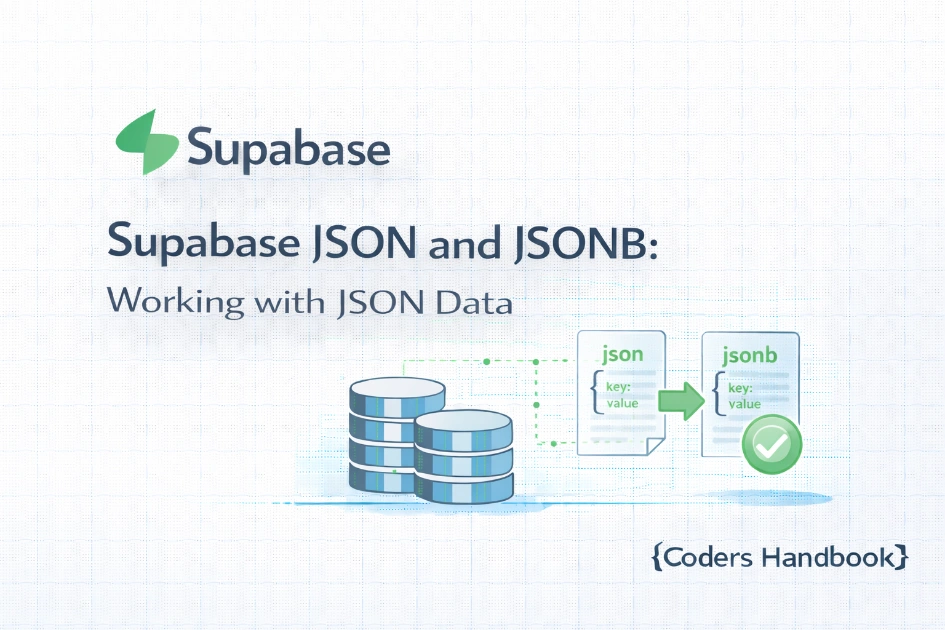
PostgreSQL JSONB operations in Supabase enable storing, querying, and manipulating semi-structured data with flexibility of NoSQL databases while maintaining relational database benefits including transactions, consistency, and powerful query capabilities creating hybrid data storage supporting dynamic schemas, nested objects, arrays, and complex filtering. Unlike traditional rigid schemas requiring migrations for every field addition, JSONB columns provide schema flexibility storing complex nested data structures, user-generated metadata, dynamic configurations, feature flags, and polymorphic data without database alterations while maintaining indexing and query performance. This comprehensive guide covers understanding JSONB data type and storage format, creating tables with JSONB columns, querying JSONB data with operators and path expressions, indexing JSONB for performance with GIN indexes, updating nested JSONB values, validating JSONB structure with constraints, using JSONB in application code, and optimizing JSONB query performance. JSONB operations demonstrate PostgreSQL's powerful JSON support combining flexibility with performance. Before starting, review database basics, queries, and performance optimization.
JSONB Fundamentals
| Operation | Operator | Example |
|---|---|---|
| Extract field | -> or ->> | data->'name' or data->>'name' |
| Extract path | #> or #>> | data#>'{user,email}' |
| Contains | @> | data @> '{"status":"active"}' |
| Contained by | <@ | '{"a":1}' <@ data |
| Has key | ? | data ? 'email' |
| Has any keys | ?| | data ?| array['a','b'] |
| Has all keys | ?& | data ?& array['a','b'] |
Creating Tables with JSONB
-- Simple JSONB column
create table products (
  id uuid default gen_random_uuid() primary key,
  name text not null,
  price numeric(10,2) not null,
  metadata jsonb, -- Store flexible product attributes
  created_at timestamp with time zone default now()
);

-- Multiple JSONB columns with different purposes
create table user_profiles (
  id uuid references auth.users on delete cascade primary key,
  username text unique not null,
  settings jsonb default '{}', -- User preferences
  profile_data jsonb default '{}', -- Bio, social links, etc.
  feature_flags jsonb default '{}', -- Feature access control
  created_at timestamp with time zone default now()
);

-- JSONB with default values
create table projects (
  id uuid default gen_random_uuid() primary key,
  name text not null,
  config jsonb default '{
    "notifications": true,
    "theme": "light",
    "language": "en"
  }'::jsonb,
  custom_fields jsonb default '[]'::jsonb, -- Array of custom fields
  created_at timestamp with time zone default now()
);

-- JSONB with constraints
create table events (
  id uuid default gen_random_uuid() primary key,
  event_type text not null,
  event_data jsonb not null,
  user_id uuid references auth.users(id),
  created_at timestamp with time zone default now(),

  -- Constraint: event_data must have 'action' key
  constraint event_data_has_action check (event_data ? 'action'),

  -- Constraint: event_data.action must be one of allowed values
  constraint valid_action check (
    event_data->>'action' in ('click', 'view', 'submit', 'delete')
  )
);

-- Insert JSONB data
insert into products (name, price, metadata) values
  ('T-Shirt', 29.99, '{
    "color": "blue",
    "size": "M",
    "material": "cotton",
    "tags": ["casual", "summer"]
  }'),
  ('Laptop', 999.99, '{
    "brand": "TechCo",
    "specs": {
      "cpu": "Intel i7",
      "ram": "16GB",
      "storage": "512GB SSD"
    },
    "warranty_years": 2
  }');

insert into user_profiles (id, username, settings, profile_data) values
  (gen_random_uuid(), 'john_doe',
   '{"theme": "dark", "notifications": {"email": true, "push": false}}',
   '{"bio": "Software Developer", "location": "San Francisco", "website": "example.com"}'
  );
Querying JSONB Data
-- Extract top-level field (returns JSON)
select
  name,
  metadata->'color' as color_json,
  metadata->>'color' as color_text  -- Returns text
from products;

-- Extract nested field
select
  name,
  metadata#>'{specs,cpu}' as cpu_json,
  metadata#>>'{specs,cpu}' as cpu_text
from products;

-- Filter by JSONB field
select * from products
where metadata->>'color' = 'blue';

-- Filter by nested field
select * from products
where metadata#>>'{specs,ram}' = '16GB';

-- Check if JSONB contains data
select * from products
where metadata @> '{"color": "blue"}';

-- Check if key exists
select * from products
where metadata ? 'warranty_years';

-- Check multiple keys exist
select * from products
where metadata ?& array['color', 'size'];

-- Check any key exists
select * from products
where metadata ?| array['color', 'brand'];

-- Query JSONB array elements
select
  name,
  jsonb_array_elements_text(metadata->'tags') as tag
from products
where metadata ? 'tags';

-- Filter by array contains
select * from products
where metadata->'tags' @> '"summer"';

-- Aggregate JSONB data
select
  metadata->>'color' as color,
  count(*) as count,
  avg(price) as avg_price
from products
where metadata ? 'color'
group by metadata->>'color';

-- Complex nested query
select
  u.username,
  u.settings->>'theme' as theme,
  u.settings#>>'{notifications,email}' as email_notifications,
  u.profile_data->>'bio' as bio
from user_profiles u
where
  u.settings @> '{"theme": "dark"}'
  and u.settings#>>'{notifications,email}' = 'true';

-- Search in JSONB text content
select * from products
where metadata::text ilike '%cotton%';

-- Convert JSONB to rows
select
  p.name,
  kv.key as attribute,
  kv.value as value
from products p,
lateral jsonb_each(p.metadata) kv;

-- Expand nested objects
select
  p.name,
  specs.key as spec_name,
  specs.value as spec_value
from products p,
lateral jsonb_each(p.metadata->'specs') specs
where p.metadata ? 'specs';

-- JSON path queries (PostgreSQL 12+)
select
  name,
  jsonb_path_query(metadata, '$.specs.cpu') as cpu,
  jsonb_path_exists(metadata, '$.tags[*] ? (@ == "summer")') as has_summer_tag
from products;
Updating JSONB Data
-- Replace entire JSONB column
update products
set metadata = '{"color": "red", "size": "L"}'
where id = 'some-uuid';

-- Set specific field (top-level)
update products
set metadata = jsonb_set(
  metadata,
  '{color}',
  '"red"'
)
where id = 'some-uuid';

-- Set nested field
update products
set metadata = jsonb_set(
  metadata,
  '{specs,ram}',
  '"32GB"'
)
where id = 'some-uuid';

-- Add new field
update products
set metadata = metadata || '{"new_field": "value"}';

-- Remove field
update products
set metadata = metadata - 'old_field';

-- Remove nested field
update products
set metadata = metadata #- '{specs,old_spec}';

-- Merge objects
update user_profiles
set settings = settings || '{
  "language": "es",
  "timezone": "PST"
}'::jsonb
where id = auth.uid();

-- Update array element
update products
set metadata = jsonb_set(
  metadata,
  '{tags,0}',  -- Update first element
  '"winter"'
)
where id = 'some-uuid';

-- Append to array
update products
set metadata = jsonb_set(
  metadata,
  '{tags}',
  (metadata->'tags') || '"new-tag"'::jsonb
)
where id = 'some-uuid';

-- Remove from array (keep elements != value)
update products
set metadata = jsonb_set(
  metadata,
  '{tags}',
  (
    select jsonb_agg(elem)
    from jsonb_array_elements(metadata->'tags') elem
    where elem::text != '"summer"'
  )
)
where id = 'some-uuid';

-- Conditional update based on JSONB value
update user_profiles
set settings = jsonb_set(
  settings,
  '{notifications,email}',
  'true'
)
where settings#>>'{notifications,email}' = 'false';

-- Increment numeric value in JSONB
update products
set metadata = jsonb_set(
  metadata,
  '{warranty_years}',
  to_jsonb((metadata->>'warranty_years')::int + 1)
)
where metadata ? 'warranty_years';

-- Function to update nested JSONB
create or replace function update_user_setting(
  p_user_id uuid,
  p_path text[],
  p_value jsonb
)
returns void as $$
begin
  update user_profiles
  set settings = jsonb_set(settings, p_path, p_value)
  where id = p_user_id;
end;
$$ language plpgsql security definer;

-- Usage:
select update_user_setting(
  auth.uid(),
  '{theme}',
  '"dark"'::jsonb
);
Indexing JSONB for Performance
-- GIN index on entire JSONB column (default operator class)
create index idx_products_metadata on products using gin(metadata);

-- GIN index with jsonb_path_ops (faster, but only supports @>, @?, @@)
create index idx_products_metadata_path on products using gin(metadata jsonb_path_ops);

-- Index specific JSONB field
create index idx_products_color on products((metadata->>'color'));

-- Index nested field
create index idx_products_cpu on products((metadata#>>'{specs,cpu}'));

-- Partial index for specific conditions
create index idx_active_users on user_profiles((settings->>'status'))
where settings @> '{"status": "active"}';

-- Expression index for case-insensitive search
create index idx_products_color_lower on products(lower(metadata->>'color'));

-- Index for array contains queries
create index idx_products_tags on products using gin((metadata->'tags'));

-- Analyze query performance
explain analyze
select * from products
where metadata @> '{"color": "blue"}';

-- Compare different index strategies
-- Without index:
explain analyze
select * from products
where metadata->>'color' = 'blue';

-- With expression index:
explain analyze
select * from products
where metadata->>'color' = 'blue';
-- Should use idx_products_color

-- Statistics for JSONB columns
select
  metadata->>'color' as color,
  count(*) as count
from products
group by metadata->>'color'
order by count desc;

-- Validate index usage
select
  schemaname,
  tablename,
  indexname,
  idx_scan,
  idx_tup_read,
  idx_tup_fetch
from pg_stat_user_indexes
where indexname like '%metadata%';
JSONB Validation and Constraints
-- Constraint: Required keys
alter table products
add constraint metadata_required_keys
check (metadata ?& array['color', 'size']);

-- Constraint: Specific value types
alter table products
add constraint metadata_price_numeric
check (
  not metadata ? 'price' or
  (metadata->>'price')::numeric > 0
);

-- Constraint: Enum values
alter table user_profiles
add constraint valid_theme
check (
  settings->>'theme' in ('light', 'dark', 'auto')
);

-- Constraint: Array length
alter table products
add constraint tags_limit
check (
  not metadata ? 'tags' or
  jsonb_array_length(metadata->'tags') <= 10
);

-- Function to validate JSONB schema
create or replace function validate_metadata_schema(data jsonb)
returns boolean as $$
begin
  -- Check required fields
  if not (data ?& array['color', 'size']) then
    raise exception 'Missing required fields: color, size';
  end if;

  -- Check data types
  if data ? 'price' then
    begin
      perform (data->>'price')::numeric;
    exception when others then
      raise exception 'Invalid price format';
    end;
  end if;

  -- Check nested structure
  if data ? 'specs' then
    if jsonb_typeof(data->'specs') != 'object' then
      raise exception 'specs must be an object';
    end if;
  end if;

  return true;
end;
$$ language plpgsql;

-- Trigger to validate on insert/update
create trigger validate_metadata
  before insert or update on products
  for each row
  execute function validate_metadata_schema_trigger();

create or replace function validate_metadata_schema_trigger()
returns trigger as $$
begin
  perform validate_metadata_schema(new.metadata);
  return new;
end;
$$ language plpgsql;

-- JSON Schema validation (requires json-schema extension)
-- Install extension
create extension if not exists jsonschema;

-- Define schema
create table json_schemas (
  id serial primary key,
  name text unique not null,
  schema jsonb not null
);

insert into json_schemas (name, schema) values
('product_metadata', '{
  "type": "object",
  "required": ["color", "size"],
  "properties": {
    "color": {"type": "string"},
    "size": {"type": "string", "enum": ["S", "M", "L", "XL"]},
    "price": {"type": "number", "minimum": 0},
    "tags": {
      "type": "array",
      "items": {"type": "string"},
      "maxItems": 10
    }
  }
}'::jsonb);

-- Validate function
create or replace function validate_against_schema(
  data jsonb,
  schema_name text
)
returns boolean as $$
declare
  schema_def jsonb;
begin
  select schema into schema_def
  from json_schemas
  where name = schema_name;

  if schema_def is null then
    raise exception 'Schema % not found', schema_name;
  end if;

  -- Validate using json-schema
  return jsonb_matches_schema(schema_def, data);
end;
$$ language plpgsql;
Using JSONB in Applications
// Querying JSONB in Supabase client
import { createClient } from '@supabase/supabase-js'

const supabase = createClient(url, key)

// Query by JSONB field
const { data: products } = await supabase
  .from('products')
  .select('*')
  .eq('metadata->>color', 'blue')

// Query nested field
const { data: laptops } = await supabase
  .from('products')
  .select('*')
  .eq('metadata->specs->>cpu', 'Intel i7')

// Contains query
const { data: activeUsers } = await supabase
  .from('user_profiles')
  .select('*')
  .contains('settings', { theme: 'dark' })

// Update JSONB field
await supabase
  .from('user_profiles')
  .update({
    settings: {
      theme: 'dark',
      notifications: {
        email: true,
        push: false
      }
    }
  })
  .eq('id', userId)

// Update specific nested field with RPC
await supabase.rpc('update_user_setting', {
  p_user_id: userId,
  p_path: ['theme'],
  p_value: 'dark'
})

// hooks/useUserSettings.ts
import { useState, useEffect } from 'react'
import { createClient } from '@/lib/supabase/client'

interface UserSettings {
  theme: 'light' | 'dark' | 'auto'
  notifications: {
    email: boolean
    push: boolean
  }
  language: string
}

export function useUserSettings() {
  const [settings, setSettings] = useState<UserSettings | null>(null)
  const [loading, setLoading] = useState(true)
  const supabase = createClient()

  useEffect(() => {
    loadSettings()
  }, [])

  async function loadSettings() {
    const { data: { user } } = await supabase.auth.getUser()
    if (!user) return

    const { data } = await supabase
      .from('user_profiles')
      .select('settings')
      .eq('id', user.id)
      .single()

    if (data) {
      setSettings(data.settings as UserSettings)
    }
    setLoading(false)
  }

  async function updateSetting(key: keyof UserSettings, value: any) {
    const { data: { user } } = await supabase.auth.getUser()
    if (!user) return

    const newSettings = { ...settings, [key]: value }

    const { error } = await supabase
      .from('user_profiles')
      .update({ settings: newSettings })
      .eq('id', user.id)

    if (!error) {
      setSettings(newSettings)
    }
  }

  async function updateNestedSetting(path: string[], value: any) {
    const { data: { user } } = await supabase.auth.getUser()
    if (!user) return

    await supabase.rpc('update_user_setting', {
      p_user_id: user.id,
      p_path: path,
      p_value: JSON.stringify(value)
    })

    await loadSettings()
  }

  return {
    settings,
    loading,
    updateSetting,
    updateNestedSetting,
  }
}

// components/SettingsForm.tsx
import { useUserSettings } from '@/hooks/useUserSettings'

export function SettingsForm() {
  const { settings, updateSetting, updateNestedSetting } = useUserSettings()

  if (!settings) return <div>Loading...</div>

  return (
    <div className="space-y-4">
      <div>
        <label className="block mb-2">Theme</label>
        <select
          value={settings.theme}
          onChange={(e) => updateSetting('theme', e.target.value)}
          className="px-4 py-2 border rounded"
        >
          <option value="light">Light</option>
          <option value="dark">Dark</option>
          <option value="auto">Auto</option>
        </select>
      </div>

      <div>
        <label className="flex items-center gap-2">
          <input
            type="checkbox"
            checked={settings.notifications.email}
            onChange={(e) =>
              updateNestedSetting(
                ['notifications', 'email'],
                e.target.checked
              )
            }
          />
          Email Notifications
        </label>
      </div>
    </div>
  )
}
JSONB Best Practices
- Use JSONB over JSON: Choose JSONB for better performance with binary storage and indexing support
- Index Frequently Queried Fields: Create GIN indexes on JSONB columns or expression indexes on specific paths
- Validate Structure: Implement constraints or triggers validating JSONB schema preventing invalid data
- Don't Overuse JSONB: Use regular columns for frequently queried structured data maintaining normalization
- Keep JSONB Flat: Avoid deep nesting making queries simpler and more performant
- Document Schema: Maintain documentation of expected JSONB structure and fields
- Monitor Query Performance: Analyze query plans ensuring indexes are used effectively
Common Issues
- Slow Queries on JSONB: Add GIN indexes or expression indexes on frequently queried paths
- Index Not Being Used: Check query uses correct operators matching index type (-> vs ->>)
- Invalid JSON Errors: Validate JSON syntax before insert, use try-catch in application code
- Type Conversion Issues: Use ->> for text extraction, cast explicitly when needed ((data->>'field')::int)
Advanced JSONB Patterns
- Implement JSON Schema validation with custom functions
- Use JSONB for event sourcing storing event payloads
- Create computed columns extracting frequently accessed JSONB fields
- Build full-text search on JSONB content with tsvector
Conclusion
PostgreSQL JSONB operations in Supabase enable flexible semi-structured data storage combining NoSQL flexibility with relational database benefits including transactions, consistency, and powerful querying creating hybrid storage supporting dynamic schemas and complex nested data. By understanding JSONB data type and binary storage format, creating tables with JSONB columns for flexible attributes, querying JSONB data with operators and path expressions, indexing JSONB for performance with GIN indexes, updating nested JSONB values with jsonb_set and merge operators, validating JSONB structure with constraints and triggers, using JSONB in application code with Supabase client, and optimizing JSONB query performance with proper indexing, you leverage PostgreSQL's powerful JSON support for modern application requirements. JSONB advantages include schema flexibility without migrations, support for nested complex structures, powerful querying with specialized operators, indexing capabilities maintaining performance, validation options ensuring data integrity, and hybrid approach combining relational and document features. Always use JSONB over JSON for better performance, index frequently queried fields with GIN or expression indexes, validate structure preventing invalid data, avoid overusing JSONB for structured data, keep nesting flat for simpler queries, document expected schema, and monitor query performance ensuring indexes work effectively. JSONB operations demonstrate PostgreSQL's versatility supporting both structured and semi-structured data in single database. Continue exploring database views and security practices.
$ share --platform
$ cat /comments/ (0)
$ cat /comments/
// No comments found. Be the first!