Supabase Database Migrations: Schema Management Guide
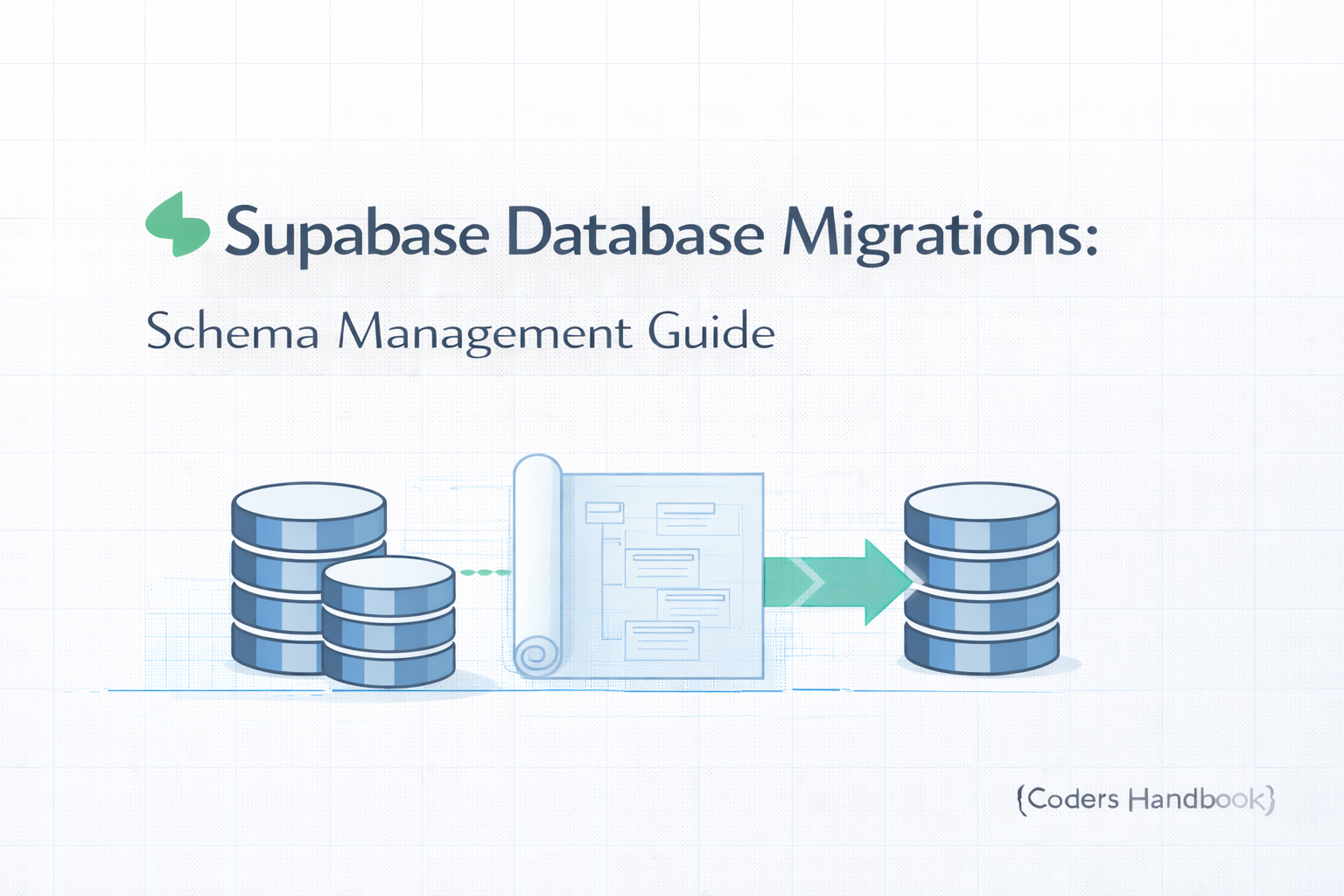
Database migrations enable systematic schema evolution through version-controlled SQL scripts, allowing teams to track database changes, deploy updates consistently across environments, rollback problematic modifications, and collaborate on schema development without conflicts. Unlike manually executing SQL commands that create inconsistencies between development, staging, and production databases, migrations provide reproducible database states ensuring all environments match exactly. This comprehensive guide covers understanding migrations concepts and importance, creating migrations locally with Supabase CLI, writing SQL migration files for tables and relationships, applying migrations to local and cloud databases, handling migration conflicts and rollbacks, team collaboration with version control, automating migrations in CI/CD pipelines, migration best practices, and debugging common issues. Migrations become critical as applications grow beyond initial prototypes requiring schema changes for new features, bug fixes, performance optimizations, and data model improvements. Before proceeding, understand database basics and Supabase CLI setup.
Why Use Database Migrations?
| Problem Without Migrations | Solution With Migrations | Benefit |
|---|---|---|
| Manual SQL changes hard to track | Version-controlled migration files | Complete change history |
| Inconsistent environments | Same migrations applied everywhere | Identical schemas |
| Difficult rollbacks | Down migrations for reverting | Safe experimentation |
| Team conflicts on schema | Sequential migration ordering | Smooth collaboration |
| Production deployments risky | Tested migrations in CI/CD | Confident releases |
Setting Up Migrations
# Install Supabase CLI
npm install -g supabase

# Login to Supabase
supabase login

# Initialize Supabase in project
cd your-project
supabase init

# This creates:
# supabase/
#   config.toml       # Project configuration
#   seed.sql          # Seed data
#   migrations/       # Migration files
#   functions/        # Edge Functions

# Link to cloud project (optional)
supabase link --project-ref your-project-ref

# Check status
supabase status
Creating Migration Files
# Create new migration
supabase migration new create_posts_table

# This creates:
# supabase/migrations/20260125120000_create_posts_table.sql
# Timestamp ensures ordering

# Generate migration from schema changes
supabase db diff -f create_posts_table

# This compares local schema with remote and generates SQL

# Create multiple migrations
supabase migration new add_comments
supabase migration new add_user_profiles
supabase migration new add_rls_policies

# Migrations are applied in chronological order by timestamp
Writing Migration SQL
-- supabase/migrations/20260125120000_create_posts_table.sql

-- Create posts table
create table if not exists posts (
  id uuid default gen_random_uuid() primary key,
  user_id uuid references auth.users(id) on delete cascade not null,
  title text not null,
  content text,
  published boolean default false,
  created_at timestamp with time zone default now() not null,
  updated_at timestamp with time zone default now() not null
);

-- Create index for faster queries
create index posts_user_id_idx on posts(user_id);
create index posts_created_at_idx on posts(created_at desc);

-- Enable Row Level Security
alter table posts enable row level security;

-- Create RLS policies
create policy "Users can view published posts"
  on posts for select
  using ( published = true or auth.uid() = user_id );

create policy "Users can create their own posts"
  on posts for insert
  with check ( auth.uid() = user_id );

create policy "Users can update their own posts"
  on posts for update
  using ( auth.uid() = user_id );

create policy "Users can delete their own posts"
  on posts for delete
  using ( auth.uid() = user_id );

-- Enable real-time
alter publication supabase_realtime add table posts;
Modifying Existing Tables
-- supabase/migrations/20260125130000_add_posts_metadata.sql

-- Add new columns
alter table posts
  add column if not exists slug text unique,
  add column if not exists views integer default 0,
  add column if not exists featured boolean default false;

-- Create index for slug lookups
create index if not exists posts_slug_idx on posts(slug);

-- Update existing data
update posts set slug = lower(replace(title, ' ', '-')) where slug is null;

-- Add constraint after data migration
alter table posts alter column slug set not null;

-- supabase/migrations/20260125140000_add_categories.sql

-- Create categories table
create table if not exists categories (
  id uuid default gen_random_uuid() primary key,
  name text unique not null,
  slug text unique not null,
  created_at timestamp with time zone default now()
);

-- Add category reference to posts
alter table posts
  add column if not exists category_id uuid references categories(id);

create index posts_category_id_idx on posts(category_id);

-- Insert default categories
insert into categories (name, slug) values
  ('Technology', 'technology'),
  ('Tutorial', 'tutorial'),
  ('News', 'news')
  on conflict do nothing;
Applying Migrations
# Start local database
supabase start

# Apply all pending migrations locally
supabase db reset

# This:
# 1. Drops local database
# 2. Recreates from scratch
# 3. Applies all migrations in order
# 4. Runs seed.sql

# Apply migrations to cloud/production
supabase db push

# This applies all local migrations to linked cloud project

# Check migration status
supabase migration list

# Output shows:
# ✓ 20260125120000_create_posts_table.sql
# ✓ 20260125130000_add_posts_metadata.sql
# ✓ 20260125140000_add_categories.sql
# ✗ 20260125150000_add_comments.sql (pending)

# Apply specific migration
supabase db execute --file supabase/migrations/20260125150000_add_comments.sql
Seeding Test Data
-- supabase/seed.sql
-- Runs after migrations on 'supabase db reset'

-- Create test users (for local development only)
insert into auth.users (id, email)
values
  ('550e8400-e29b-41d4-a716-446655440000', '[email protected]'),
  ('660e8400-e29b-41d4-a716-446655440000', '[email protected]')
  on conflict do nothing;

-- Insert sample categories
insert into categories (name, slug) values
  ('Development', 'development'),
  ('Design', 'design')
  on conflict (name) do nothing;

-- Insert sample posts
insert into posts (user_id, title, content, slug, published, category_id)
select
  '550e8400-e29b-41d4-a716-446655440000',
  'Getting Started with Supabase',
  'This is a sample post about Supabase...',
  'getting-started-with-supabase',
  true,
  (select id from categories where slug = 'development')
where not exists (select 1 from posts where slug = 'getting-started-with-supabase');

-- Seed more sample data
insert into posts (user_id, title, content, slug, published)
select
  '660e8400-e29b-41d4-a716-446655440000',
  'Draft Post',
  'This is a draft...',
  'draft-post',
  false
where not exists (select 1 from posts where slug = 'draft-post');
Rolling Back Migrations
-- Create down migration for rollback
-- supabase/migrations/20260125150000_add_comments.sql

-- Up migration
create table if not exists comments (
  id uuid default gen_random_uuid() primary key,
  post_id uuid references posts(id) on delete cascade not null,
  user_id uuid references auth.users(id) on delete cascade not null,
  content text not null,
  created_at timestamp with time zone default now()
);

-- To rollback, create reverse migration:
-- supabase/migrations/20260125160000_remove_comments.sql

drop table if exists comments cascade;

-- Alternative: Use conditional logic
-- Check if table exists before creating
-- Use IF EXISTS when dropping

-- Manual rollback via SQL Editor
-- 1. Go to Supabase Dashboard
-- 2. SQL Editor
-- 3. Execute DROP statements
-- 4. Remove migration file locally

# Reset to specific migration (local only)
supabase db reset --version 20260125130000
Team Collaboration Workflow
# Developer A creates migration
supabase migration new add_likes
# Edit migration file
git add supabase/migrations/
git commit -m "Add likes table"
git push

# Developer B pulls changes
git pull
supabase db reset  # Apply new migrations locally

# Handling conflicts:
# If two devs create migrations simultaneously,
# timestamps determine order

# Developer A: 20260125120000_add_feature_a.sql
# Developer B: 20260125120001_add_feature_b.sql
# Both apply in chronological order

# If migrations conflict (e.g., both modify same column):
# 1. Coordinate before creating migrations
# 2. Merge conflicts in Git
# 3. Test combined migrations locally
# 4. Create new migration to resolve conflicts

# Best practices:
# - Pull before creating new migrations
# - Test migrations locally before pushing
# - Keep migrations focused and small
# - Document breaking changes
CI/CD Automation
# .github/workflows/deploy.yml

name: Deploy Database Migrations

on:
  push:
    branches:
      - main

jobs:
  deploy:
    runs-on: ubuntu-latest
    steps:
      - uses: actions/checkout@v3

      - name: Setup Supabase CLI
        run: npm install -g supabase

      - name: Link to Supabase project
        run: |
          supabase link --project-ref ${{ secrets.SUPABASE_PROJECT_REF }}
        env:
          SUPABASE_ACCESS_TOKEN: ${{ secrets.SUPABASE_ACCESS_TOKEN }}

      - name: Push migrations
        run: supabase db push
        env:
          SUPABASE_ACCESS_TOKEN: ${{ secrets.SUPABASE_ACCESS_TOKEN }}

# Add secrets in GitHub repo settings:
# - SUPABASE_PROJECT_REF
# - SUPABASE_ACCESS_TOKEN
Migration Best Practices
- One Purpose Per Migration: Each migration should handle a single logical change for clarity and reversibility
- Test Locally First: Always test migrations with supabase db reset before pushing to production
- Use IF EXISTS/IF NOT EXISTS: Make migrations idempotent so they can be safely re-run
- Avoid Data Loss: Never drop columns or tables without backing up data first
- Order Matters: Dependencies like foreign keys must reference already-created tables
- Document Complex Changes: Add comments explaining why changes were made
- Version Control Everything: Commit migrations with meaningful messages
Common Issues
- Migration Fails on Push: Check SQL syntax and test locally with supabase db reset first
- Timestamp Conflicts: If two migrations have same timestamp, rename one with later timestamp
- Foreign Key Errors: Ensure referenced tables are created in earlier migrations
- RLS Blocking Queries: Remember to create RLS policies after enabling RLS on tables
Next Steps
- Learn Database Functions: Implement triggers and functions for automation
- Add Search Features: Implement full-text search in your tables
- Build Complete Apps: Apply migrations in React projects or Next.js applications
- Automate Deployments: Set up CI/CD pipelines for automatic migration deployment
Conclusion
Database migrations provide systematic schema evolution through version-controlled SQL files, enabling teams to track changes, deploy consistently across environments, rollback problematic updates, and collaborate without conflicts. By using Supabase CLI to create timestamped migration files, writing idempotent SQL for tables and relationships, applying migrations locally before production, and automating deployments through CI/CD, you maintain database integrity throughout application lifecycle. Migrations become essential as applications grow requiring schema modifications for new features, performance optimizations, and data model improvements. Always test migrations locally with supabase db reset, use IF EXISTS clauses for idempotency, document complex changes, never drop columns without backups, and coordinate with team members to avoid conflicts. With migration workflows mastered, your database schema evolves systematically alongside application code maintaining consistency across all environments. Continue building production applications with database automation, search features, and framework integrations.
$ share --platform
$ cat /comments/ (0)
$ cat /comments/
// No comments found. Be the first!